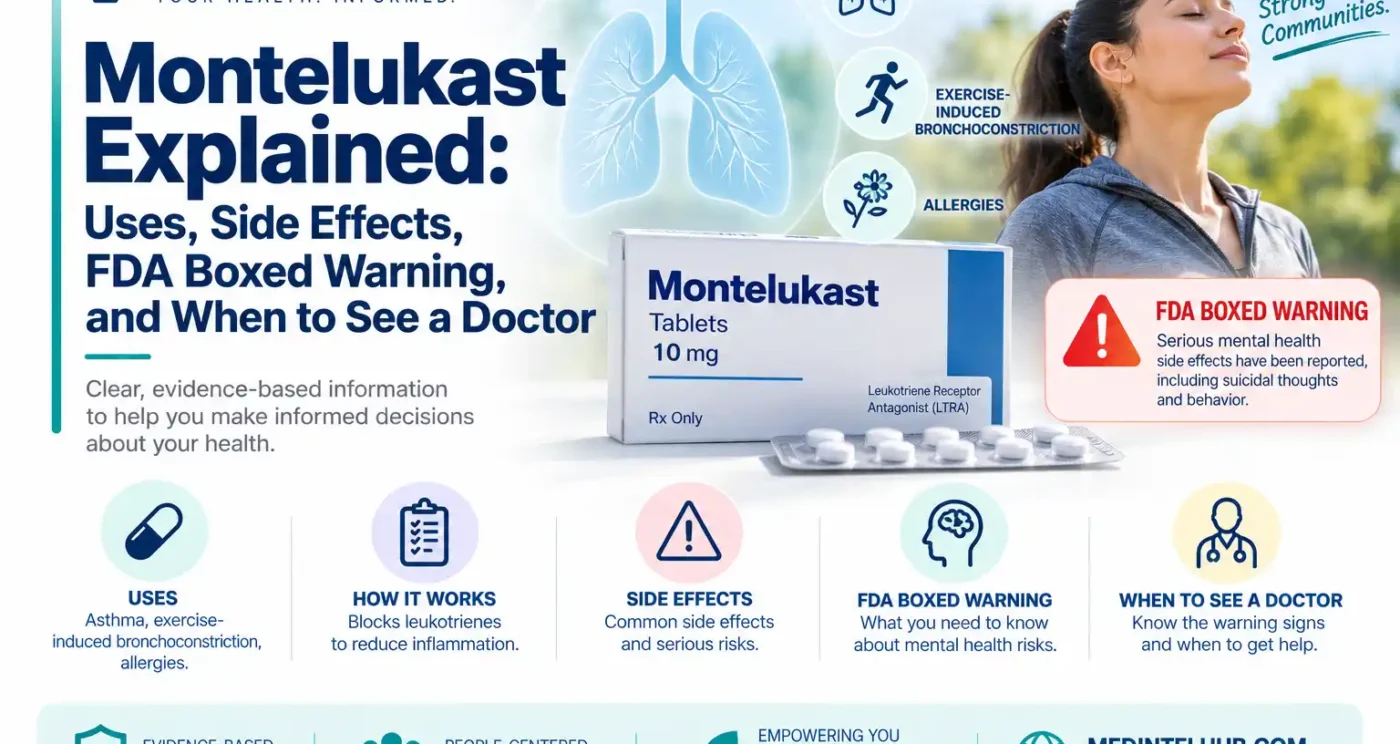
Montelukast is one of those medicines people may take for years without thinking much about it. A child might receive it because asthma symptoms keep returning. An adult may use it for exercise-triggered breathing problems. Someone else may have been given it for stubborn seasonal allergies.
Then they notice the warning on the medication guide.
Montelukast carries an FDA Boxed Warning—the agency’s most prominent type of medication warning—because serious changes in mood, behavior, and mental health have been reported, including suicidal thoughts and actions. Those events have occurred in people with and without a previous psychiatric history, and some have been reported after the medicine was stopped.
That warning does not mean montelukast should never be used. The medicine has established roles in asthma and exercise-induced bronchoconstriction. The issue is whether its expected benefit outweighs its risks for the particular person taking it.
The calculation is especially important for allergies. FDA recommends reserving montelukast for allergic rhinitis when other treatments have not worked adequately or cannot be tolerated, rather than treating it as a routine first choice for mild hay fever.
There is another distinction worth knowing from the start: montelukast is not an emergency asthma medicine. It does not replace the rescue treatment prescribed for an acute asthma attack.
Contents
- 1. What Is Montelukast?
- 2. What Is Montelukast Used For?
- 3. Is Montelukast a Steroid?
- 4. Is Montelukast an Antihistamine?
- 5. How Does Montelukast Help Asthma?
- 6. Is Montelukast a Rescue Medicine?
- 7. Can Montelukast Replace an Inhaled Corticosteroid?
- 8. Can Montelukast Help Exercise-Induced Bronchoconstriction?
- 9. Can Montelukast Help Seasonal Allergies?
- 10. Why Does Montelukast Have an FDA Boxed Warning?
- 11. What Mental Health and Behavioral Side Effects Have Been Reported?
- 12. Can Montelukast Cause Suicidal Thoughts?
- 13. Can Neuropsychiatric Effects Occur Without a Mental Health History?
- 14. Can Montelukast Cause Nightmares?
- 15. Can Montelukast Cause Anxiety?
- 16. Can Montelukast Cause Depression?
- 17. Can Montelukast Cause Sleep Problems?
- 18. Can Side Effects Start After Montelukast Is Stopped?
- 19. What Are the More Common Side Effects of Montelukast?
- 20. Can Montelukast Cause an Allergic Reaction?
- 21. What Are Eosinophilic Conditions Associated With Montelukast?
- 22. Does Montelukast Protect People With Aspirin-Sensitive Asthma?
- 23. Can Children Take Montelukast?
- 24. Is Montelukast Safe for Children?
- 25. How Is Montelukast Taken?
- 26. What Should You Do if You Miss a Dose?
- 27. Can You Take an Extra Dose Before Exercise?
- 28. Can You Stop Montelukast Suddenly?
- 29. Can Montelukast Be Used During Pregnancy?
- 30. Can Montelukast Be Used While Breastfeeding?
- 31. Does Montelukast Interact With Other Medicines?
- 32. What Should People With Phenylketonuria Know?
- 33. How Do You Know Whether Montelukast Is Working?
- 34. When Should You Contact Your Doctor About Montelukast?
- 35. When Is a Montelukast-Related Problem an Emergency?
- 36. Montelukast Safety at a Glance
- 37. Frequently Asked Questions
- 37.1. What Is Montelukast Used For?
- 37.2. Is Singulair the Same as Montelukast?
- 37.3. Is Montelukast a Steroid?
- 37.4. Is Montelukast an Antihistamine?
- 37.5. Does Montelukast Help Asthma?
- 37.6. Can Montelukast Stop an Asthma Attack?
- 37.7. Can Montelukast Help Exercise-Induced Asthma?
- 37.8. Can Montelukast Help Allergies?
- 37.9. Why Does Montelukast Have a Black Box Warning?
- 37.10. Can Montelukast Cause Nightmares?
- 37.11. Can Montelukast Cause Anxiety?
- 37.12. Can Montelukast Cause Depression?
- 37.13. Can Montelukast Cause Suicidal Thoughts?
- 37.14. Can Children Have Behavioral Side Effects From Montelukast?
- 37.15. Can Side Effects Continue After Montelukast Is Stopped?
- 37.16. Should You Stop Montelukast if Nightmares or Mood Changes Begin?
- 37.17. Can Montelukast Replace a Steroid Inhaler?
- 37.18. Can You Take Montelukast Every Day?
- 37.19. What Happens if You Miss a Dose?
- 37.20. Can You Take Extra Montelukast Before Exercise?
- 37.21. Can Montelukast Be Taken During Pregnancy?
- 37.22. Can You Breastfeed While Taking Montelukast?
- 38. Conclusion
- 39. Resources
- 39.1. U.S. Food and Drug Administration — Montelukast Boxed Warning
- 39.2. DailyMed — Current Montelukast Prescribing Information
- 39.3. MedlinePlus — Montelukast
- 39.4. Global Initiative for Asthma — 2026 Strategy Report
- 39.5. LactMed — Montelukast and Breastfeeding
- 39.6. MedIntelHub — Preparing for a Specialist Appointment
- 39.7. MedIntelHub — Mental Health Screenings in Primary Care
- 39.8. MedIntelHub — Editorial Policy
- 40. Editorial Disclaimer
What Is Montelukast?
Montelukast is a prescription medication belonging to a group of medicines called leukotriene receptor antagonists, or LTRAs.
The original brand name is Singulair, although generic montelukast is now widely available.
Leukotrienes are inflammatory signaling chemicals produced in the body. In the airways and nose, they can contribute to swelling, mucus production, bronchoconstriction, and allergic symptoms.
Montelukast blocks a leukotriene receptor known as the CysLT1 receptor, reducing some of these effects. MedlinePlus describes it as a medicine that blocks substances involved in asthma and allergic-rhinitis symptoms.
Unlike an inhaler, it is taken by mouth.
Available formulations include conventional tablets, chewable tablets, and oral granules. The appropriate formulation depends partly on age and why the medicine is being prescribed.
What Is Montelukast Used For?
Current U.S. labeling includes three main uses:
| Use | Role of montelukast |
|---|---|
| Asthma | Long-term prevention and control |
| Exercise-induced bronchoconstriction | Helps prevent airway narrowing triggered by exercise |
| Allergic rhinitis | Can relieve seasonal or year-round nasal allergy symptoms, but use is restricted because of the boxed warning |
Specific approved ages vary according to the indication and formulation. Current labeling includes asthma treatment in some formulations from 12 months of age, EIB prevention from age 6, seasonal allergic rhinitis from age 2, and perennial allergic rhinitis from 6 months. Product-specific labeling should be checked because generic formulations can differ.
Is Montelukast a Steroid?
No.
Montelukast is not a corticosteroid.
Inhaled corticosteroids, such as those commonly used as asthma controller medicines, reduce airway inflammation through a different and broader anti-inflammatory mechanism.
Montelukast works by blocking leukotriene signaling.
That difference matters because the two drug classes are not equally effective for asthma.
The 2026 Global Initiative for Asthma (GINA) strategy report states that leukotriene receptor antagonists such as montelukast are generally less effective than inhaled corticosteroids, particularly for preventing asthma exacerbations.
Montelukast may still be useful in selected patients, but it should not automatically be viewed as an equivalent substitute for an inhaled corticosteroid.
Is Montelukast an Antihistamine?
No.
Antihistamines and montelukast target different inflammatory pathways.
Antihistamines primarily block the effects of histamine, which contributes to symptoms such as sneezing, itching, and runny nose.
Montelukast blocks leukotriene receptors.
Both may be used in people with allergic disease, but they are not interchangeable medicines.
This becomes particularly relevant for allergic rhinitis because FDA specifically points out that numerous other allergy treatments are available and recommends reserving montelukast for people who do not respond adequately to, or cannot tolerate, alternatives.
How Does Montelukast Help Asthma?
Asthma involves inflammation and excessive narrowing of the airways.
Leukotrienes contribute to both.
By blocking leukotriene receptors, montelukast can help reduce bronchoconstriction and some airway inflammation, which may improve symptoms such as:
- Wheezing
- Cough
- Chest tightness
- Difficulty breathing
It is used as a controller or preventive medication, not as a medicine that rapidly reverses a severe attack.
Current prescribing information describes montelukast as a medication for prophylaxis and chronic asthma treatment.
Is Montelukast a Rescue Medicine?
No.
This is one of the most important facts for anyone taking it for asthma.
Montelukast is not indicated to reverse bronchospasm during an acute asthma attack. Current U.S. labeling advises patients to keep the appropriate rescue medication available.
If someone suddenly develops worsening wheezing, shortness of breath, or chest tightness, taking an extra montelukast tablet is not a substitute for following their asthma action plan.
People who have been prescribed a rescue inhaler should use it according to the instructions provided by their healthcare professional.
Severe breathing difficulty, inability to speak normally because of breathlessness, blue or gray discoloration, extreme exhaustion, confusion, or symptoms that do not respond to prescribed rescue treatment can require emergency care.
Can Montelukast Replace an Inhaled Corticosteroid?
Not automatically.
Current GINA guidance gives inhaled corticosteroid-containing treatment a central role in asthma management because ICS therapy is better at reducing the risk of serious exacerbations.
GINA’s 2026 strategy report describes LTRAs such as montelukast as less effective than ICS, particularly for preventing exacerbations.
There may still be circumstances where a clinician recommends montelukast, either alone in a selected patient or alongside other asthma therapy.
What should not happen is abruptly replacing an inhaled or oral corticosteroid with montelukast without medical guidance.
Current prescribing information specifically warns against abruptly substituting montelukast for corticosteroid therapy.
Can Montelukast Help Exercise-Induced Bronchoconstriction?
Yes.
Some people breathe normally at rest but develop narrowing of the airways during or shortly after exercise. This is called exercise-induced bronchoconstriction, or EIB.
Symptoms may include:
- Coughing
- Wheezing
- Chest tightness
- Shortness of breath
- Reduced exercise tolerance
Montelukast is FDA-approved for prevention of EIB in patients within the appropriate age range. Current labeling notes that when it is prescribed specifically for EIB, it is taken before exercise; patients already taking it daily should not simply add another dose for the workout.
Someone with exercise-triggered symptoms may still need a rescue inhaler available.
Montelukast prevents or reduces bronchoconstriction; it does not guarantee that an acute episode cannot happen.
Can Montelukast Help Seasonal Allergies?
Yes, montelukast can improve symptoms of allergic rhinitis, including seasonal hay fever and perennial allergies.
Those symptoms may include:
- Sneezing
- Runny nose
- Nasal congestion
- Nasal itching
But this is where the boxed warning has changed how the medicine should be used.
FDA says montelukast should not generally be the first-choice medicine for mild allergic rhinitis. It should be reserved for people whose symptoms are not adequately controlled by other treatments or who cannot tolerate those alternatives.
That recommendation exists because allergic rhinitis often has several other effective treatment options, while montelukast carries the possibility of serious neuropsychiatric adverse events.
Why Does Montelukast Have an FDA Boxed Warning?
FDA strengthened the warning for montelukast in March 2020 after reviewing reports of serious behavioral and mood-related adverse events.
The agency required a Boxed Warning, its most prominent medication warning, and a Medication Guide that patients should receive with prescriptions.
The current prescribing information continues to carry that warning.
Reported neuropsychiatric effects have been varied and have included agitation, aggressive behavior, depression, sleep disturbances, suicidal thinking, suicidal behavior, and completed suicide. The exact biological mechanism responsible for these reactions is still not well understood.
FDA’s warning is not based on the claim that every person taking montelukast will experience psychiatric effects.
Rather, the potential seriousness of the reported events means patients and caregivers should know what to watch for before treatment begins.
What Mental Health and Behavioral Side Effects Have Been Reported?
FDA’s safety communication includes a wide range of reported symptoms.
These have included agitation or aggression, anxiety, depression, irritability, confusion, attention or memory problems, vivid or disturbing dreams, hallucinations, restlessness, sleepwalking, tremor, trouble sleeping, obsessive-compulsive symptoms, stuttering, uncontrolled movements, and suicidal thoughts or actions.
Not every symptom experienced while taking montelukast is necessarily caused by the medication.
But a clear change in mood, sleep, thinking, or behavior after treatment begins should not be brushed aside.
That is particularly true when the change feels unusual for the person.
Can Montelukast Cause Suicidal Thoughts?
Serious reports have included suicidal thoughts, suicide attempts, and completed suicide, which is one reason FDA required the boxed warning.
FDA’s review of spontaneous reports cannot by itself determine exactly how frequently these events occur or prove causation in every case. Its Sentinel observational analysis also did not show a statistically significant increase in several measured mental-health outcomes compared with inhaled corticosteroids, although FDA identified limitations in those studies.
That uncertainty does not remove the warning.
The practical instruction remains clear: FDA advises patients to stop montelukast and contact a healthcare professional immediately if new neuropsychiatric symptoms or suicidal thoughts or behaviors occur.
If someone is in immediate danger of self-harm, has attempted suicide, or cannot be kept safe, emergency help is appropriate rather than waiting for a routine appointment.
Can Neuropsychiatric Effects Occur Without a Mental Health History?
Yes.
FDA says these events have been reported in patients with and without pre-existing psychiatric disease.
A past history of depression, anxiety, or another psychiatric condition is important information for the prescriber.
But the absence of such a history does not mean monitoring is unnecessary.
Families of children taking montelukast should also pay attention to new sleep problems, agitation, unusual aggression, nightmares, anxiety, withdrawal, or other marked behavioral changes.
Can Montelukast Cause Nightmares?
Yes.
Bad or vivid dreams are among the neuropsychiatric events listed by FDA and MedlinePlus.
A single unpleasant dream has many possible explanations.
A pattern of intense nightmares that begins after montelukast is started—particularly when accompanied by anxiety, sleepwalking, agitation, or behavioral changes—deserves prompt attention.
FDA’s advice is to stop the medicine and contact a healthcare professional when new neuropsychiatric symptoms develop.
Can Montelukast Cause Anxiety?
Anxiety has been reported.
FDA’s listed neuropsychiatric effects include feeling anxious, restlessness, agitation, irritability, and other changes in mood or behavior.
It is not possible to assume that every episode of anxiety in someone using montelukast came from the medicine.
Asthma itself can be frightening, sleep disruption can worsen anxiety, and anxiety disorders are common independently.
The timing and overall pattern help clinicians decide whether the medication may be contributing.
Can Montelukast Cause Depression?
Depression has also been reported and appears in the boxed-warning information.
New persistent sadness, withdrawal, hopelessness, major loss of interest, or other significant mood changes after starting montelukast should be discussed promptly rather than simply waiting until the next refill appointment.
MedIntelHub’s article on mental-health screening explains why symptoms such as depression and anxiety often require a fuller assessment rather than being interpreted from one screening question or symptom alone. MedIntelHub: Mental Health Screenings in Primary Care
Can Montelukast Cause Sleep Problems?
Yes.
Reported problems include:
- Trouble falling asleep
- Trouble staying asleep
- Vivid or disturbing dreams
- Restlessness
- Sleepwalking
Sleep disruption is easy to attribute to stress, school schedules, asthma, or other factors.
The important clue may be a noticeable change after montelukast is started or restarted.
FDA advises responding to new neuropsychiatric symptoms rather than assuming they are harmless medication effects.
Can Side Effects Start After Montelukast Is Stopped?
They have been reported.
FDA notes that most reported neuropsychiatric events occurred while people were taking montelukast, but some developed or continued after discontinuation. In many reports symptoms improved after stopping; in others, they persisted.
That means stopping the medication does not make persistent severe symptoms something to ignore.
If mood, behavior, sleep, or thinking remains significantly abnormal after discontinuation, follow-up is still appropriate.
What Are the More Common Side Effects of Montelukast?
The boxed warning receives the most attention because of its seriousness, but more ordinary side effects can occur too.
Current prescribing information and FDA materials list commonly reported adverse events such as headache, upper respiratory symptoms, fever, sore throat, cough, abdominal pain, diarrhea, runny nose, sinus symptoms, and ear problems in some pediatric groups.
MedlinePlus also lists headache, heartburn, stomach pain, tiredness, and diarrhea among side effects that may occur.
These symptoms are usually very different from the neuropsychiatric warning signs.
Persistent or troublesome side effects can still be discussed with the prescriber.
Can Montelukast Cause an Allergic Reaction?
Rarely, medications can trigger serious hypersensitivity reactions.
MedlinePlus advises immediate medical attention for symptoms such as difficulty breathing or swallowing, swelling of the face, throat, lips, tongue, or eyes, hoarseness, hives, itching, or rash.
A severe allergic reaction with breathing difficulty, throat swelling, fainting, or rapidly worsening symptoms can be an emergency.
Do not take another dose while trying to “see if it happens again” after a suspected severe allergic reaction.
What Are Eosinophilic Conditions Associated With Montelukast?
Current prescribing information contains another uncommon but important warning.
Some patients with asthma taking montelukast have developed systemic eosinophilia accompanied by features of vasculitis consistent with eosinophilic granulomatosis with polyangiitis, historically called Churg-Strauss syndrome. These events have sometimes occurred when oral corticosteroids were being reduced, and the label states that a causal association with montelukast has not been established.
Possible warning findings can include worsening pulmonary symptoms, unusual rash, numbness or nerve symptoms, eosinophilia, or cardiac complications.
This is rare, but it is one reason new systemic symptoms during changes in asthma therapy deserve medical assessment.
Does Montelukast Protect People With Aspirin-Sensitive Asthma?
Not completely.
Montelukast may improve asthma control in some patients who are sensitive to aspirin.
It does not mean aspirin or nonsteroidal anti-inflammatory drugs suddenly become safe for someone whose asthma is triggered by them.
The current label advises people with known aspirin sensitivity to continue avoiding aspirin or NSAIDs that trigger their asthma while taking montelukast.
Can Children Take Montelukast?
Yes.
Montelukast is approved for pediatric use in several indications, with age limits varying by diagnosis and formulation.
Current product labeling includes asthma treatment in young children, allergic-rhinitis indications in certain pediatric age groups, and EIB prevention from age 6 in applicable formulations.
Children also fall under the boxed neuropsychiatric warning.
Parents and caregivers should therefore know what the child’s baseline sleep, mood, and behavior normally look like before treatment begins.
A sudden change can be easier to recognize when there is something to compare it with.
Is Montelukast Safe for Children?
“Safe” is not a simple yes-or-no label for any prescription medicine.
Montelukast has established pediatric indications, and many children use it without serious adverse effects.
At the same time, the 2026 GINA strategy report says patients or parents and caregivers should be counseled about the risk of neuropsychiatric events before montelukast is prescribed.
The decision should consider why the medicine is being prescribed, how severe the asthma or allergy symptoms are, what alternatives exist, and whether the expected benefit justifies the risk.
How Is Montelukast Taken?
How the medicine is scheduled depends on the reason it was prescribed.
Current U.S. labeling describes once-daily use for chronic asthma and allergic rhinitis, with separate instructions for EIB prevention. Montelukast is available as regular tablets, chewable tablets, and oral granules.
Patients should follow the instructions on their own prescription rather than copying another person’s regimen.
The age, formulation, diagnosis, and whether someone already takes montelukast every day all affect the instructions.
What Should You Do if You Miss a Dose?
MedlinePlus advises skipping the missed dose and returning to the regular dosing schedule rather than taking two doses together to make up for it.
If there is uncertainty—particularly with a child’s medicine or an EIB regimen—the pharmacist or prescriber can clarify what to do.
Can You Take an Extra Dose Before Exercise?
Not simply because you are planning a workout.
Current prescribing information states that patients already taking montelukast daily for another indication should not take an additional dose specifically for exercise-induced bronchoconstriction within the same 24-hour period.
People with exercise-triggered asthma should also have the appropriate rescue medicine available if their clinician has prescribed one.
Can You Stop Montelukast Suddenly?
This question has two different answers depending on why someone wants to stop it.
For routine treatment changes, it is generally sensible to discuss the plan with the prescriber, particularly when montelukast is helping control asthma. Stopping an effective controller without another plan may allow symptoms to return.
But new neuropsychiatric symptoms are different.
FDA specifically tells patients and caregivers to stop montelukast and contact a healthcare professional immediately when new behavior or mood-related changes, suicidal thoughts, or suicidal behavior occur.
Someone at immediate risk of self-harm needs emergency support, not simply a medication-review appointment.
Can Montelukast Be Used During Pregnancy?
Available human data have not established an association between montelukast use during pregnancy and major birth defects, although the available studies have limitations. The current U.S. label also emphasizes that inadequately controlled asthma during pregnancy carries risks of its own.
That balance is important.
Stopping an asthma medicine automatically because of pregnancy can be harmful if asthma then becomes poorly controlled.
Someone who is pregnant, planning pregnancy, or discovers a pregnancy while taking montelukast should discuss the medication with the clinician managing the asthma or allergies.
Can Montelukast Be Used While Breastfeeding?
Montelukast passes into breastmilk in very low amounts.
LactMed’s 2024 review estimates that infant exposure through milk is small and states that adverse effects in breastfed infants would not be expected based on the available evidence.
Individual decisions can still depend on the infant’s health, other medicines, the reason the parent needs montelukast, and the availability of alternatives.
Does Montelukast Interact With Other Medicines?
Montelukast has fewer major interactions than some medications, but a medication review is still worthwhile.
Current labeling reports that dose adjustment is not generally needed with several commonly used medications, including some corticosteroids, fexofenadine, warfarin, thyroid hormones, and other drug classes.
That does not mean every combination is automatically appropriate.
Bring the prescriber or pharmacist a complete list of prescription medicines, over-the-counter products, vitamins, and supplements.
MedIntelHub’s specialist-appointment guide includes a medication-list checklist that can be useful before an allergy or pulmonary visit. MedIntelHub: How to Prepare Questions Before a Specialist Appointment
What Should People With Phenylketonuria Know?
Some montelukast chewable tablets contain aspartame, which is a source of phenylalanine.
Current labeling specifically warns that this can matter for people with phenylketonuria (PKU).
The amount varies by product and strength, so patients with PKU should check the exact medication label or ask their pharmacist rather than assuming all formulations are identical.
How Do You Know Whether Montelukast Is Working?
For asthma, improvement may show up as fewer symptoms, better exercise tolerance, fewer nighttime problems, or less need for rescue medication.
For allergic rhinitis, nasal symptoms may become less troublesome.
But treatment effectiveness should not be judged only by whether someone “feels okay today.”
For asthma, clinicians also consider:
- Frequency of daytime symptoms
- Nighttime waking
- Rescue-medication use
- Activity limitations
- Exacerbations
- Lung function when appropriate
If rescue-inhaler use is increasing or asthma attacks are becoming more frequent, the asthma plan needs reassessment rather than simply continuing the same treatment indefinitely.
When Should You Contact Your Doctor About Montelukast?
Prompt contact is appropriate for a meaningful new change after starting the medication, particularly a change in mood, sleep, thinking, or behavior.
FDA’s warning specifically identifies symptoms such as agitation, aggression, anxiety, depression, confusion, hallucinations, nightmares, memory problems, restlessness, sleepwalking, suicidal thoughts, and other unusual neuropsychiatric symptoms.
Other reasons to contact a healthcare professional include worsening asthma control, increasing need for rescue treatment, persistent troublesome side effects, unexplained rash or neurological symptoms, or concerns about using the medicine during pregnancy.
New medication side effects do not necessarily need to wait for a routine preventive examination. MedIntelHub’s guide to annual physicals explains why a new medical problem may need a separate problem-focused visit. MedIntelHub: Understanding Your Annual Physical
When Is a Montelukast-Related Problem an Emergency?
Some situations should not wait for an office callback.
Seek emergency help for severe breathing difficulty, a serious allergic reaction, loss of consciousness, or an acute asthma attack that is not responding appropriately to prescribed rescue treatment.
Immediate help is also appropriate when someone has suicidal intent, has attempted self-harm, cannot be kept safe, or develops severe behavioral or psychiatric symptoms that create an immediate danger.
Montelukast itself should never be relied on as the emergency treatment for acute bronchospasm.
Montelukast Safety at a Glance
| Question | Key Point |
|---|---|
| Is montelukast a steroid? | No |
| Is it an antihistamine? | No |
| Can it help asthma? | Yes, in selected patients |
| Is it a rescue medicine? | No |
| Can it prevent EIB? | Yes, when appropriately prescribed |
| Can it treat allergies? | Yes, but FDA recommends reserving it for people who cannot use or do not respond adequately to alternatives |
| Does it carry a Boxed Warning? | Yes, for serious neuropsychiatric events |
| Can effects occur without prior mental illness? | Yes |
| Can neuropsychiatric effects occur after stopping? | They have been reported |
| Should new psychiatric symptoms be ignored until the next appointment? | No—FDA advises stopping the medicine and contacting a healthcare professional immediately |
Frequently Asked Questions
What Is Montelukast Used For?
Montelukast is used for long-term asthma control, prevention of exercise-induced bronchoconstriction, and selected cases of seasonal or perennial allergic rhinitis.
Is Singulair the Same as Montelukast?
Yes.
Singulair is a brand name for montelukast. Generic versions contain the same active medicine.
Is Montelukast a Steroid?
No.
It is a leukotriene receptor antagonist.
Is Montelukast an Antihistamine?
No.
Antihistamines block histamine, whereas montelukast blocks leukotriene receptors.
Does Montelukast Help Asthma?
It can.
Montelukast is an approved controller option, although current GINA guidance considers LTRAs less effective than inhaled corticosteroids, particularly for preventing exacerbations.
Can Montelukast Stop an Asthma Attack?
No.
It is not a rescue medicine and should not replace the acute-relief medication included in a person’s asthma action plan.
Can Montelukast Help Exercise-Induced Asthma?
Yes.
It is FDA-approved for prevention of exercise-induced bronchoconstriction in appropriately aged patients.
Can Montelukast Help Allergies?
Yes, but FDA recommends reserving it for allergic rhinitis when other treatments have not worked adequately or cannot be tolerated.
Why Does Montelukast Have a Black Box Warning?
The official term is Boxed Warning.
FDA requires it because serious neuropsychiatric events have been reported, including behavioral changes, depression, sleep disturbances, suicidal thoughts, suicidal behavior, and completed suicide.
Can Montelukast Cause Nightmares?
Yes.
Bad or vivid dreams are among the neuropsychiatric events FDA lists.
Can Montelukast Cause Anxiety?
Anxiety has been reported and is included in FDA’s safety information.
Can Montelukast Cause Depression?
Yes, depression has been reported.
New or worsening depression while taking montelukast warrants prompt attention.
Can Montelukast Cause Suicidal Thoughts?
Serious reports have included suicidal thoughts and actions.
FDA advises stopping montelukast and contacting a healthcare professional immediately if these or other new neuropsychiatric symptoms occur.
Can Children Have Behavioral Side Effects From Montelukast?
Yes.
The boxed warning applies to pediatric patients as well as adults.
Parents and caregivers should watch for new changes in sleep, mood, attention, aggression, anxiety, or behavior.
Can Side Effects Continue After Montelukast Is Stopped?
They have in some reports.
FDA notes that some events appeared or persisted after discontinuation.
Should You Stop Montelukast if Nightmares or Mood Changes Begin?
FDA advises stopping the medicine and contacting a healthcare professional immediately when new neuropsychiatric symptoms occur.
This is different from casually stopping an asthma controller because symptoms seem better.
Can Montelukast Replace a Steroid Inhaler?
Not automatically.
GINA 2026 states that LTRAs are less effective than inhaled corticosteroids, particularly for preventing asthma exacerbations.
Can You Take Montelukast Every Day?
It may be prescribed daily for asthma or allergic rhinitis.
Follow the schedule on the specific prescription rather than changing timing or frequency yourself.
What Happens if You Miss a Dose?
MedlinePlus advises skipping the forgotten dose and returning to the normal schedule rather than doubling up.
Can You Take Extra Montelukast Before Exercise?
Patients already using daily montelukast should not simply add another dose for exercise within the same 24-hour period.
Can Montelukast Be Taken During Pregnancy?
Available human data have not established a medication-associated risk of major birth defects, but treatment decisions should balance the medication’s risks and benefits with the risks of poorly controlled asthma.
Can You Breastfeed While Taking Montelukast?
Available LactMed data show very low concentrations in breastmilk, and adverse effects in breastfed infants would not be expected based on current evidence.
Individual medical advice is still appropriate.
Conclusion
Montelukast is neither a simple allergy pill nor an emergency asthma treatment.
It is a leukotriene receptor antagonist with established uses in chronic asthma, exercise-induced bronchoconstriction, and selected cases of allergic rhinitis.
For some patients, it is genuinely useful.
For asthma, however, current 2026 GINA guidance notes that leukotriene receptor antagonists are generally less effective than inhaled corticosteroids—particularly when the goal is preventing serious exacerbations.
For allergic rhinitis, the threshold is even higher.
Because other effective allergy treatments are available, FDA says montelukast should be reserved for people who do not respond adequately to, or cannot tolerate, alternatives.
The reason is the Boxed Warning for serious neuropsychiatric events.
Agitation, anxiety, aggression, depression, nightmares, sleepwalking, hallucinations, attention or memory problems, suicidal thoughts, and suicidal behavior are among the events that have been reported. They have occurred in people with and without a prior mental-health history. Some reports have also described symptoms appearing or continuing after the medicine was stopped.
That risk should not be exaggerated, but it should not be buried in the fine print either.
Patients and caregivers should know about it before treatment begins.
The other essential safety point is straightforward: montelukast does not replace a rescue inhaler during an acute asthma attack.
Used for the right person, for the right reason, with appropriate monitoring, montelukast can still be part of effective asthma or allergy care.
The useful question is not simply, “Is montelukast good or bad?”
It is whether the expected benefit for this particular patient outweighs the risks—and whether everyone involved knows which symptoms should trigger a change in the plan.
Resources
U.S. Food and Drug Administration — Montelukast Boxed Warning
FDA explains the serious neuropsychiatric warning, restrictions for allergic-rhinitis use, and what patients and caregivers should do if behavioral or mood symptoms develop.
FDA: Montelukast Boxed Warning and Drug Safety Communication
DailyMed — Current Montelukast Prescribing Information
Current U.S. labeling covers asthma, EIB, allergic rhinitis, the boxed warning, acute-asthma limitations, eosinophilic conditions, aspirin sensitivity, and pediatric formulations.
DailyMed: Montelukast Sodium Prescribing Information
MedlinePlus — Montelukast
MedlinePlus provides patient-focused information about uses, common side effects, neuropsychiatric warning symptoms, missed doses, and serious adverse reactions.
MedlinePlus: Montelukast Drug Information
Global Initiative for Asthma — 2026 Strategy Report
GINA’s current asthma strategy discusses leukotriene receptor antagonists, their comparative effectiveness, and counseling about montelukast’s neuropsychiatric risk.
GINA: 2026 Global Strategy for Asthma Management and Prevention
LactMed — Montelukast and Breastfeeding
LactMed summarizes available information about montelukast transfer into human milk.
MedIntelHub — Preparing for a Specialist Appointment
Useful for organizing asthma symptoms, medication questions, side effects, and treatment concerns before an allergy or pulmonary appointment.
How to Prepare Questions Before a Specialist Appointment
MedIntelHub — Mental Health Screenings in Primary Care
Provides additional context about how mood and behavioral symptoms are evaluated rather than diagnosed from a single symptom or questionnaire.
Mental Health Screenings: Why Primary Care Visits Now Include Them
MedIntelHub — Editorial Policy
MedIntelHub’s editorial policy explains its approach to healthcare sourcing, accuracy, transparency, updates, and limitations.
Editorial Disclaimer
This article is for general educational and informational purposes only. It does not determine whether montelukast is appropriate for a particular adult or child and should not replace individualized advice from a qualified healthcare professional.
Montelukast has an FDA Boxed Warning for serious neuropsychiatric events. FDA advises stopping the medication and contacting a healthcare professional immediately if new behavior or mood changes, suicidal thoughts, suicidal behavior, or other new neuropsychiatric symptoms develop.
People using montelukast for asthma should not rely on it to treat an acute asthma attack. Follow the prescribed asthma action plan and rescue-medication instructions.
Do not abruptly substitute montelukast for an inhaled or oral corticosteroid unless a clinician directs the change.
Seek emergency help for severe breathing difficulty, a serious allergic reaction, loss of consciousness, suicidal behavior or imminent risk of self-harm, or another rapidly worsening medical or psychiatric emergency.

David Bennett
David Bennett is an author at MedIntelHub, where he creates clear, practical, and well-researched content about healthcare, medical billing, insurance, and patient education. His goal is to make complex healthcare topics easier for readers to understand and use in everyday situations. David emphasizes accuracy, transparency, and reliable sourcing, using information from trusted organizations and official healthcare resources whenever possible. Content published by David is intended for educational purposes and should not replace advice from qualified medical, legal, or healthcare professionals.