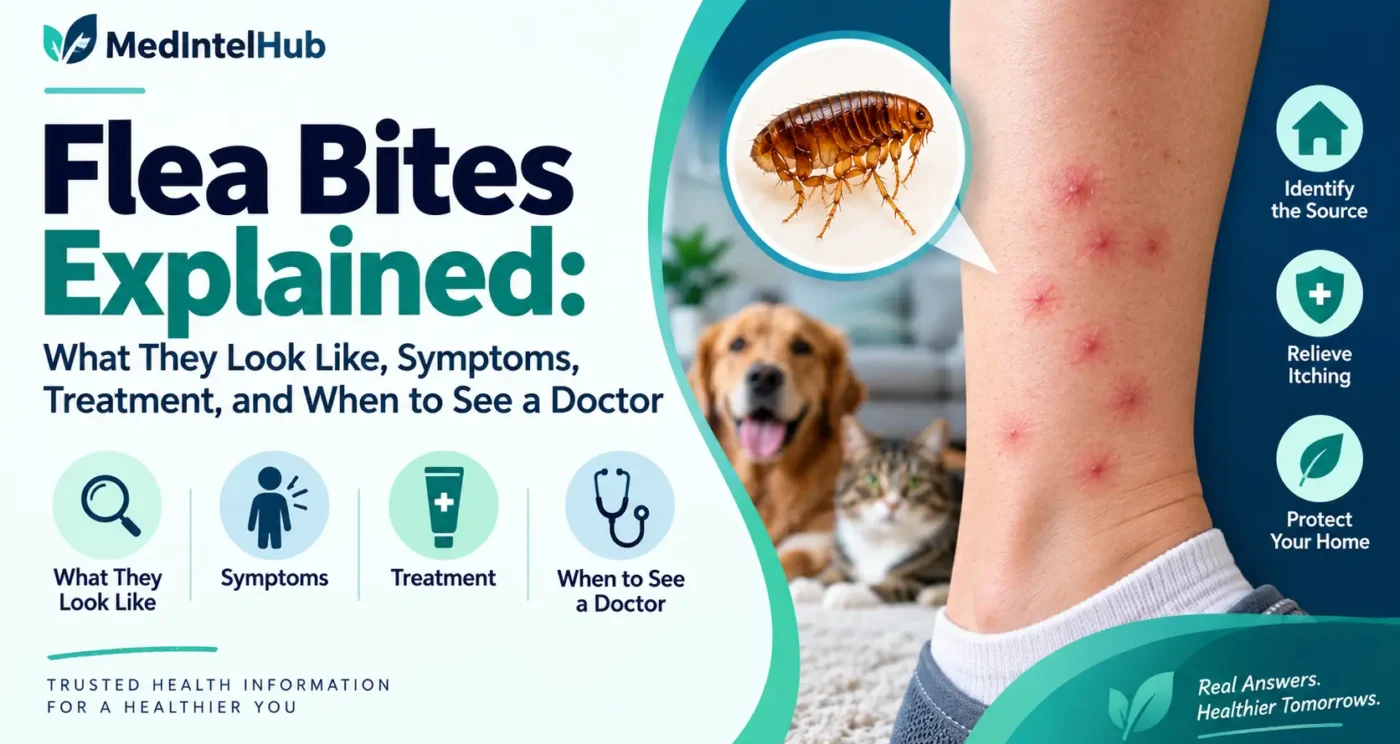
A few intensely itchy bumps around the ankles can be easy to dismiss at first. Then another cluster appears. Perhaps the family pet has started scratching more than usual, you recently stayed somewhere with animals, or the bites seem to show up after sitting on a particular carpet or couch.
Flea bites are a common explanation for that pattern, but appearance alone cannot prove that fleas are responsible.
Fleas are tiny, wingless insects that feed on blood. Although many species prefer animal hosts, fleas can bite people, especially when an infested animal is nearby or when their usual host is no longer available. The bites most often cause itching, irritation, and small inflamed bumps.
Most flea bites are more annoying than medically dangerous. They usually improve with basic skin care and itch relief. The bigger practical problem is often stopping new bites by treating the source of the infestation—pets, bedding, carpets, furniture, or other areas where immature fleas are developing.
There are also a few situations worth recognizing. Scratching can lead to a secondary skin infection. Some people develop a more intense hypersensitivity reaction. And in certain geographic and exposure settings, infected fleas can transmit illnesses such as flea-borne typhus or plague. Those complications are very different from an ordinary itchy flea bite and produce symptoms beyond a few bumps on the skin.
This guide explains what flea bites usually look and feel like, where they appear, how they differ from bed bug and mosquito bites, how to treat them safely, how to get rid of fleas in the home, and which symptoms deserve medical attention.
Flea Bites at a Glance
| Question | Key point |
|---|---|
| What do flea bites look like? | Usually small, intensely itchy bumps that may occur in clusters, sometimes with a central puncture point or tiny blister. |
| Where are they most common? | Ankles, feet, and lower legs are common sites, although other exposed areas can be bitten. |
| Are flea bites contagious? | No. The skin reaction itself does not spread from person to person. |
| Why do they itch? | The immune system reacts to substances in flea saliva introduced while the flea feeds. |
| How long do they last? | Many uncomplicated bites improve over several days, although stronger reactions can persist longer. |
| Can new bites keep appearing? | Yes, if fleas remain in the home, on pets, or in the environment. |
| Can flea bites become infected? | Yes. Repeated scratching can break the skin and allow bacterial infection to develop. |
| Do fleas spread disease? | Some fleas can transmit flea-borne typhus, plague, and other infections, but most ordinary flea bites do not cause these diseases. |
| What helps the itching? | Washing the skin, a cold compress, and appropriate OTC anti-itch treatments such as hydrocortisone or an oral antihistamine may help. |
| When should you see a doctor? | Seek care for signs of infection, severe or persistent reactions, unexplained fever or systemic illness, or uncertainty about the cause of the rash. |
| What is an emergency? | Difficulty breathing, swelling of the lips/tongue/throat, fainting, or severe systemic illness requires urgent emergency evaluation. |
What Are Flea Bites?
A flea bite occurs when an adult flea pierces the skin to take a blood meal.
Fleas do not have wings. Their powerful hind legs allow them to jump between the environment and a potential host. Adult fleas locate hosts using cues that include body heat, movement, vibration, and breathing.
Several flea species can interact with people. In the United States, medically relevant species include cat fleas, dog fleas, ground squirrel fleas, and Oriental rat fleas. Cat fleas are particularly common around domestic animals.
The flea introduces saliva into the skin while feeding. The body’s immune response to that saliva produces much of the redness, swelling, and itching associated with the bite.
For most people, the reaction stays localized to the skin.
What Do Flea Bites Look Like?
Flea bites commonly appear as small, itchy, raised bumps, medically called papules.
They may be:
- pink or red on lighter skin
- reddish-brown, purple, darker than surrounding skin, or less obviously red on deeper skin tones
- surrounded by mild swelling
- grouped in small clusters
- marked by a tiny central puncture point
- occasionally topped by a small blister in people with a stronger reaction
DermNet describes intense itching as the main symptom and notes that stronger hypersensitivity reactions can cause more pronounced swelling, blisters, oozing, or crusting.
Flea bites are often small compared with the broad raised welts associated with some mosquito bites, but there is plenty of overlap.
Do Flea Bites Appear in a Line?
They can.
Flea bites sometimes occur in groups or short lines because one or more fleas may feed repeatedly in the same general area.
However, a line of bites does not prove fleas are responsible.
Bed bugs are also associated with grouped or linear bites. Other insects can produce multiple nearby lesions, and scratching can make the original pattern difficult to recognize.
A photograph of the skin is therefore only one part of the investigation.
Clues such as pets scratching, visible fleas, flea dirt in an animal’s coat, bites concentrated around the ankles, or evidence of fleas in carpets and bedding can make the diagnosis more plausible.
Where Do Flea Bites Usually Appear?
The feet, ankles, and lower legs are classic locations.
This makes sense mechanically: fleas living in carpets, floors, pet bedding, or low furniture can jump onto the nearest exposed skin.
DermNet also notes that bites may occur around the waistband or other places where clothing leaves access to the skin.
Possible locations include:
- ankles
- feet
- lower legs
- calves
- waistline
- forearms
- other exposed skin
The location can change depending on the environment. Someone lying on an infested carpet may develop bites on areas that would not normally be exposed while standing.
Can Fleas Bite Through Clothes?
Fleas generally need access to skin to feed.
Loose clothing, sock openings, waistbands, or gaps between garments can give them access. Covering the lower legs with long socks and pants can reduce exposure in environments where fleas may be present. CDC specifically recommends covering skin as part of flea-bite prevention.
What Do Flea Bites Feel Like?
Itching is usually the dominant symptom.
The urge to scratch may be surprisingly strong compared with the small size of the bite.
Other possible sensations include:
- mild burning
- irritation
- tenderness
- localized warmth
- mild swelling
Some people barely react. Others develop much more noticeable bumps.
Children in particular may develop papular urticaria, an exaggerated hypersensitivity reaction to insect bites. This can produce repeated crops of very itchy bumps and sometimes small blisters. New bites may even make older lesions become itchy again.
Why Do Flea Bites Itch So Much?
The itch is produced primarily by the body’s immune response to flea saliva.
When a flea feeds, substances in its saliva help facilitate blood feeding. The immune system recognizes components of that saliva as foreign and releases inflammatory mediators around the bite site.
That can lead to:
- itching
- redness or discoloration
- swelling
- formation of a small bump
People differ substantially in how strongly they react.
Two family members exposed to the same room may therefore look completely different the next morning. One may have numerous obvious bumps while the other notices very little.
That does not necessarily mean only one person was bitten.
Flea Bites vs Bed Bug Bites
Flea bites and bed bug bites are easy to confuse.
| Feature | Flea bites | Bed bug bites |
|---|---|---|
| Typical location | Ankles, feet, lower legs; other areas possible | Exposed skin while sleeping, including arms, legs, face, neck, and shoulders |
| Lesion | Small itchy bump, sometimes with central punctum | Itchy raised bump or welt; appearance varies |
| Pattern | May occur in clusters or short lines | May occur individually, in clusters, or lines |
| Exposure clue | Fleas on pets, flea dirt, infested carpets or upholstery | Bed bugs or spotting around mattress seams, bed frame, headboard, or nearby furniture |
| Timing | Can happen whenever exposed | Often noticed after sleeping |
| Can appearance alone diagnose it? | No | No |
The commonly repeated idea that a specific three-bite pattern automatically identifies bed bugs—or fleas—is unreliable.
Environmental evidence is more persuasive than the geometric arrangement of the rash.
Flea Bites vs Mosquito Bites
Mosquito bites often produce softer, larger, puffy welts on exposed areas such as the arms and legs.
Flea bites tend to be smaller and are particularly common around the ankles and lower legs.
Still, either insect can produce:
- itching
- redness or discoloration
- swelling
- multiple bumps
- unusually large reactions in sensitive people
If the suspected exposure occurred outdoors around dusk, mosquitoes may be more likely. If new bites appear around carpets, pets, pet bedding, or upholstered furniture, fleas become more plausible.
Neither clue is absolute.
Flea Bites vs Chigger Bites
Chiggers are mites rather than fleas.
Their bites often occur after exposure to grassy, brushy, or wooded areas and may concentrate where clothing fits tightly, including around the waistband, sock line, or behind the knees.
Both chigger and flea bites can be extremely itchy.
The surrounding circumstances therefore matter. Recent hiking through dense vegetation points toward a different exposure than sitting in a home where a dog or cat has an active flea infestation.
Are Flea Bites Contagious?
No.
The inflammatory bump created by a flea bite cannot spread from one person to another.
You also cannot make another person develop flea bites by touching or scratching your own bite.
What can happen is that fleas or flea eggs are present in an environment shared by multiple people. Several members of the household may then be bitten independently.
If fresh bumps continue appearing, ongoing exposure is more likely than the original bites somehow spreading across the skin.
Why Do New Flea Bites Keep Appearing?
This is one of the most frustrating parts of a flea infestation.
Killing a few adult fleas does not necessarily eliminate the problem because fleas have a four-stage life cycle:
- Egg
- Larva
- Pupa
- Adult
Adult fleas feed and lay eggs. Those eggs can fall from a pet into carpeting, bedding, furniture, floor cracks, or other areas.
Larvae hatch and develop in the environment.
They eventually form cocoons and enter the pupal stage. The cocoon can protect the developing flea from environmental conditions and some flea-control products. Adult fleas may remain inside until movement, heat, or other signals indicate that a host is nearby.
This explains a familiar scenario: a house appears flea-free for a short period, then new adult fleas emerge.
It can also happen after someone enters a home that has been empty for a while. Footsteps and body heat can stimulate waiting adult fleas to emerge from cocoons.
How Long Do Flea Bites Last?
An uncomplicated bite usually improves gradually over several days.
More pronounced hypersensitivity reactions may remain itchy or visible longer, and repeatedly scratched lesions can take substantially more time to heal.
Some people are left with temporary darker or lighter marks after the inflammation settles, particularly if the bite has been scratched repeatedly. Papular insect-bite reactions can remain visible for days to weeks.
If apparently new bites are developing every day, think about ongoing exposure rather than assuming one original flea bite is spreading.
Can Flea Bites Become Infected?
Yes.
The flea bite itself creates a small break in the skin, but scratching is often the bigger problem. Fingernails can damage the skin further and introduce bacteria.
Signs suggesting secondary bacterial infection include:
- increasing pain rather than gradually improving discomfort
- spreading redness or discoloration
- increased warmth
- worsening swelling
- pus or cloudy drainage
- yellowish crusting
- a growing tender area around the bite
- fever or feeling generally unwell
DermNet notes that scratching flea bites can lead to secondary bacterial infection.
Antibiotics are not routinely needed for ordinary flea bites. They may be prescribed if a healthcare professional determines that bacterial infection has developed.
Are Flea Bites Dangerous?
Most are not.
For the average person, a flea bite produces localized itching and irritation that resolves without lasting harm.
There are several exceptions worth knowing about:
- secondary bacterial infection from scratching
- pronounced allergic or hypersensitivity reactions
- flea-borne typhus
- plague in specific geographic/exposure settings
- indirect involvement in cat-scratch disease
- accidental transmission of certain tapeworms through swallowing an infected flea
These complications should be understood without assuming that every flea carries disease.
Can Fleas Spread Disease to Humans?
Yes, certain flea species can carry disease-causing organisms.
CDC identifies flea-borne typhus and plague among important flea-associated diseases in the United States. Fleas also participate in the ecology of Bartonella henselae, the organism responsible for cat-scratch disease.
The actual risk depends heavily on:
- flea species
- geographic location
- animal hosts
- local disease activity
- type of exposure
Flea-Borne Typhus
Flea-borne typhus, also called murine typhus, is caused by the bacterium Rickettsia typhi.
Transmission usually occurs when infected flea feces contaminate broken skin, including a flea bite or a scratch. People can also become exposed if infected flea dirt reaches the eyes or is inhaled.
Possible symptoms include:
- fever
- chills
- headache
- muscle and body aches
- reduced appetite
- nausea or vomiting
- abdominal pain
- cough
- rash
Symptoms typically begin within about 3 to 14 days after exposure. Importantly, many patients do not remember being bitten by a flea.
In the United States, most reported cases occur in California, Texas, and Hawaii, although infections can occur elsewhere.
Flea-borne typhus is treatable with antibiotics. A persistent fever or systemic illness after meaningful flea, rat, opossum, or free-roaming cat exposure should be evaluated rather than treated as an ordinary skin reaction.
Plague
Plague is caused by Yersinia pestis.
In the United States, it occurs naturally among wild rodents and their fleas in parts of the western United States, especially rural areas. It is now rare, but it remains medically important because treatment needs to begin promptly.
Bubonic plague commonly produces:
- sudden fever
- chills
- headache
- weakness
- one or more rapidly developing, very painful swollen lymph nodes known as buboes
Symptoms of bubonic plague usually develop about 2 to 8 days after an infected flea bite.
Someone who develops this illness after relevant flea, rodent, or sick-animal exposure in a plague-endemic area needs immediate medical attention.
Current CDC clinical guidance emphasizes that when plague is genuinely suspected, treatment should not be delayed while waiting for laboratory confirmation.
This does not mean that every itchy flea bite in the western United States is a plague concern. A few local bumps without fever or systemic illness are a completely different clinical picture.
Fleas and Cat-Scratch Disease
The relationship between fleas and cat-scratch disease is often oversimplified.
Cat-scratch disease is caused by Bartonella henselae. Fleas are important in spreading the bacteria among cats.
People most often become infected after being scratched by an infected cat, particularly a kitten. Flea feces containing the bacteria may contaminate the cat’s claws and then enter the person’s skin through the scratch.
CDC’s updated March 2026 guidance notes that direct transmission to people through the bite of an infected cat flea has been suggested but has not been proven.
So a flea bite by itself should not automatically be called cat-scratch disease.
Fleas and Tapeworms
Some fleas can carry the larval form of the dog and cat tapeworm Dipylidium caninum.
Humans become infected by accidentally swallowing an infected flea, not because the flea bites them.
Small children can be at greater risk because they spend more time near floors and pets and may put their hands or objects into their mouths.
Treating flea infestations in pets and the home therefore protects against more than itchy skin.
How to Treat Flea Bites at Home
Most uncomplicated flea bites can be managed at home.
1. Wash the Skin
Gently wash the area with soap and water.
There is no benefit to aggressive scrubbing. The goal is simply to keep the irritated skin clean, especially if it has already been scratched.
2. Use a Cold Compress
A cool wet cloth or wrapped cold pack can reduce itching and swelling.
Mayo Clinic recommends cold application for minor insect-bite reactions, generally for short periods at a time rather than placing ice directly against the skin.
3. Try an Appropriate Anti-Itch Treatment
An over-the-counter topical hydrocortisone product can reduce inflammation and itching in many uncomplicated insect bites.
Calamine lotion is another option for soothing irritated skin.
The American Academy of Dermatology also lists topical hydrocortisone and oral antihistamines as options for relieving itch from ordinary bug bites.
Follow product labeling and check with a healthcare professional or pharmacist if you are unsure whether a product is appropriate for your age, pregnancy status, other medicines, or medical conditions.
4. Consider an Oral Antihistamine When Appropriate
An over-the-counter oral antihistamine can help some people with significant itching.
Different antihistamines have different side-effect profiles. Some may cause substantial drowsiness or interact with other medicines.
Follow the package directions and ask a pharmacist or healthcare professional if you are uncertain which type is appropriate.
5. Avoid Scratching
This may be the hardest part.
Keeping fingernails short, using cold compresses, and treating the itch can help interrupt the itch-scratch cycle.
Repeated scratching increases inflammation and makes bacterial infection more likely.
What Should You Avoid Putting on Flea Bites?
A small flea bite does not need aggressive treatment.
Avoid:
- household bleach
- disinfectant sprays intended for surfaces
- concentrated essential oils
- veterinary flea medication
- pet shampoos or flea dips
- pesticides
- repeated alcohol or peroxide applications that irritate healing skin
- leftover prescription antibiotic creams unless specifically advised
- popping or deliberately opening small blisters
Never apply a veterinary flea-control product to human skin.
Products designed for pets or household pest control are formulated for entirely different uses and may be harmful if used incorrectly.
How Do You Get Rid of Fleas in the Home?
Treating your ankles but ignoring the infestation usually leads to more bites.
CDC recommends addressing fleas through a coordinated approach involving sanitation, pet treatment, environmental treatment when necessary, and follow-up.
Wash Bedding and Pet Bedding
Wash:
- human bedding if flea exposure is suspected there
- pet bedding
- washable rugs
- blankets pets regularly use
Follow normal laundering instructions for the fabric.
Vacuum Thoroughly
Vacuum:
- carpets
- rugs
- upholstered furniture
- under furniture
- floor edges
- cracks and crevices
- areas where pets sleep or rest
Continue vacuuming regularly while the infestation is being controlled.
CDC notes that sanitation needs to continue because eggs and immature flea stages may remain in the environment after adult fleas have been killed.
Treat Every Pet Appropriately
If one dog or cat has fleas, other pets in the home may also be exposed.
Talk with a veterinarian about an appropriate flea-control program for each species, age, and health status.
Do not assume a product intended for one animal is safe for another. For example, certain flea-control chemicals that may be used around dogs can be toxic to cats.
Treat the Environment When Needed
A moderate or severe infestation may require targeted environmental pest control.
CDC recommends synchronizing home treatment with pet treatment and notes that professional pest-control assistance may be helpful in selecting suitable indoor and outdoor measures.
Follow pesticide labels exactly. More product is not necessarily more effective and can create unnecessary exposure risks.
Expect Follow-Up to Be Necessary
One treatment may not solve the problem.
The pupal cocoon can protect immature fleas from some control measures. CDC recommends follow-up treatment during an infestation and continued vacuuming and sanitation because newly emerged adults may appear after the initial intervention.
A persistent infestation does not automatically mean every treatment has failed. It often reflects different generations of fleas reaching adulthood at different times.
Can Fleas Live in Your Bed?
They can be found around beds, particularly when pets sleep there or an infestation is widespread.
Unlike bed bugs, however, common cat and dog fleas usually depend heavily on animal hosts and their surroundings rather than specializing in living around human beds.
Flea eggs can fall from an infested animal into:
- bedding
- carpets
- furniture
- floorboards
- pet sleeping areas
If bites occur primarily after sleeping, bed bugs should remain part of the differential unless fleas or another source are actually found.
Can Fleas Live on Humans?
Common pet fleas can certainly bite humans, but they generally prefer animal hosts.
CDC notes that fleas prefer animals and tend to resort to biting people when animal hosts are unavailable.
They therefore do not usually establish a permanent human-body infestation comparable with head lice.
A person can nevertheless experience repeated flea bites for as long as the surrounding environment remains infested.
Can You Have Flea Bites Without Owning a Pet?
Absolutely.
Possible sources include:
- visiting a home with infested animals
- moving into a property where infested pets previously lived
- wildlife around the home
- rodents
- shared indoor environments
- carpets or upholstered furniture containing flea life stages
DermNet notes that people entering previously occupied buildings can be bitten when vibration triggers adult fleas to emerge from protected cocoons.
So the absence of a pet does not rule fleas out.
How to Prevent Flea Bites
The best protection is preventing an infestation in the first place.
Keep Pets on Effective Flea Control
A veterinarian can recommend prevention appropriate to your pet’s:
- species
- age
- weight
- medical history
- lifestyle
- local parasite risks
Consistent prevention is generally easier than eliminating an established household infestation.
Vacuum and Clean Pet Areas Regularly
Pay particular attention to places where animals spend time:
- beds
- rugs
- sofas
- floor edges
- shaded outdoor resting areas
CDC notes that fleas can live in carpets, bedding, and other surfaces frequented by pets.
Reduce Wildlife and Rodent Contact
Do not feed or handle stray or wild animals unnecessarily.
Use gloves when handling sick or dead wildlife and contact appropriate local services if there are unexplained animal deaths or major rodent problems.
This becomes particularly relevant in locations where flea-borne diseases circulate.
Use Appropriate Insect Repellent When Exposure Is Likely
CDC recommends EPA-registered repellents containing approved active ingredients such as DEET or picaridin for preventing flea and other arthropod bites when appropriate. Covering the lower legs with long pants and socks also reduces exposed skin.
Always follow the product label, especially when applying repellent to children.
Flea Bites in Babies and Children
Children may experience stronger reactions to insect bites and may scratch them more aggressively.
Very itchy clustered bumps can occasionally represent papular urticaria, a hypersensitivity reaction seen particularly in children.
Basic measures such as gentle cleansing, cool compresses, keeping nails short, and preventing repeated flea exposure are helpful.
Medication choices need more caution.
Do not assume that an adult antihistamine or topical product is suitable for an infant or young child. Check the age restrictions on the label and speak with a pediatric healthcare professional or pharmacist when uncertain.
Seek medical advice if:
- swelling is substantial
- the child cannot stop scratching
- the skin becomes painful, warm, crusted, or draining
- fever develops
- the rash is widespread or unexplained
- the child appears generally unwell
Flea Bites During Pregnancy
An uncomplicated flea bite is usually a local skin problem rather than a pregnancy emergency.
Pregnancy does, however, affect medication decisions.
If significant itching requires treatment, check that the chosen antihistamine, topical corticosteroid, or other medicine is appropriate during pregnancy rather than relying solely on what you used before becoming pregnant.
CDC states that EPA-registered insect repellents are considered safe and effective for pregnant and breastfeeding women when used according to label instructions.
Fever or systemic illness after meaningful flea or animal exposure should be assessed clinically instead of being attributed to pregnancy or a normal bite reaction.
When Should You See a Doctor for Flea Bites?
Arrange a medical evaluation if:
- you are not sure the rash is actually caused by fleas
- bites are severe or unusually widespread
- itching is persistent despite basic care
- swelling continues to increase
- lesions are becoming painful rather than less uncomfortable
- pus, crusting, spreading redness, or warmth develops
- you develop fever or feel systemically ill
- a rash appears along with fever, headache, or body aches
- symptoms occur after significant rodent, wildlife, or flea exposure
- you have a weakened immune system and symptoms are worsening
A rash that continues despite successful elimination of fleas also deserves reassessment. Eczema, contact dermatitis, scabies, other insect bites, medication reactions, and several other conditions can resemble an arthropod-bite reaction.
A new infected-looking bite or systemic illness should not simply be held until your next preventive appointment. MedIntelHub’s guide to what is covered during an annual physical explains why a new active problem may require a separate visit.
MedIntelHub: Understanding Your Annual Physical
When Is a Flea Bite an Emergency?
Most bites do not require emergency care.
Call emergency medical services if an insect bite is followed by signs of a severe allergic reaction, such as:
- difficulty breathing
- a sensation that the throat is closing
- swelling of the lips, tongue, or face
- severe dizziness or fainting
- widespread hives accompanied by breathing or circulatory symptoms
The American Academy of Dermatology recommends immediate emergency evaluation for serious systemic symptoms after an insect bite or sting.
Although a severe allergic reaction from an ordinary flea bite is unusual, breathing problems should never be dismissed because the original skin lesion looked minor.
When Flea-Borne Illness Needs Urgent Attention
Seek prompt medical attention if fever, chills, severe headache, marked weakness, or another systemic illness develops after a meaningful flea exposure.
Of particular concern is rapidly developing fever plus a very painful swollen lymph node after flea or rodent exposure in an area where plague occurs. CDC advises immediate care when plague is suspected because early treatment is critical.
Frequently Asked Questions About Flea Bites
What Do Flea Bites Look Like?
They commonly look like small, intensely itchy raised bumps, often occurring in groups.
A tiny central puncture point may be visible. Stronger reactions can produce more swelling or even a small blister.
Appearance varies with skin tone and individual immune response, and no single bite pattern proves that fleas are responsible.
Where Do Flea Bites Usually Appear?
The ankles, feet, and lower legs are particularly common locations because fleas in carpets and floors can jump onto nearby exposed skin.
Bites can also occur around clothing openings or elsewhere on the body depending on how the exposure happened.
Are Flea Bites Always in Clusters?
No.
They may appear individually, in clusters, or in short irregular lines.
The pattern can help raise suspicion but cannot reliably distinguish fleas from bed bugs or other biting insects.
How Can I Tell Flea Bites From Bed Bug Bites?
Location and exposure history are often more useful than the bumps themselves.
Flea bites commonly affect the lower legs and may occur in a home with infested pets or carpeting. Bed bug bites are often noticed after sleeping and can occur on exposed arms, legs, face, neck, or shoulders.
Finding the insect or evidence of infestation provides stronger evidence than the arrangement of the bites.
Are Flea Bites Bigger Than Mosquito Bites?
Often they are smaller, but not always.
Mosquito bites frequently produce broader puffy welts. Flea bites tend to be smaller itchy papules, particularly around the ankles.
Individual reactions vary enough that size alone is unreliable.
How Long Do Flea Bites Take to Go Away?
Many uncomplicated bites settle over several days.
A stronger allergic skin reaction, repeated scratching, or secondary infection can make lesions last longer.
If new bumps keep appearing, investigate ongoing flea exposure.
Why Am I Still Getting Flea Bites After Treating My Pet?
The home may still contain flea eggs, larvae, or pupae.
The pupal stage is particularly well protected inside a cocoon, and adult fleas can emerge later when they detect movement or body heat.
Pet treatment therefore needs to be combined with cleaning and, when required, environmental flea control.
Do Flea Bites Spread Across Your Body?
The original bites do not spread like a contagious rash.
Fresh bumps can appear if you continue being bitten, and a new insect bite can sometimes trigger renewed itching in older lesions in people with papular urticaria.
Are Flea Bites Contagious?
No.
You cannot catch a flea-bite rash from another person’s skin.
Multiple people can develop bites if they share an environment containing fleas.
Can Fleas Live in Human Hair?
Common cat and dog fleas may briefly jump onto and bite people, but humans are generally not their preferred long-term host.
Persistent scalp itching is more likely to have another explanation, such as head lice, dermatitis, or another scalp condition, and should not automatically be blamed on fleas.
Can Fleas Live in a Mattress?
Flea eggs and immature stages can be found in environments where infested animals spend time, which may include bedding.
However, a mattress-associated biting problem is not automatically caused by fleas. Bed bugs are another important possibility.
Can You Get Flea Bites Without Pets?
Yes.
Previous occupants’ pets, rodents, wildlife, neighboring animals, infested furniture, or time spent in another flea-infested environment can expose someone without a pet of their own.
What Stops Flea Bites From Itching?
A cold compress, topical OTC hydrocortisone, and selected oral antihistamines can reduce itching in uncomplicated insect bites.
Avoid scratching and follow medication labels carefully.
Should I Pop a Flea Bite?
No.
There is usually nothing useful to drain.
Picking, squeezing, or opening the skin increases irritation and the chance of bacterial infection.
Should I Put Antibiotic Cream on Flea Bites?
Not routinely.
Ordinary flea bites are inflammatory reactions, not bacterial infections.
If a bite becomes increasingly painful, warm, swollen, crusted, or draining, a clinician can determine whether infection has developed and what treatment is appropriate.
Can Flea Bites Cause an Allergic Reaction?
Yes, some people develop an exaggerated hypersensitivity reaction to flea saliva.
This can cause larger, more persistent itchy lesions or papular urticaria.
Seek emergency care for breathing difficulty, facial or throat swelling, fainting, or other signs of a severe generalized reaction.
Can Flea Bites Cause Plague?
A bite from a flea infected with Yersinia pestis can transmit plague.
That does not mean ordinary pet flea bites commonly cause plague. In the United States, plague is rare and occurs primarily in rural areas of the West where the bacteria circulate among wild rodents and their fleas.
What Are the Symptoms of Flea-Borne Typhus?
Possible symptoms include fever, chills, headache, muscle aches, reduced appetite, nausea, vomiting, abdominal pain, cough, and sometimes rash.
CDC reports that symptoms usually begin within 3–14 days after exposure to infected fleas or flea dirt.
Can Flea Bites Give You a Tapeworm?
Not through the bite itself.
Dipylidium tapeworm infection occurs when a person accidentally swallows an infected flea.
When Should I Worry About Flea Bites?
A few itchy bumps without other symptoms are generally not a reason for alarm.
Seek medical care if the bites become increasingly painful or infected, the reaction is severe or persistent, or you develop fever, headache, body aches, swollen lymph nodes, or other systemic symptoms after a relevant exposure.
Breathing difficulty, throat or facial swelling, fainting, or severe rapidly developing illness requires emergency care.
Conclusion
Most flea bites are small problems with a surprisingly large ability to disrupt sleep and concentration. The itching can be intense, but uncomplicated bites usually respond to gentle skin care, cold compresses, appropriate anti-itch treatment, and—most importantly—stopping further exposure.
That last part is what separates successful treatment from an endless cycle of new bumps.
If fleas are present in the home, treating the skin alone will not solve the problem. Flea eggs, larvae, and protected pupae can remain in carpets, furniture, pet bedding, and other areas long after the first adults are noticed. Effective control usually means treating pets appropriately, cleaning the environment thoroughly, and continuing follow-up long enough to interrupt the flea life cycle.
At the same time, avoid diagnosing every itchy cluster from appearance alone. Fleas, bed bugs, mosquitoes, mites, and several non-insect skin conditions can overlap visually.
And while flea-borne diseases deserve awareness, they should remain in perspective. A few itchy ankle bumps are very different from fever, severe headache, a painful swollen lymph node, or serious systemic illness.
The practical takeaway is simple: treat the itch, find the source, prevent new bites—and pay attention when symptoms extend beyond the skin.
Resources
Centers for Disease Control and Prevention — Fleas
Patient information about flea bites, medically important flea species, and flea-borne diseases.
CDC: About Fleas
Centers for Disease Control and Prevention — Getting Rid of Fleas
Practical guidance on household sanitation, treating pets, environmental control, and follow-up.
CDC: Getting Rid of Fleas
Centers for Disease Control and Prevention — Flea Life Cycles
Explains the egg, larva, pupa, and adult stages and why flea infestations can persist after the first treatment.
CDC: Flea Life Cycles
Centers for Disease Control and Prevention — Flea-Borne Typhus
Current information about transmission, symptoms, geographic patterns, diagnosis, and treatment of murine typhus.
CDC: Flea-Borne Typhus
Centers for Disease Control and Prevention — Plague
Information about the rare but serious flea-associated infection, including where it occurs and which symptoms need urgent evaluation.
CDC: Plague
American Academy of Dermatology — Bug Bites and Stings
Dermatologist-reviewed guidance on home treatment for itching and warning signs that require medical attention.
AAD: Bug Bites and Stings
DermNet — Flea Bites
Dermatology reference covering typical flea-bite appearance, hypersensitivity reactions, secondary infection, and environmental control.
DermNet: Flea Bites
MedIntelHub Editorial Policy
Learn how MedIntelHub approaches medical research, sourcing, review, and patient-health information.
Read the MedIntelHub Editorial Policy
Editorial Disclaimer
This article is intended for general educational and informational purposes. It does not diagnose flea bites, bed bug bites, allergic reactions, skin infections, flea-borne typhus, plague, or any other medical condition, and it does not replace individualized evaluation by a qualified healthcare professional.
Skin reactions from different insects and non-infectious conditions can look similar. A photograph or bite pattern alone may not reliably identify the cause.
Use over-the-counter anti-itch medicines only according to their labeling and seek professional advice when choosing products for infants, young children, pregnancy, breastfeeding, people with significant medical conditions, or anyone taking medicines that may interact.
Do not apply veterinary flea treatments, household pesticides, bleach, or other pest-control products directly to human skin.
Seek medical care for increasing pain, warmth, swelling, drainage, spreading redness or discoloration, persistent unexplained rash, or systemic symptoms such as fever and severe headache. Difficulty breathing, swelling of the lips, tongue, face, or throat, fainting, or another severe generalized reaction requires emergency medical care.

David Bennett
David Bennett is an author at MedIntelHub, where he creates clear, practical, and well-researched content about healthcare, medical billing, insurance, and patient education. His goal is to make complex healthcare topics easier for readers to understand and use in everyday situations. David emphasizes accuracy, transparency, and reliable sourcing, using information from trusted organizations and official healthcare resources whenever possible. Content published by David is intended for educational purposes and should not replace advice from qualified medical, legal, or healthcare professionals.