Medical billing • Obstetrical coding • Updated September 2026
A claim can look perfectly ordinary on a billing screen even when the visit was clearly part of prenatal care. Imagine an established patient coming in for a routine pregnancy visit. The office E/M code tells the payer that an encounter occurred, but the code alone may not show that the visit belongs to maternity care. For some payers, Modifier TH supplies that missing context.
That sounds simple until the payer rules are compared. TH is not a blanket instruction for every visit involving pregnancy, and it does not select the E/M level. Some Medicaid programs already use E/M-plus-TH billing for selected maternity encounters in 2026. Other plans are still following the ordinary 2026 obstetric reporting structure. A commercial plan may publish yet another rule.
The timing matters because maternity coding changes substantially on January 1, 2027. The American Medical Association (AMA) has restructured maternity reporting so antepartum, labor management, delivery, and postpartum care can be reported as separate phases. Antepartum and postpartum care move to encounter-level E/M reporting. The American College of Obstetricians and Gynecologists (ACOG) has urged health plans to begin transitioning earlier and recommends TH on the E/M line to identify maternity care during that transition.
For a coder or practice manager, the useful question is not “Does this patient happen to be pregnant?” It is narrower: does this service fit the prenatal or postpartum use of TH, and what does this payer require for this date of service? The rest of this guide works through that question in practical terms.
What Does Modifier TH Mean?
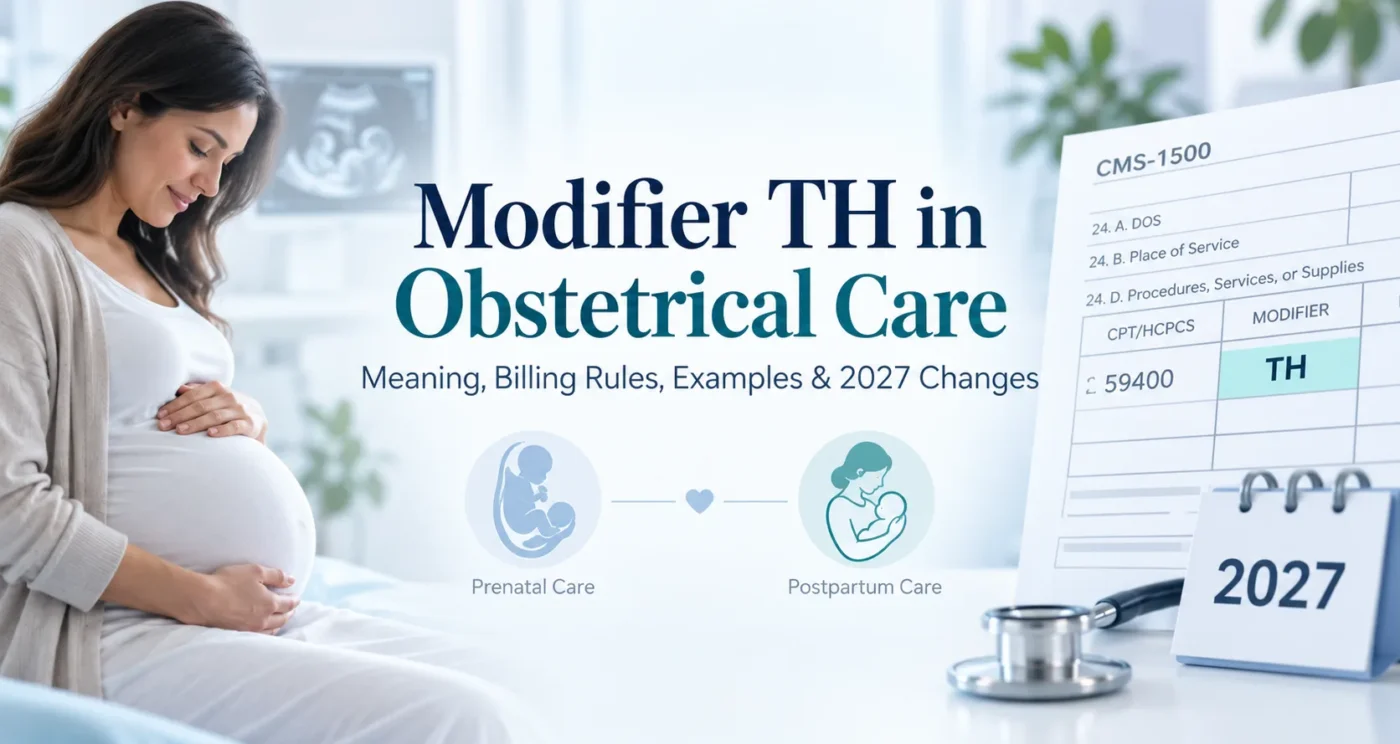
Modifier TH is a HCPCS Level II modifier used in connection with obstetrical treatment or services for prenatal or postpartum care. It is appended to another service code when the code combination and the payer policy support its use.
Think of the claim as several pieces describing different things. The E/M or procedure code says what service was furnished. The diagnosis code explains the clinical reason for the service. TH adds a maternity label to the line when the payer uses that modifier to recognize prenatal or postpartum care.
That distinction matters. TH does not turn a non-obstetrical visit into prenatal care. It also does not make an otherwise unsupported E/M level billable. The medical record and the payer rules still have to support the underlying service.
Is TH a CPT Modifier or a HCPCS Modifier?
TH is a HCPCS Level II modifier. It is not one of the familiar two-digit CPT modifiers. CMS explains that HCPCS Level II is the national coding system CMS maintains for items, services, and modifiers that sit outside the CPT Level I code set.
The classification can be easy to overlook because TH is often written beside a CPT E/M code on the same claim line. Seeing the two together does not make TH a CPT modifier; it remains a HCPCS Level II modifier attached to a CPT-reported service.
It is also worth separating coding from payment. A valid modifier does not create coverage by itself. The payer can still apply its own benefit rules, reimbursement policy, contract terms, medical-necessity edits, and claim-processing requirements.
When Is Modifier TH Used in Obstetrical Care?
TH is most useful when the underlying code does not, on its own, make the maternity context obvious. That is why the modifier is being discussed so often in connection with office and other E/M services. A standard E/M code can describe the visit, while TH can identify it as prenatal or postpartum care when the payer asks for that distinction.
Prenatal and Antepartum Encounters
For prenatal care, a payer may instruct the practice to append TH to an appropriate E/M code. The modifier identifies the obstetrical context; it does not choose the E/M level. The clinician still documents the visit, and the code is selected under the E/M rules that apply to that setting and date of service.
Do not assume TH belongs on every service performed during pregnancy. A prenatal visit can include or occur alongside laboratory work, ultrasound, fetal surveillance, injections, or other procedures. Those services have their own coding rules. TH should be used only where the code instructions and payer policy support it.
For example, fetal surveillance has separate reporting considerations. MedIntelHub’s guide to CPT code 59025 and fetal nonstress testing explains why the indication, number of fetuses, same-day services, and professional/technical components matter independently of the maternity context.
Postpartum Encounters
TH also applies to postpartum obstetrical care. That part of the modifier’s meaning will become more visible in 2027 because the current postpartum-only coding structure is being retired. Many postpartum encounters will instead be reported with the E/M code appropriate to the setting.
There is one important timing detail: routine postpartum care provided on the same calendar day as delivery is included in the 2027 delivery service. A later hospital management day or an outpatient postpartum visit may be separately reportable, depending on the circumstances. Only after deciding that the encounter itself is separately reportable should the billing team ask whether the payer expects TH.
When TH May Not Fit the Visit
Pregnancy does not make every medical service an obstetrical service. A pregnant patient may be treated for an unrelated respiratory infection, an injury, a dermatologic problem, or another condition that is not prenatal management. In those situations, automatically attaching TH simply because pregnancy appears in the chart can misstate what the claim line represents.
The same caution applies to labor and delivery. The 2027 code set gives those phases their own reporting structure. TH should not be sprayed across maternity claims as a general-purpose pregnancy marker. If a payer publishes a specific instruction for a labor- or delivery-related line, follow it; otherwise, use the code and modifier rules that actually apply to that service.
Which Codes Can Modifier TH Be Appended To?
There is no single national “TH code list” that can safely be copied into every payer profile. The most visible current use is with E/M services, particularly as payers prepare for encounter-based antepartum and postpartum reporting.
ACOG’s obstetric payment guidance recommends that health plans move antepartum visits toward E/M reporting and append TH to differentiate maternity care. ACOG references the broader E/M range 99202–99499 in that recommendation. Individual payers can be more restrictive.
North Carolina Medicaid provides a good example of that narrower approach. Its 2026 transition bulletin encourages E/M codes 99202–99215 with TH for qualifying prenatal or postpartum care beginning September 1, 2026. New York Medicaid has its own transition policy, with its own eligibility dates and claim details. Those are payer rules, not a universal expansion of TH to every E/M code.
Before creating an automated edit, verify the exact code family the payer allows, the date the policy starts, the patient population it applies to, and whether the rule differs between fee-for-service and managed care.
Does Modifier TH Change the E/M Level?
No. TH does not raise, lower, or otherwise determine the E/M level.
Under the AMA’s 2027 maternity FAQ, antepartum visits will be reported one encounter at a time with the appropriate E/M service. Standard E/M rules apply, including selection by medical decision making (MDM) or total time when permitted for the code family.
Two prenatal visits for the same patient therefore do not have to produce the same E/M code. A brief, uncomplicated encounter and a visit involving a new clinical concern may involve different work. The documentation for each date of service drives the code. TH simply tells the payer that the qualifying encounter is prenatal or postpartum care when its policy uses the modifier.
A useful internal check is to select the E/M level first, based on the note, then evaluate modifier and payer requirements. Reversing that order can lead staff to treat TH as if it were evidence for the visit level. It is not.
Documentation and Diagnosis Coding for TH Claims
A clean modifier does not rescue a weak note. The record should make the maternity purpose of the encounter understandable and support the code billed. For E/M services, that means the documentation must support the method used to select the visit—MDM or time, where applicable—along with the clinical work that actually occurred.
TH does not replace ICD-10-CM diagnosis coding. The modifier identifies the service as prenatal or postpartum in the way the payer uses TH; the diagnosis describes the pregnancy supervision, complication, postpartum condition, or other clinical reason for care.
The AMA advises payers to use pregnancy-related ICD-10-CM information to recognize maternity encounters and to consider TH where applicable. Some payers add further requirements. North Carolina Medicaid’s transition guidance, for example, tells providers to record the appropriate ICD-10-CM code and weeks of gestation when applicable.
Diagnosis selection should come from the documented clinical circumstances, not from a generic “prenatal” shortcut. If the pregnancy is complicated, the claim should reflect the supported condition. If the visit is for routine supervision, use the diagnosis family that accurately matches that situation and trimester or gestational context when required.
What the Note Should Make Clear
A reviewer should be able to tell why the patient was seen, whether the encounter was prenatal or postpartum, what was assessed, and what management occurred. If time is used to select the E/M code, the record should support that method under the applicable E/M rules. If MDM is used, the documentation should support the problems addressed, data, and risk as required.
Separately billed tests or procedures need their own support. TH on an office visit does not automatically establish medical necessity for an ultrasound, nonstress test, laboratory service, or procedure billed on another line.
Modifier TH Billing Examples
The examples below are teaching examples, not universal claim recipes. A payer can change the allowed code range, diagnosis requirements, modifier order, or transition date. Always check the policy that applies to the actual claim.
| Scenario | Illustrative reporting concept | What to check before billing |
| Routine prenatal office encounter | Appropriate office/outpatient E/M code + TH when the payer requires or accepts it | Select the E/M level from the documented service. Confirm the payer’s TH rule for the date of service. |
| Initial prenatal visit under a transition policy | Appropriate new- or established-patient E/M code + TH | Look for extra payer requirements such as pregnancy diagnoses, gestational age, quality codes, or special effective-date criteria. |
| Postpartum office follow-up in 2027 | Appropriate E/M code + TH where the payer uses it | First determine that the encounter is separately reportable under the 2027 maternity/E/M rules. |
| Visit during pregnancy for an unrelated condition | Report the service that was actually provided; TH may not belong on the line | Do not treat pregnancy status alone as proof that the encounter was prenatal obstetrical care. |
| Labor management or delivery | Use the applicable maternity code structure | Do not append TH automatically. Check the code instructions and the payer’s written policy. |
One common shorthand is to show an established-patient office E/M code followed by “-TH.” That shorthand is useful for understanding the claim structure, but it should not be read as permission to choose a particular E/M level. The note still decides the E/M code; the payer policy decides whether TH belongs on it.
How TH Fits With the Other Pieces of an Obstetrical Claim
A maternity claim is easier to audit when each element is assigned one job. Problems arise when the modifier is expected to do work that belongs to the diagnosis, documentation, or payer policy.
| Claim element | What it contributes |
| Procedure or E/M code | Describes the service or encounter being reported. |
| Modifier TH | Adds prenatal/postpartum obstetrical context when the payer uses the modifier. |
| ICD-10-CM diagnosis | Describes pregnancy supervision, a complication, postpartum condition, or another clinical reason for care. |
| Gestational-age information | Adds timing detail when clinically appropriate and required by the code set or payer. |
| Payer policy | Determines whether TH is required, accepted, ignored, or edited for a particular service. |
| Documentation | Supports the service, E/M level, medical necessity, and the clinical circumstances reported. |
Payer-Specific Rules: Where Most TH Errors Begin
A modifier rule can be perfectly correct for one payer and wrong for the next. That is the central operational problem with TH in 2026. National organizations are preparing the industry for 2027, but payers are not all using the same transition schedule.
When staff hear that a large Medicaid program has moved to E/M plus TH, it is tempting to update the whole billing system. Resist that shortcut. Build the rule at the payer and product level, and include the effective date. Otherwise a policy intended for one population can spill into commercial, exchange, or other Medicaid claims that follow different instructions.
New York Medicaid: A Transition With Specific Eligibility Dates
New York State Medicaid’s April 2026 update directs fee-for-service providers to use E/M codes with TH for prenatal services furnished to patients who initiate prenatal care on or after June 1, 2026, and/or have an estimated due date on or after January 1, 2027. The same policy calls for pregnancy-related O or Z diagnosis codes on prenatal visits.
New York also requires Category II code 0500F on the initial prenatal visit under that transition policy. Patients who had established prenatal care before June 1, 2026 are handled under the prior guidance through December 31, 2026.
That is a good illustration of why “use TH for prenatal care” is too vague for production billing. A usable payer rule needs the plan, service type, qualifying dates, diagnosis requirements, and any additional claim elements.
North Carolina Medicaid: A Different 2026 Start Date
North Carolina Medicaid announced a transition period beginning September 1, 2026 for NC Medicaid Direct and Managed Care. Providers are encouraged to use E/M codes 99202–99215 with TH to identify prenatal or postpartum care for the covered transition scenarios.
NC Medicaid also ties the encounter to standard E/M documentation. The bulletin states that documentation should support MDM or time consistent with CPT guidance and calls for appropriate ICD-10-CM coding, including weeks of gestation when applicable.
The New York and North Carolina policies point in the same general direction, but their dates and operational details are not identical. That difference is exactly why a national “TH rule” is unsafe.
Commercial Plans and Other Medicaid Programs
Commercial insurers and other state Medicaid programs may publish their own maternity edits, transition notices, or provider-manual updates. Some may follow ACOG’s recommended transition timing; some may wait for January 1, 2027; others may phase changes in by product or network.
If your practice does not already maintain a payer-update process, MedIntelHub’s guide to tracking healthcare policy and payer updates outlines a workable way to record the official source, effective date, affected services, owner, and implementation status.
What Are the Baseline CPT Rules for Antepartum Care in 2026?
This is the part of the transition that creates the most confusion. The new maternity framework does not become the baseline CPT structure until January 1, 2027. A payer can adopt a special transition policy earlier, but that does not rewrite the 2026 CPT rules for everyone else.
The AMA’s August 2026 maternity FAQ states that antepartum care provided in 2026 remains subject to the 2026 reporting guidelines. Under those rules, one to three antepartum visits are reported with appropriate E/M codes; the existing antepartum-only codes remain available in 2026 for larger visit groupings as applicable. The new encounter-by-encounter approach for all antepartum care starts with 2027 dates of service.
ACOG has separately encouraged health plans to transition earlier and recommends E/M plus TH for maternity visits during that transition. Both statements can be true at once: CPT establishes the baseline code-set rules, while a payer can publish a more specific 2026 policy for the claims it processes.
When the payer has not published an exception, do not assume the early-transition approach applies. When the payer has published one, follow the payer’s written criteria and keep the source in the billing team’s policy file.
Common Modifier TH Billing Mistakes
Most TH problems are not exotic coding puzzles. They usually come from applying a reasonable rule too broadly or failing to carry the payer’s effective date into the billing workflow.
- Adding TH to every claim line merely because the patient is pregnant. The service itself must fit the prenatal/postpartum context and the payer’s rule.
- Letting TH drive the E/M level. The modifier does not substitute for MDM, time, or the documentation used to select the underlying visit code.
- Using TH instead of an appropriate pregnancy diagnosis. Modifier and diagnosis coding answer different questions on the claim.
- Copying a Medicaid transition policy into all payer profiles. A state-specific bulletin is not a national coding instruction.
- Missing the date-of-service split between 2026 and 2027. The new CPT maternity framework begins January 1, 2027, while payer transition dates can start earlier.
- Adding TH after a denial solely to make the claim pass an edit. A corrected claim should reflect the service that was actually documented and the policy that applied on the original date of service.
- Leaving old claim-scrubber logic active after the payer changes its policy. Automated rules can keep creating the same error at scale.
- Treating every postpartum encounter as separately payable. Same-day routine postpartum work is included in the 2027 delivery service.
When a denial does occur, start with the remittance reason and the payer’s current rule instead of experimenting with modifiers. MedIntelHub’s claim-denial prevention and follow-up checklist provides a practical framework for finding the root cause before resubmission or appeal.
What Changes for Obstetrical Billing on January 1, 2027?
The 2027 update is much bigger than TH. It changes the basic architecture of professional maternity reporting. Instead of one global code representing a long episode of care, the new framework lets the major phases of the pregnancy be reported separately.
According to the AMA’s 2027 maternity overview, the revision separately identifies antepartum care, labor management, delivery, and postpartum care. The maternity update includes 17 deleted codes, 12 new codes, and six revised codes.
Antepartum Care
The current antepartum-only codes are deleted for 2027. Antepartum care is reported per encounter with the E/M code appropriate to the setting—office, hospital, telehealth, or another applicable location. Standard E/M rules apply.
That change is the main reason TH is receiving so much attention. Once the claim line looks like an ordinary E/M service, payers need a reliable way to recognize that it belongs to maternity care. Diagnosis coding is part of that picture, and some payers also use TH.
Labor Management
Labor management becomes its own reportable phase. The new structure includes separate codes for initial and subsequent days and distinguishes straightforward from complex management. Labor management is no longer simply hidden inside the old global maternity package.
TH should not be assumed on these lines. Labor management has its own codes and reporting instructions; payer guidance should be checked before any modifier is added.
Delivery
Delivery also separates from the legacy global package. New codes distinguish vaginal and cesarean delivery scenarios, while labor management may be reported separately when the circumstances support it. The delivery codes include routine postpartum care on the same calendar day.
For billing teams, this means the delivery claim can no longer be treated as the single code that implicitly represents months of antepartum and postpartum work. Charge capture has to know which phase occurred and which clinician or group furnished it.
Postpartum Care
Current postpartum-only coding is deleted for 2027. Postpartum care is generally reported encounter by encounter with the applicable E/M service. For facility births, subsequent hospital care can be reported for management days after the delivery date until discharge, subject to the code rules.
Outpatient postpartum visits likewise move into E/M reporting. This is another place where payer-specific TH instructions may become important, because the underlying code alone may not signal that the encounter is postpartum obstetrical care.
For a broader discussion of annual code maintenance and implementation, see MedIntelHub’s CPT code changes for 2026. The operational lesson carries forward: a code-set update has to reach EHR templates, charge capture, claim edits, payer rules, and staff training—not just the coding manual.
Pregnancies That Begin in 2026 and Continue Into 2027
Crossover pregnancies are where calendar-year thinking can fail. A patient may establish prenatal care in late 2026, receive several visits under a payer’s transition policy, deliver after January 1, and then have postpartum visits under the new 2027 structure. The claim logic can change during the same pregnancy.
Build the transition around dates of service, not around a single “pregnancy start year.” For each major payer, write down the 2026 rule, any early transition date, the qualifying population, and the 2027 rule. Then test a few realistic patient timelines against that map.
Do not assume fee-for-service and managed-care products move at the same time. New York’s 2026 fee-for-service instructions, for example, should not be silently extended to a managed-care plan unless that plan has issued compatible guidance. The same principle applies in every state.
A Practical TH Modifier and 2027 Readiness Checklist
Before turning on an automated TH edit, have coding, billing, clinical operations, and EHR staff agree on the exact rule the system is supposed to enforce. A short payer matrix can prevent a great deal of rework.
- List the Medicaid, commercial, exchange, and managed-care plans that generate most of the practice’s maternity claims.
- Save the current official maternity policy or provider bulletin for each payer.
- Record the publication date, effective date, and—when different—the implementation date.
- Note whether TH is required, recommended, accepted, or not addressed.
- Record the E/M code families the payer allows with TH.
- Map pregnancy-related diagnosis and gestational-age requirements.
- Capture any additional claim elements, such as Category II codes or payer-specific fields.
- Keep ordinary 2026 CPT rules separate from payer-specific early-transition exceptions.
- Create a rule for pregnancies that cross January 1, 2027 rather than forcing the entire episode into one year’s logic.
- Review documentation templates for MDM or time support before encounter-based E/M billing expands.
- Update superbills, charge-entry tools, claim scrubbers, clearinghouse edits, and staff reference sheets together.
- Test prenatal and postpartum claims before broad deployment, then watch rejections, denials, and underpayments after go-live.
The goal is not to put TH on more claims. A well-built process puts it on the right claim line, for the right payer, on the right date, with documentation and diagnosis coding that tell the same story.
Modifier TH at a Glance
| Question | Practical answer |
| What does TH identify? | Prenatal or postpartum obstetrical treatment/services. |
| What kind of modifier is it? | HCPCS Level II. |
| Is it required on every prenatal visit? | No. Use depends on the payer, service, and date of care. |
| Does TH select the E/M level? | No. The E/M level comes from the applicable MDM or time rules. |
| Does TH replace ICD-10-CM? | No. Diagnosis coding remains separate. |
| Can it apply postpartum? | Yes, when the encounter is separately reportable and the payer uses TH. |
| Does it automatically belong on labor or delivery codes? | No. Check the specific code instructions and payer policy. |
| What changes in 2027? | Global maternity reporting is replaced by phase-specific reporting; antepartum and postpartum use encounter-level E/M services. |
| Best place to verify? | Current coding resources plus the payer’s written policy for the date of service. |
Frequently Asked Questions About Modifier TH
What is the full meaning of Modifier TH?
TH is used to identify obstetrical treatment or services related to prenatal or postpartum care. It is a HCPCS Level II modifier that adds maternity context to another reported service when its use is appropriate.
Is Modifier TH required for every prenatal visit?
No. There is no universal rule requiring TH on every prenatal encounter. Some payers specifically require or encourage it with certain E/M services, while others use different claim rules. Verify the plan and date of service.
Can Modifier TH be used with 99213?
It can be, if 99213 accurately represents the documented established-patient E/M service and the payer permits or requires TH for that prenatal or postpartum encounter. TH does not make 99213 appropriate by itself.
Can TH be used with new-patient E/M codes?
Some payer policies allow it. A transition policy may include new-patient office/outpatient codes as well as established-patient codes. The allowed range should come from the payer’s current written instructions.
Does TH mean the pregnancy is high risk?
No. TH identifies the prenatal or postpartum context. High-risk supervision or a pregnancy complication is communicated through the supported diagnosis coding and the clinical documentation.
Does Modifier TH replace a pregnancy diagnosis code?
No. The modifier and the diagnosis do different jobs. TH can identify maternity context; the ICD-10-CM code describes the clinical reason for care, supervision status, complication, or postpartum condition.
Should TH be used for labor management?
Do not assume that it should. The 2027 maternity structure has separate labor-management codes. Follow the code instructions and the payer’s modifier policy for the claim.
Should TH be added to delivery codes?
Not automatically. Delivery is a separate phase of the 2027 maternity framework. Use TH on a delivery-related line only when the applicable payer and coding instructions support it.
Can TH be used for postpartum visits?
Yes. Postpartum care is within the scope of TH. Beginning in 2027, many postpartum encounters will be billed with E/M services, so payer-specific modifier rules become especially relevant.
Does TH increase reimbursement?
Not by definition. TH adds information to the claim; it does not guarantee a higher payment. Payment still depends on the underlying service, coverage, contract, fee schedule, edits, and documentation.
What can happen if TH is missing when the payer requires it?
The claim may be rejected, denied, or processed under a different edit, depending on the payer. Read the remittance reason and compare it with the policy that applied on the date of service before correcting the claim.
Should TH be added after a claim is denied?
Only if the original service and payer rule actually support the modifier. Do not add TH simply to get around an edit. A corrected claim should remain consistent with the record.
What is the biggest maternity coding change in 2027?
The major change is the end of the traditional global maternity structure. Antepartum, labor management, delivery, and postpartum care are reported as separate phases, with antepartum and postpartum care moving to encounter-level E/M reporting.
How should a practice handle a pregnancy that crosses from 2026 into 2027?
Use a payer- and date-of-service-specific transition plan. Some payers have 2026 transition policies, while the baseline CPT maternity structure changes on January 1, 2027. Do not use one blanket rule for the whole pregnancy.
Where should a coder verify TH requirements?
Check current CPT and HCPCS resources, the payer’s provider manual or bulletin, and any state Medicaid or managed-care instructions that apply. If a commercial policy is unclear, obtain clarification from the payer and document the response.
The Bottom Line
Modifier TH is not a universal pregnancy modifier. It is a HCPCS Level II modifier used to identify prenatal or postpartum obstetrical care when the underlying service and the payer’s rules support it. The E/M or procedure code still describes the service. ICD-10-CM still explains the clinical reason. The note still has to support what was billed.
That division of labor becomes more important in 2027. Once antepartum and postpartum care are reported with ordinary E/M code families, billing systems need a reliable way to preserve the maternity context without inventing rules that the payer never published.
For day-to-day billing, one question catches most of the risk: what does this payer require for this service, this patient, and this date of care? Answer that before the claim goes out, and TH becomes a precise claim detail rather than a guess.
Resources
American Medical Association — CPT 2027 Maternity Care Services Code Changes
AMA overview of the 2027 maternity restructure, including the separate antepartum, labor-management, delivery, and postpartum phases and the affected code set.
American Medical Association — CPT 2027 Maternity Care Services Code Changes
American Medical Association — FAQs: CPT 2027 Maternity Care Services Code Changes
Detailed transition guidance on 2026 versus 2027 reporting, encounter-level E/M services, documentation, and payer readiness.
American Medical Association — FAQs: CPT 2027 Maternity Care Services Code Changes
American College of Obstetricians and Gynecologists — Payment for Obstetric Services
ACOG recommendations for the transition from global obstetric payment, including E/M reporting and use of TH to identify maternity care.
American College of Obstetricians and Gynecologists — Payment for Obstetric Services
Centers for Medicare & Medicaid Services — Healthcare Common Procedure Coding System
CMS background on HCPCS Level II and its role in national coding and modifiers.
Centers for Medicare & Medicaid Services — Healthcare Common Procedure Coding System
New York State Medicaid — April 2026 Medicaid Update
Official NY Medicaid fee-for-service instructions for selected prenatal patients during the 2026 transition, including E/M plus TH and additional claim requirements.
New York State Medicaid — April 2026 Medicaid Update
North Carolina Medicaid — 2027 Maternity CPT Transition
Official NC Medicaid guidance for its September 1, 2026 transition period and E/M-plus-TH reporting.
North Carolina Medicaid — 2027 Maternity CPT Transition
MedIntelHub — How to Track Healthcare Policy and Payer Updates
A practical process for turning official payer notices and coding changes into assigned operational updates.
MedIntelHub — How to Track Healthcare Policy and Payer Updates
Editorial Guidelines & Medical Disclaimer
MedIntelHub publishes medical-coding and healthcare-billing information for general educational purposes. This article does not determine coverage, establish reimbursement, or replace the current coding references, payer contract, provider manual, or official billing instructions that apply to a specific claim.
CPT®, HCPCS, ICD-10-CM, payer edits, fee schedules, and maternity billing policies can change. Requirements can also differ by insurer, state Medicaid program, managed-care product, provider type, network agreement, and date of service. Before changing a production billing workflow, verify the rule in the current official source.
The article was reviewed against information available in September 2026 from the AMA, ACOG, CMS, New York State Medicaid, and North Carolina Medicaid. It should be used as an educational guide rather than as an instruction to add or remove TH from an individual claim without reviewing the underlying documentation and payer policy.
For details on how MedIntelHub researches, reviews, and updates content, see the MedIntelHub Editorial Policy.

David Bennett
David Bennett is an author at MedIntelHub, where he creates clear, practical, and well-researched content about healthcare, medical billing, insurance, and patient education. His goal is to make complex healthcare topics easier for readers to understand and use in everyday situations. David emphasizes accuracy, transparency, and reliable sourcing, using information from trusted organizations and official healthcare resources whenever possible. Content published by David is intended for educational purposes and should not replace advice from qualified medical, legal, or healthcare professionals.