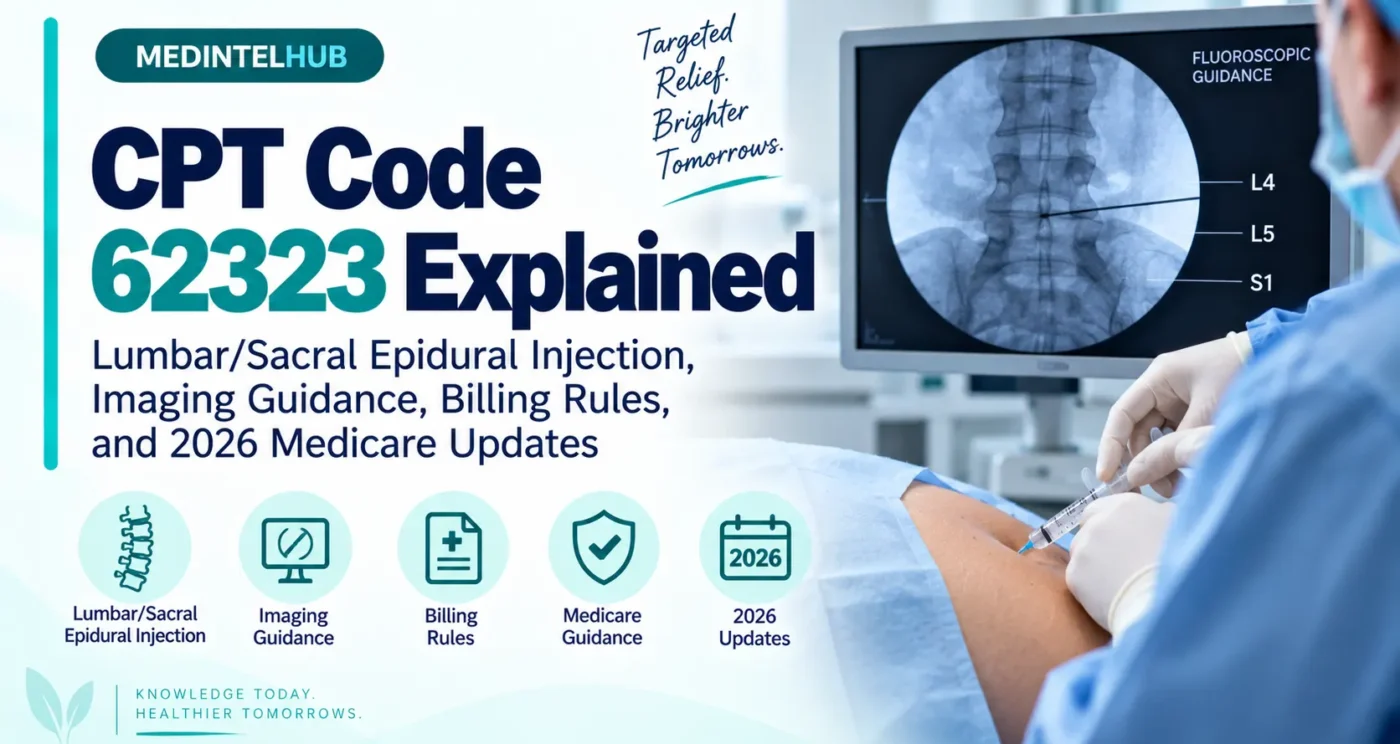
A lumbar epidural injection can look straightforward on a procedure schedule: patient arrives, imaging is used to guide the needle, medication is delivered, and the patient goes home. The claim is less forgiving. The code changes with the approach, imaging is already built into some services, Medicare may limit the number of levels and sessions, and the diagnosis has to match the reason the injection was performed.
CPT code 62323 sits in the middle of those decisions. It is used for a lumbar or sacral interlaminar or caudal epidural/subarachnoid injection performed with fluoroscopic or CT guidance. In everyday pain-management billing, the most familiar use is an image-guided lumbar or caudal epidural injection. The code should not be treated as interchangeable with a transforaminal epidural injection such as 64483.
CMS’s 2026 Medicare NCCI Policy Manual confirms another important point: imaging guidance is already included in 62323. Separate fluoroscopy or CT needle-guidance codes such as 77003 or 77012 should not be added simply because imaging was used during the injection.
The harder part is usually not remembering the five-digit code. It is proving that the documented service, approach, level, diagnosis, imaging, medical necessity, and utilization history all point to the same claim. Medicare coverage is especially important because epidural steroid injection policies are often administered through Local Coverage Determinations (LCDs), which means the exact rules can vary by MAC jurisdiction.
CPT 62323 at a Glance
| Question | Practical answer |
| What does 62323 represent? | An image-guided lumbar/sacral interlaminar or caudal epidural/subarachnoid injection. |
| Is imaging included? | Yes. Fluoroscopy or CT guidance is part of 62323. |
| Can 77003 or 77012 be billed separately? | Not for the imaging guidance already included in 62323. |
| How many levels may Medicare allow? | Current ESI LCDs commonly limit interlaminar/caudal injections to one level per session. |
| Is modifier 50 appropriate? | Current Medicare ESI policies generally do not treat 62323 as a bilateral procedure. |
| How often may it be covered? | Some current MAC LCDs limit ESIs to four sessions per spinal region in a rolling 12 months. |
| What changed in 2026? | The code remains established, but the 2026 NCCI manual and several MAC LCDs were updated; jurisdiction-specific coverage still needs verification. |
What Is CPT Code 62323?
CPT 62323 is used for an injection of a diagnostic or therapeutic substance into the lumbar or sacral epidural or subarachnoid space when the service is performed with fluoroscopic or CT guidance. The code includes needle or catheter placement as part of the injection service. Because CPT descriptions are copyrighted, the safest way to think about the code is by its essential elements: lumbar/sacral region, interlaminar or caudal approach, and image guidance.
For pain-management claims, 62323 is commonly associated with lumbar interlaminar epidural steroid injections and caudal epidural steroid injections. The substance injected may include a corticosteroid, local anesthetic, saline, or another qualifying diagnostic or therapeutic solution depending on the clinical purpose and payer policy.
The code itself does not guarantee payment. Medicare coverage depends on whether the medical record supports the indication, whether the injection was performed within the applicable utilization limits, and whether the provider followed the MAC’s current LCD and billing article.
What Type of Injection Does 62323 Represent?
There are several ways to reach the epidural space, and that approach changes coding. An interlaminar injection enters through the posterior spine between adjacent laminae. A caudal injection reaches the epidural space through the sacral hiatus. Both approaches can fall within the lumbar/sacral 62323 family when the other coding requirements are met and imaging guidance is used.
A transforaminal injection takes a different path. The needle is advanced through the neural foramen toward a specific spinal nerve root. Medicare coding articles place lumbar/sacral transforaminal injections in the 64483/64484 family, not under 62323. That distinction is more than terminology; it changes level reporting, bilateral rules, and sometimes modifier use.
Interlaminar vs. Caudal Epidural Injection
Interlaminar and caudal injections are grouped together for important Medicare utilization rules, but the procedures are not anatomically identical. With an interlaminar approach, the clinician enters the epidural space between vertebral laminae. With a caudal approach, access is obtained through the sacral hiatus and medication is advanced cephalad within the epidural space.
For billing teams, the procedural note should make the route obvious. A vague statement such as ‘lumbar epidural performed’ is less useful than documentation that identifies the lumbar/sacral region, the interlaminar or caudal approach, the level when applicable, the imaging modality, contrast findings when required, and the medication delivered.
Why Imaging Guidance Is Included in CPT 62323
The final digits matter. CPT 62323 is the image-guided version of the lumbar/sacral interlaminar or caudal injection service. CMS’s 2026 NCCI policy specifically groups 62323 with other spinal injection codes that already include fluoroscopic or CT guidance.
That means the facility or practitioner should not create a second line for the same guidance simply because fluoroscopy or CT was documented. The imaging is part of the work represented by 62323. This is one of the easiest places for accidental unbundling to occur when a charge master or superbill was built around older code structures.
Can 77003 or 77012 Be Billed With 62323?
Not for the imaging guidance that is integral to 62323. The 2026 Medicare NCCI manual states that 77003 and 77012 should not be separately reported with 62323 when they represent the fluoroscopic or CT guidance already included in the procedure.
This is a good example of why a valid code can still be wrong on a particular claim. 77003 and 77012 are legitimate imaging-guidance codes in other circumstances. The problem is reporting them again when the primary procedure already includes that work. Before overriding an edit, confirm that the imaging service truly represents something distinct rather than the guidance inherent in 62323.
CPT 62323 vs. 62322
The main distinction is imaging. CPT 62322 is the lumbar/sacral interlaminar or caudal injection service without imaging guidance, while 62323 represents the corresponding service with fluoroscopic or CT guidance.
For Medicare epidural steroid injections, current LCD language commonly requires CT or fluoroscopy with contrast, subject to limited exceptions such as documented contrast allergy or pregnancy. As a result, 62323 is frequently the relevant code for a Medicare-covered lumbar/sacral ESI, while 62322 may not satisfy a particular LCD’s image-guidance requirement. Always check the policy that applies to the date of service and jurisdiction.
CPT 62323 vs. 62321
Both codes represent image-guided interlaminar epidural/subarachnoid injection services, but the spinal region differs. CPT 62321 is used for the cervical or thoracic region. CPT 62323 is used for the lumbar or sacral region.
When documentation says only ‘epidural steroid injection’ without identifying the region, the coder does not have enough information to choose between these services. The operative note should make the anatomy clear.
CPT 62323 vs. 64483 and 64484
This is one of the most important comparisons in pain-management coding. CPT 62323 describes an interlaminar or caudal lumbar/sacral approach. CPT 64483 describes a lumbar/sacral transforaminal epidural injection at a single level, and 64484 is used for an additional lumbar/sacral transforaminal level when appropriate.
The practical difference is the needle path. If the clinician performs a transforaminal injection directed through a foramen toward a specific nerve root, 62323 should not be selected just because the injection occurred in the lumbar region. Conversely, an interlaminar or caudal injection should not be converted into 64483 simply because the patient has radicular symptoms.
| Code | Region/approach | Imaging | Key billing distinction |
| 62322 | Lumbar/sacral interlaminar or caudal | Not built in | Without imaging guidance. |
| 62323 | Lumbar/sacral interlaminar or caudal | Fluoroscopy or CT included | Imaging is integral; typically one level per session under Medicare ESI LCDs. |
| 62321 | Cervical/thoracic interlaminar | Fluoroscopy or CT included | Same basic image-guided concept, different spinal region. |
| 64483 | Lumbar/sacral transforaminal | Fluoroscopy or CT included | Single transforaminal level. |
| 64484 | Lumbar/sacral transforaminal | Fluoroscopy or CT included | Additional transforaminal level; reported with 64483 when supported. |
How Many Levels Can Be Reported With 62323?
Under current Medicare ESI LCDs, caudal and interlaminar epidural steroid injections are generally limited to one level per session. CMS billing articles tied to these policies state that 62323 may be reported for one level per session.
This rule is different from lumbar/sacral transforaminal coding, where 64483 may be paired with 64484 for a second level when medically necessary and permitted by the LCD. A billing team should not create extra 62323 units simply because medication is expected to spread across more than one level or because the note mentions multilevel disease.
Can CPT 62323 Be Billed Bilaterally?
Current Medicare ESI LCDs generally say no. Caudal and interlaminar ESIs are not considered bilateral procedures for these policies, so modifier 50 is not the normal way to report 62323.
The distinction makes sense anatomically. The procedure accesses the epidural space rather than separately treating paired left and right foraminal targets. If the operative note documents a bilateral transforaminal procedure, the claim belongs in the transforaminal code family and should follow the payer’s bilateral instructions for those codes.
Medicare Medical-Necessity Requirements
Medical necessity is where many otherwise clean 62323 claims succeed or fail. One current Medicare LCD requires a history, physical examination, and concordant radiologic testing supporting conditions such as radiculopathy, radicular pain, or neurogenic claudication from disc herniation, degenerative changes, or stenosis; post-laminectomy syndrome; or acute herpes-zoster-related pain.
The same LCD requires the symptoms to be severe enough to meaningfully affect function or quality of life and calls for a baseline pain or functional assessment. It also generally expects at least four weeks of symptoms plus failure or intolerance of noninvasive conservative care, except in certain acute herpes zoster circumstances.
Those criteria are useful examples, not a substitute for checking the patient’s MAC. Medicare coverage is local when an LCD applies. A commercial payer may use different diagnoses, authorization requirements, frequency limits, or documentation standards.
What Diagnoses May Support CPT 62323?
There is no single diagnosis that universally guarantees payment. Current Medicare billing articles include diagnosis groups that may support epidural injection services when the rest of the LCD requirements are met. Common themes include radiculopathy associated with degenerative spine disease or disc disorders, spinal stenosis with radicular symptoms or neurogenic claudication, post-laminectomy syndrome, certain herpes-zoster pain diagnoses, and selected pain diagnoses in specific circumstances.
A generic low-back-pain code should not be used as a shortcut when the record actually describes radicular symptoms, nor should a radiculopathy code be selected merely to satisfy coverage. The ICD-10-CM code should reflect the documented condition at the highest supported specificity.
One current LCD specifically lists nonspecific low-back pain, axial spine pain, complex regional pain syndrome, diffuse pain, and certain other conditions among uses it does not consider medically reasonable and necessary for ESI coverage.
Documentation Requirements for 62323
Good documentation makes the coding almost anticlimactic. The note should tell a reviewer why the injection was performed, where the needle was placed, what imaging was used, what the contrast study showed when contrast is required, what medication was administered, and whether the patient’s symptoms and previous treatment meet the payer’s coverage rules.
CMS billing articles also emphasize retention of images that document final needle position and contrast flow, along with a signed record that supports the diagnosis and the service billed. The chart should connect the procedure to the patient’s complaint rather than reading like a generic injection template.
A strong procedure note commonly includes:
- Lumbar/sacral region and the specific interlaminar or caudal approach.
- Clinical indication and relevant diagnosis.
- Baseline pain score or functional measure when required by the payer.
- Relevant imaging or diagnostic findings supporting the indication.
- Fluoroscopy or CT guidance and final needle position.
- Contrast use and flow pattern when applicable, or the reason contrast was not used.
- Medication name, dose, concentration, and volume.
- Any complications or unusual circumstances.
- The provider signature and date.
- Prior response information when the service is a repeat injection.
Contrast, Fluoroscopy, and CT Guidance
For 62323, fluoroscopy or CT guidance is part of the CPT service. Medicare coverage policies often go further and require image guidance with contrast to confirm epidural placement, unless there is a documented contraindication such as contrast allergy or pregnancy.
Do not confuse the coding rule with the coverage rule. Coding tells you that imaging guidance is bundled into 62323. Coverage policy tells you whether the payer expects contrast, what exceptions it recognizes, and what documentation must be retained.
Repeat Injections and Response Documentation
Repeat injections need their own medical-necessity story. A current Medicare LCD allows repeat ESI when the first injection produced significant improvement, with documentation of at least 50% sustained pain improvement for at least three months or at least 50% improvement in function compared with baseline using the same assessment scale. The policy also allows a repeat after 14 days when the initial injection fails to respond well, if a different approach, level, or medication is used when appropriate and the rationale is documented.
That language is a reminder not to schedule an automatic series and fill in the justification later. The same LCD states that a predetermined series is not medically reasonable and necessary. Each session should be tied to the patient’s actual response and current plan.
Medicare Frequency Limits
A commonly used Medicare ESI framework limits treatment to four epidural injection sessions per spinal region in a rolling 12-month period. It also limits treatment to one spinal region per session and one interlaminar or caudal level during that session.
These are Medicare LCD rules rather than universal clinical or commercial-payer rules. A plan may be more restrictive, may count sessions differently, or may require prior authorization. Before the procedure is scheduled, the practice should confirm the patient’s prior injection history under the relevant payer.
Sedation With Epidural Steroid Injections
Routine moderate or deep sedation is another area where the clinical record and claim need to agree. Current Medicare LCD language says moderate or deep sedation, general anesthesia, or monitored anesthesia care is usually unnecessary or rarely indicated for these procedures. Exceptional circumstances must be clearly documented.
From a billing standpoint, do not assume a separate anesthesia service is payable simply because the patient is anxious or because the procedure occurs in an ASC. The level of sedation, who provided it, the reason it was necessary, and the payer’s policy all matter.
When the KX Modifier May Be Relevant
The KX modifier is not a routine modifier for 62323. Some Medicare billing articles use KX to distinguish a diagnostic selective nerve root block from a therapeutic epidural injection because the procedures may otherwise be coded similarly. Those instructions are aimed primarily at the transforaminal code family such as 64483 and 64484.
For a standard lumbar/sacral interlaminar or caudal ESI reported with 62323, do not add KX simply because the payer uses it elsewhere in its epidural policy. Follow the exact billing article that applies to the procedure and jurisdiction.
Same-Day Procedures and NCCI Edits
A pain-management encounter can include several services, but not every individually recognizable action earns a separate line item. CMS NCCI policies are designed to prevent payment for work that is already integral to another procedure. Imaging guidance is the clearest 62323 example, but edits can also affect other same-day combinations.
When another spinal procedure is performed on the same date, review the current NCCI PTP edits and the MAC’s LCD limitations before adding a modifier. A modifier should explain a genuinely distinct service, not serve as a workaround for an edit.
2026 Medicare Updates for CPT 62323
The biggest 2026 coding update is not a new identity for 62323. Instead, practices need to work from the current 2026 Medicare NCCI Policy Manual, which continues to treat fluoroscopic and CT guidance as included in 62323 and says those guidance services should not be reported separately.
Coverage policy also moved during 2026. Several Medicare Administrative Contractors refreshed epidural steroid injection LCDs in April 2026. The details were not identical everywhere. For example, one LCD revision described clarifications and expanded language in covered indications, while another current policy identifies its April 2026 revision as non-substantive and says it did not change the intent of coverage.
That variation is exactly why a national article should not turn one contractor’s wording into a universal Medicare rule. Before billing, check the Medicare Coverage Database for the patient’s jurisdiction, the effective date of service, and the linked billing article.
The practical 2026 message is simple: keep the code, edits, and coverage policy synchronized. An old template may still produce the right code while missing a new or revised documentation expectation in the MAC policy.
Practical CPT 62323 Billing Examples
Example 1: Lumbar Interlaminar ESI With Fluoroscopy
A patient with documented lumbar radiculopathy undergoes an L4-L5 interlaminar epidural steroid injection under fluoroscopy. Contrast confirms epidural spread. The service is reported with 62323. The fluoroscopy guidance is not separately reported with 77003 because it is included in 62323.
Example 2: Caudal ESI With CT Guidance
A patient with qualifying lumbosacral radicular pain receives a caudal epidural injection under CT guidance. When the service and medical necessity are supported, 62323 represents the image-guided lumbar/sacral caudal injection. CT needle-guidance code 77012 is not added for the guidance already built into 62323.
Example 3: Two Lumbar Interlaminar Levels Requested
The schedule lists two separate lumbar interlaminar levels for the same Medicare session. Under current ESI LCD frameworks, interlaminar/caudal injections are generally limited to one level per session. The case should be reviewed before billing rather than automatically submitting two units of 62323.
Example 4: Bilateral Radicular Symptoms
A patient has symptoms on both sides, but the physician performs one lumbar interlaminar ESI. The procedure does not become bilateral simply because the symptoms are bilateral. Current Medicare ESI policies do not treat 62323 as a bilateral service, so modifier 50 should not be added by habit.
Example 5: Transforaminal Injection Instead of Interlaminar
The procedure note documents a lumbar transforaminal injection at one nerve-root level under fluoroscopy. That is not 62323. The lumbar/sacral transforaminal family begins with 64483, with 64484 available for an additional supported level.
Example 6: Repeat Injection After Good Prior Response
A prior ESI produced documented sustained improvement meeting the MAC policy threshold. The patient later has recurrence of radicular symptoms and receives another image-guided interlaminar injection. The current note should reference the prior response and continued medical necessity rather than simply stating that this is injection number two in a series.
Common CPT 62323 Coding Errors
Separately Billing Fluoroscopy or CT Guidance
Adding 77003 or 77012 to 62323 for the same needle guidance can create an unbundling problem because imaging guidance is already included.
Using 62323 for a Transforaminal Injection
The anatomical route matters. A transforaminal lumbar/sacral injection belongs in the 64483/64484 family, not under 62323.
Reporting Multiple 62323 Units for Several Levels
Current Medicare ESI policies generally limit interlaminar or caudal injections to one level per session.
Adding Modifier 50
62323 is not treated as a bilateral procedure under current Medicare ESI LCD frameworks.
Using a Nonspecific Diagnosis Without Support
The diagnosis should match the documented condition. Generic axial low-back pain may not meet Medicare ESI coverage criteria when the LCD requires qualifying radicular or other covered conditions.
Scheduling a Predetermined Series
Current LCD language says predetermined ESI series are not medically reasonable and necessary. Repeat services should be based on documented response and current need.
Ignoring Prior Injection History
Frequency limits are measured over time. A technically correct claim can still deny when the patient has already reached the payer’s utilization limit.
Common Reasons 62323 Claims Are Denied
A denial can come from coding, coverage, utilization, or documentation. Common problems include:
- No qualifying diagnosis under the applicable MAC LCD.
- Insufficient documentation of radicular symptoms, functional impact, or failed conservative care.
- Missing or unsupported image-guidance documentation.
- Incorrect code family for the approach actually performed.
- Unbundled fluoroscopy or CT guidance.
- Frequency or level limits exceeded.
- Use of modifier 50 on an interlaminar/caudal service.
- Repeat injection without documented prior response or rationale.
- Missing authorization under a non-Medicare payer policy.
- Same-day code combinations that fail NCCI or payer edits.
When a claim denies, start with the payer’s actual remittance reason rather than changing the code reflexively. MedIntelHub’s claim denial prevention and follow-up checklist provides a broader workflow for deciding whether the claim needs correction, records, reconsideration, or appeal.
CPT 62323 Pre-Bill Checklist
- Confirm the procedure was lumbar/sacral and interlaminar or caudal rather than transforaminal.
- Confirm fluoroscopy or CT was used when required and do not separately add integral imaging guidance.
- Check the patient’s MAC or payer policy for diagnosis and medical-necessity criteria.
- Confirm the record documents a qualifying condition and the relevant symptoms/function.
- Check whether conservative-care requirements were met when required.
- Verify one interlaminar/caudal level per session under applicable Medicare policy.
- Do not add modifier 50 simply because symptoms are bilateral.
- Review prior ESI dates and the rolling utilization limit.
- For a repeat injection, document prior response and the reason another injection is needed.
- Review current NCCI edits for same-day procedures.
- Confirm any separate sedation service is medically necessary and supported.
- Check payer-specific authorization or notification requirements before claim submission.
Where CPT 62323 Fits in the Billing Workflow
The procedure code is only one part of the claim. Eligibility, authorization, diagnosis coding, documentation, charge capture, NCCI edits, and remittance all influence the final result. For the broader sequence, see MedIntelHub’s Medical Billing Workflow: From Patient Visit to Payment.
Annual code-set updates can also change surrounding rules even when a familiar code remains active. MedIntelHub’s New CPT Code Changes for 2026: What Providers Need to Know explains why practices should refresh code tables, templates, and payer workflows each year.
Frequently Asked Questions About CPT 62323
What is CPT code 62323 used for?
It is used for an image-guided lumbar or sacral interlaminar/caudal epidural or subarachnoid injection of diagnostic or therapeutic substance(s). In pain management, it is commonly used for image-guided lumbar or caudal epidural injections.
Does 62323 include fluoroscopy?
Yes. Fluoroscopic or CT guidance is built into 62323. CMS NCCI policy says 77003 or 77012 should not be separately reported for the same integral guidance.
Can I bill 77003 with 62323?
Not for the fluoroscopic guidance already included in 62323. If another distinct imaging service is being considered, review the current NCCI edits and documentation rather than assuming it is separately payable.
What is the difference between 62322 and 62323?
62322 is the lumbar/sacral interlaminar or caudal injection service without imaging guidance. 62323 is the corresponding service with fluoroscopic or CT guidance.
What is the difference between 62323 and 64483?
62323 is interlaminar or caudal. 64483 is a lumbar/sacral transforaminal epidural injection at a single level.
Can 62323 be billed twice for two lumbar levels?
Current Medicare ESI LCDs generally limit interlaminar/caudal injections to one level per session, so two units of 62323 would usually not fit those policies.
Is CPT 62323 bilateral?
Current Medicare ESI policies generally do not treat 62323 as a bilateral procedure. Modifier 50 is therefore not routinely appropriate.
How many epidural injection sessions does Medicare allow?
A commonly used current Medicare LCD framework limits ESIs to four sessions per spinal region in a rolling 12-month period. Verify the patient’s MAC because LCDs are jurisdiction-specific.
Does Medicare cover 62323 for ordinary low-back pain?
Not automatically. Current ESI LCDs often require qualifying radiculopathy, radicular pain, neurogenic claudication, or another covered indication, along with additional medical-necessity criteria.
Can a repeat ESI be done after only 14 days?
Some current Medicare LCD language allows a repeat after 14 days when the initial ESI did not respond well and a different approach, level, or medication is used when appropriate, with clear rationale and medical-necessity documentation.
Can moderate sedation be billed with 62323?
Current Medicare LCDs generally say moderate/deep sedation, general anesthesia, or MAC is usually unnecessary or rarely indicated. Exceptional cases need clear documentation and are subject to payer rules.
Is KX required on 62323?
No. KX is not a routine 62323 modifier. Some Medicare articles use KX for diagnostic selective nerve root blocks coded in the transforaminal family.
Can 62323 be performed without contrast?
Coverage policies often require contrast to confirm epidural placement, but recognize limited exceptions such as documented contrast allergy or pregnancy. Check the applicable LCD.
Did CPT 62323 change in 2026?
The code remains established. The important 2026 developments are the current NCCI policy manual and MAC LCD revisions affecting coverage and documentation in specific jurisdictions.
Does a valid 62323 code guarantee reimbursement?
No. Payment still depends on medical necessity, diagnosis support, utilization limits, documentation, payer edits, authorization where applicable, and the patient’s benefits.
The Bottom Line
CPT 62323 is not simply ‘the lumbar epidural code.’ It identifies a specific lumbar/sacral interlaminar or caudal injection service performed with fluoroscopic or CT guidance. That approach distinction separates it from transforaminal codes, and the built-in imaging separates it from the corresponding non-image-guided service.
For Medicare claims, most of the risk sits around the code rather than inside it: the diagnosis has to fit the LCD, the record has to support the indication and level, imaging cannot be unbundled, bilateral reporting is generally inappropriate, repeat injections need documented response, and utilization limits must be checked before the claim goes out.
The most reliable workflow is to start with the actual procedure note, then verify the payer’s current policy for the date of service. When the approach, anatomy, imaging, diagnosis, prior treatment, and utilization history all agree, 62323 becomes much easier to bill correctly.
Resources
Centers for Medicare & Medicaid Services — 2026 Medicare NCCI Policy Manual, Chapter 8
CMS explains current Medicare NCCI coding policy for nervous-system procedures, including the rule that fluoroscopic or CT guidance is included in CPT 62323.
Centers for Medicare & Medicaid Services — Epidural Steroid Injections for Pain Management LCD L36920
This current LCD provides an example of Medicare coverage criteria, image-guidance requirements, utilization limits, repeat-injection rules, sedation limitations, and 2026 revision history.
Centers for Medicare & Medicaid Services — Billing and Coding Article A58731
CMS provides billing guidance on spinal regions, transforaminal vs. interlaminar coding, bilateral treatment, KX use for selective nerve-root blocks, utilization limits, and documentation.
Centers for Medicare & Medicaid Services — Epidural Steroid Injections LCD L39240
This active MAC policy illustrates how Medicare epidural coverage may be revised by jurisdiction and includes an April 2026 effective revision.
Centers for Medicare & Medicaid Services — Medicare NCCI Program
CMS maintains current NCCI policy manuals and quarterly coding-edit files used to support correct Medicare coding.
Editorial Guidelines & Medical Disclaimer
This article is for general educational and informational purposes. It explains coding and billing concepts and does not diagnose a medical condition, determine whether an epidural injection is clinically appropriate for a particular patient, or replace individualized medical advice.
CPT, Medicare, NCCI, LCD, authorization, modifier, documentation, and payment requirements can change. Medicare coverage may also differ by MAC jurisdiction. Before submitting a claim, practices should verify the current licensed CPT resource, the applicable 2026 CMS/NCCI materials, the patient’s MAC LCD and billing article, payer instructions, and any authorization requirements that apply to the date of service.
Clinical decisions about epidural injections, medication selection, sedation, contraindications, and follow-up belong to qualified healthcare professionals working from the individual patient’s history and current clinical circumstances.
MedIntelHub develops medical and billing content from authoritative sources and reviews it for accuracy and clarity. Read our Editorial Policy for information about sourcing, updates, and corrections.

David Bennett
David Bennett is an author at MedIntelHub, where he creates clear, practical, and well-researched content about healthcare, medical billing, insurance, and patient education. His goal is to make complex healthcare topics easier for readers to understand and use in everyday situations. David emphasizes accuracy, transparency, and reliable sourcing, using information from trusted organizations and official healthcare resources whenever possible. Content published by David is intended for educational purposes and should not replace advice from qualified medical, legal, or healthcare professionals.