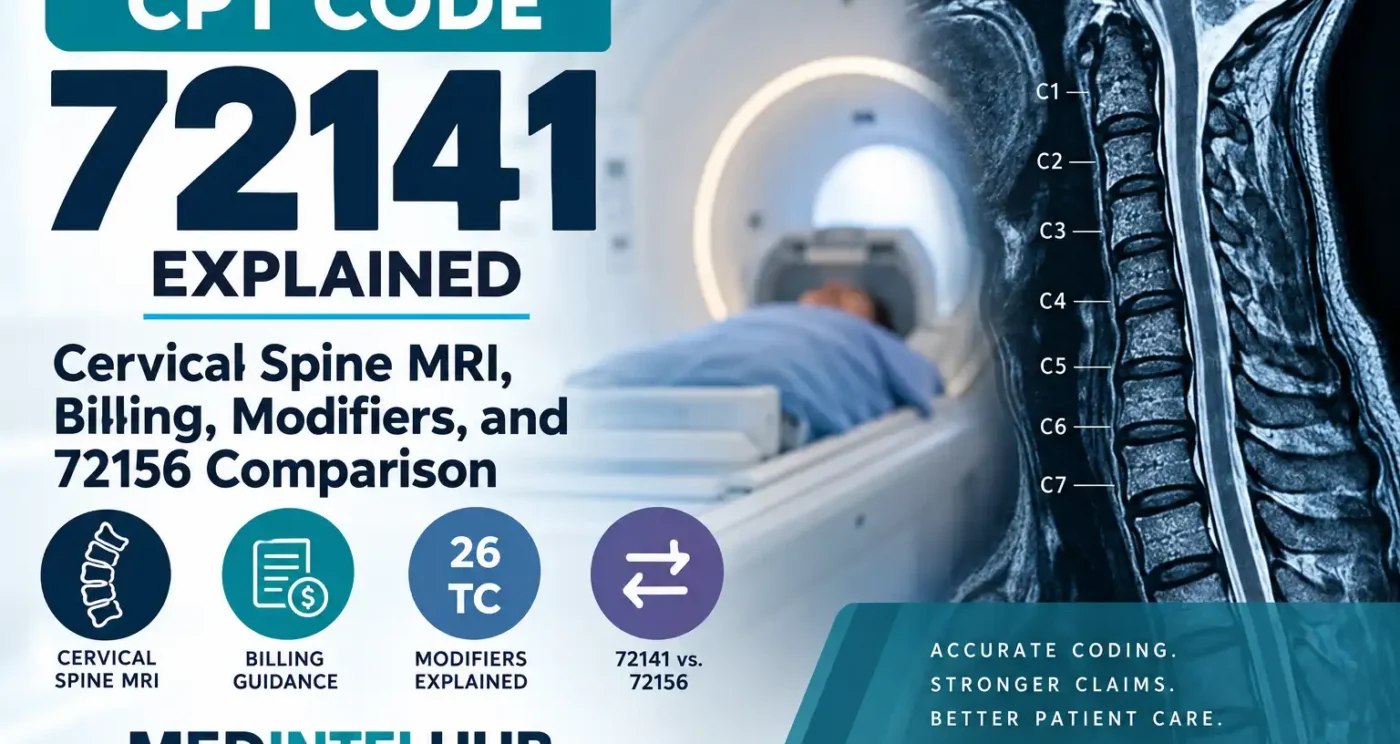
A cervical spine MRI can look straightforward on an order: scan the neck, review the images, issue a report. The billing decision is less simple. One of the first questions is whether the study was performed without contrast, with contrast, or as a complete examination that began without contrast and continued after contrast. That distinction changes the CPT code.
CPT code 72141 is used for a magnetic resonance imaging examination of the cervical spinal canal and its contents performed without contrast material. It is a radiology code for the imaging service itself. It does not identify the patient’s diagnosis, guarantee that an insurer will cover the scan, or tell the billing team whether prior authorization was required.
The practical coding work begins with the performed protocol and the documentation. A noncontrast cervical MRI may fit 72141. A contrast-only cervical MRI belongs to a different code. A study that includes both pre-contrast imaging and post-contrast sequences has its own more comprehensive code. Professional and technical components can also be billed separately in qualifying arrangements.
This guide focuses on those distinctions and on the billing issues that commonly surround 72141 in 2026: medical necessity, contrast selection, modifiers 26 and TC, NCCI bundling, units, repeat imaging, prior authorization, documentation, diagnosis coding, and the difference between 72141 and 72156.
CPT 72141 at a Glance
| Item | Practical meaning |
| Code | 72141 |
| Modality | MRI |
| Anatomic region | Cervical spine / cervical spinal canal and contents |
| Contrast status | Without contrast material |
| Common comparison | 72142 for contrast-only cervical MRI; 72156 for without-and-with-contrast cervical MRI |
| PC/TC concept | May be split into professional and technical components when the billing arrangement supports it |
| Main coding risk | Using a noncontrast code when a more comprehensive contrast protocol was actually performed, or separately reporting component studies that are included in one comprehensive MRI service |
| Coverage point | A valid CPT code does not itself establish medical necessity, prior authorization, coverage, or payment |
What Is CPT Code 72141?
CPT 72141 identifies an MRI study of the cervical spinal canal and its contents performed without contrast material. In everyday billing language, it is commonly described as a cervical spine MRI without contrast. The code belongs to the diagnostic radiology section of CPT.
The word cervical refers to the neck portion of the spine. The examination may assess the cervical vertebrae, intervertebral discs, spinal canal, spinal cord, neural foramina, and surrounding soft tissues. The images can help clinicians investigate symptoms or conditions such as radicular pain, suspected nerve-root compression, degenerative changes, disc disease, spinal stenosis, or other abnormalities when MRI is clinically appropriate.
For 2026 coding context, CMS continues to list 72141 in the MRI spine code family. The CMS code-family materials distinguish 72141 as the noncontrast cervical-spine MRI from 72142 and 72156. See the CMS physician fee schedule resources and current Medicare coding files when confirming payment indicators for a specific date of service.
What a Cervical Spine MRI Can Evaluate
MRI is especially useful for soft-tissue detail. Depending on the clinical question and protocol, a cervical MRI may show the spinal cord, discs, nerve roots, ligamentous structures, marrow, and the relationship between degenerative or structural changes and the spinal canal.
The imaging finding and the billing code are separate concepts. A radiologist may describe disc protrusion, foraminal narrowing, central canal stenosis, cord signal change, or no significant abnormality. None of those findings changes the fact that the procedure code must match the MRI protocol that was actually performed.
A normal result also does not invalidate the code. Procedure coding describes the service performed, while diagnosis coding and medical-necessity review explain why the service was ordered and whether the payer’s criteria were met.
When Is CPT 72141 Commonly Used?
CPT 72141 is appropriate when the performed examination is a cervical-spine MRI without contrast and the medical record supports the study. Whether MRI itself is clinically appropriate depends on the patient’s presentation, prior evaluation, red flags, and the ordering clinician’s judgment.
The American College of Radiology Appropriateness Criteria for cervical pain and cervical radiculopathy illustrate why the clinical context matters. For adults with chronic cervical pain and radiculopathy without trauma or red-flag symptoms, MRI of the cervical spine without IV contrast is rated “usually appropriate.” In some other presentations, radiography, CT, contrast-enhanced MRI, or another approach may be more appropriate.
That difference is important for coders. The fact that 72141 exists does not mean it is the correct imaging choice for every patient with neck pain. Coding follows the documented service; clinical appropriateness and payer medical-necessity criteria are separate layers.
When Might Contrast Be Needed Instead?
Contrast is not simply an optional billing add-on. It changes the MRI protocol and can change the CPT code. The ordering clinician and radiology team choose the protocol based on the clinical question, patient factors, prior surgery, suspected pathology, and applicable imaging guidance.
For example, the ACR guidance indicates that MRI without and with IV contrast is an appropriate initial study in certain situations involving suspected spine infection. Contrast-enhanced MRI can also be important when malignancy, epidural disease, leptomeningeal involvement, postoperative complications, or other soft-tissue processes are part of the differential diagnosis.
A coder should not infer that contrast was used simply because the diagnosis sounds serious. The report, protocol, medication administration record, and facility documentation should show what was actually performed.
CPT 72141 vs. 72142 vs. 72156
These three codes are easy to confuse because they involve the same anatomic region but describe different contrast protocols. The safest approach is to start with the imaging sequence documented in the record.
| Code | Cervical MRI protocol | Typical coding use | Key caution |
| 72141 | Without contrast | Use when the cervical MRI is performed without contrast material | Do not use merely because the study began with noncontrast images if the same examination continued with contrast and further sequences. |
| 72142 | With contrast | Use for a cervical MRI performed with contrast when the code definition and documentation are satisfied | This is not the code for a standard combined pre- and post-contrast study. |
| 72156 | Without contrast, followed by contrast and further imaging | Use when the complete cervical MRI includes both noncontrast and post-contrast imaging | Do not separately stack component MRI codes when one comprehensive code describes the full same-site service. |
CMS correct-coding policy uses a broad family-of-codes principle: when one comprehensive code describes the services performed, component codes should not be reported separately. CMS has also identified MRI unbundling as a compliance issue when a more extensive MRI of the same site incorporates a less extensive study.
For the official Medicare rationale, review the 2026 Medicare NCCI Policy Manual, Chapter 1 and CMS’s guidance on excessive MRI units and unbundling.
Can CPT 72141 and 72156 Be Billed Together?
Not simply because the examination started without contrast and then contrast was administered. If the same cervical MRI session includes the noncontrast portion followed by contrast and additional sequences, 72156 is the more comprehensive code for that combined protocol. Reporting 72141 in addition to 72156 for the component already represented in 72156 would generally be unbundling.
A different question arises when a truly separate MRI study is performed at a separate encounter or under circumstances that make the second service distinct and medically necessary. Those cases require careful review of the actual technical studies, reports, timing, payer edits, and documentation. A modifier should not be added automatically just because two claim lines otherwise edit against each other.
The operational rule is simple: code the study that actually occurred, choose the most comprehensive code that describes it, and use separate reporting only when the services are genuinely separate and the payer’s rules allow it.
CPT 72141 vs. 72125: MRI Is Not CT
CPT 72141 and CPT 72125 can both involve the cervical spine, but they represent different imaging modalities. CPT 72141 is an MRI without contrast. CPT 72125 is a CT examination of the cervical spine without contrast.
MRI and CT answer overlapping but different clinical questions. MRI excels at spinal cord, disc, nerve-root, marrow, and other soft-tissue evaluation. CT provides excellent bony detail and is commonly used in trauma and other situations where osseous anatomy is central to the clinical question. The order, protocol, and report should make the modality clear.
A coder should never select a code solely from the body part. “Cervical spine without contrast” is not enough; the modality must also match.
CPT 72141 vs. 72146 and 72148: The Spinal Region Matters
MRI spine codes also vary by anatomic region. A cervical MRI does not automatically include separately reportable thoracic or lumbar examinations.
- 72141: cervical spine MRI without contrast.
- 72146: thoracic spine MRI without contrast.
- 72148: lumbar spine MRI without contrast.
If more than one spinal region is imaged, each reported service must be supported as a distinct examination by the order, protocol, technical work, interpretation, and medical necessity. Payer-specific edits should be checked before claim submission.
Professional and Technical Components of CPT 72141
Diagnostic radiology services can involve two different kinds of work: creating the images and interpreting them. Medicare’s fee-schedule framework recognizes this professional/technical split for diagnostic tests and radiology services when the code carries the applicable PC/TC indicator.
Modifier 26: Professional Component
Modifier 26 is used when the billing practitioner reports only the professional component of an eligible diagnostic service. For a cervical MRI, that generally means the physician’s interpretation and report rather than the technical acquisition of the images.
A common example is a hospital or imaging center that performs the scan while an independent radiologist interprets it. The radiologist may report the professional component with modifier 26 when all billing requirements are met.
Modifier TC: Technical Component
Modifier TC identifies the technical component when it is separately billable. The technical side generally reflects the equipment, technologist work, supplies, image acquisition, and other resources involved in performing the examination, subject to the billing entity and setting rules.
Global Billing
When the same eligible billing entity furnishes both the technical and professional components and the setting permits global billing, the code may be reported without 26 or TC. The absence of a component modifier should not be interpreted as “technical only.” In Medicare fee-schedule logic, the unmodified eligible diagnostic code represents the combined service when global billing applies.
CMS explains the PC/TC indicator and component-modifier framework in the Medicare Claims Processing Manual, Chapter 23.
Does CPT 72141 Need Modifier 59?
Modifier 59 is not a routine modifier for 72141. It is not an “MRI modifier,” and it should not be appended merely because the payer bundled two services or denied one line.
Under Medicare NCCI policy, modifier 59 and the X{EPSU} modifiers are used only when the clinical circumstances support a distinct service and no more specific modifier better describes the situation. Common concepts include a separate encounter or a separate anatomic site, but the documentation must support the distinction.
CMS specifically warns that NCCI-associated modifiers should not be used simply to bypass an edit. See the current Medicare NCCI FAQ Library for modifier guidance and current edit resources.
For same-site cervical MRI services, the first question is not “Which modifier gets this paid?” The first question is “Were there actually two separately reportable services?” If the answer is no, a modifier does not make the coding correct.
How Many Units of CPT 72141 Should Be Reported?
A complete cervical MRI examination is generally reported as the applicable imaging service, not as a unit for every sequence, plane, image series, or attempted acquisition. Extra sequences used to complete the same examination do not automatically create another complete MRI service.
The 2026 Medicare NCCI manual emphasizes that a single technical study used to generate imaging for an anatomic region is not multiplied into separate services simply because additional image sets or reports can be created from the same acquisition. Its general correct-coding rules also require the most comprehensive code that accurately describes the work performed.
A genuinely separate MRI study may be different. For example, if a patient leaves and later returns for another medically necessary examination because of a new clinical development, the billing analysis is not the same as repeating a sequence because of motion artifact during the original scan. The medical record should make the distinction clear.
Do not translate “same date” into a blanket prohibition or permission. Units depend on the actual services, encounters, code definitions, NCCI edits, medically unlikely edits where applicable, and payer policy.
What If Images Have to Be Repeated?
Repeat image acquisition can happen because the patient moved, an initial sequence was nondiagnostic, positioning needed correction, or an additional sequence was necessary to answer the original clinical question. In those situations, the additional acquisition is usually part of completing the original MRI examination rather than a second separately billable 72141 service.
The analysis changes when there is a second, distinct diagnostic study with its own medical necessity. The documentation should show why the additional examination was required, whether it was a separate encounter or technical study, and what new clinical question was being addressed.
When the payer has a duplicate-service edit, use the denial message and current policy to determine whether documentation, a corrected claim, or an appropriate modifier is needed. Do not resubmit an identical line repeatedly without first understanding the reason for the edit.
Billing Contrast Administration With Cervical MRI
CPT 72141 itself is the noncontrast cervical MRI code, so routine contrast administration is not part of that service. However, when a contrast MRI code such as 72156 is performed, Medicare NCCI policy treats the vascular access and contrast administration used to accomplish the imaging procedure as integral in many circumstances.
The 2026 Medicare NCCI Policy Manual, Chapter 9 states that when CT or MRI requires parenteral contrast, vascular access and contrast administration are integral to the radiologic procedure and are not separately reportable under the examples described in the manual.
That statement should not be expanded into a claim about every drug, supply, facility charge, or non-Medicare payer. Facilities and commercial plans may have additional coding and payment rules. The point for coders is to check the current payer policy rather than assuming that every element involved in contrast administration produces a separate payable claim line.
Documentation Requirements for CPT 72141
Good documentation connects the order, the performed study, and the final report. It should be possible for a reviewer to understand why the MRI was obtained, what body region was scanned, whether contrast was used, and what the interpreting physician concluded.
Depending on the setting and payer, useful documentation commonly includes:
- The ordering or referring clinician and valid order when required.
- The clinical indication, relevant symptoms, history, or prior findings.
- The anatomic region: cervical spine.
- The performed MRI protocol and contrast status.
- Pertinent sequences or technical details appropriate to the radiology record.
- The radiologist’s findings and impression.
- A finalized and authenticated report according to organizational and payer requirements.
- Prior authorization information when the plan requires authorization.
- Documentation supporting a separate repeat study if more than one service is reported.
The note should support what happened, not be retrofitted to a code. If the MRI was ordered without contrast but the protocol changed to without-and-with contrast, the claim should reflect the service actually performed and the authorization issue should be addressed separately.
What ICD-10-CM Diagnosis Code Goes With CPT 72141?
There is no single ICD-10-CM code that universally “goes with” CPT 72141. Diagnosis coding should reflect the documented reason for the MRI and the patient’s clinical condition at the time of the service.
Depending on the record, the indication might involve cervical radiculopathy, neck pain, degenerative disc disease, spinal stenosis, myelopathic symptoms, neurologic deficits, suspected structural disease, or another condition. That does not mean every diagnosis in those categories establishes medical necessity for every payer.
A valid ICD-10-CM code answers “What condition, symptom, or clinical reason is being reported?” The payer then applies its coverage rules, medical-necessity policy, prior authorization requirements, and benefit provisions. Using a diagnosis merely because it appears on a payer list—without support in the medical record—creates a compliance problem.
Medical Necessity for Cervical Spine MRI
Medical necessity is not determined by the CPT code alone. The ordering clinician’s assessment, symptom pattern, neurologic findings, duration of symptoms, prior treatment, trauma history, red flags, known cancer, infection risk, prior surgery, and other factors can influence whether MRI is appropriate and whether contrast is needed.
The ACR criteria are useful for understanding this clinical nuance. In chronic cervical pain with radiculopathy and no trauma or red flags, noncontrast cervical MRI is usually appropriate. In suspected infection, MRI without and with contrast is an appropriate initial examination. In patients with malignancy and acute cervical pain or radiculopathy, contrast-enhanced MRI can be particularly helpful for evaluating marrow and soft-tissue extension.
Payer policy can be narrower or structured differently from professional-society appropriateness criteria. A prior authorization vendor may require conservative treatment history, documented neurologic findings, prior imaging, or other plan-specific elements. Billing staff should use the payer’s current criteria for the date of service.
There is no universal prior-authorization rule for CPT 72141 across all insurers. Advanced imaging is a common target for utilization management, but requirements vary by commercial plan, Medicare Advantage plan, Medicaid program, network, benefit design, site of service, and clinical indication.
Before the scan, staff should verify more than whether the member is active. When authorization applies, confirm the approved service, body region, contrast protocol if specified, number of authorized services, date range, performing facility, rendering provider, and authorization number.
An authorization is also not a promise of payment. Coverage can still depend on eligibility at the date of service, correct coding, medical necessity, network status, claim submission, and other payer requirements.
For a broader denial-prevention workflow, MedIntelHub’s Claim Denials: A Practical Prevention and Follow-Up Checklist explains how authorization, documentation, coding, units, and payer edits fit together before and after claim submission.
Medicare Billing Considerations for CPT 72141 in 2026
CPT 72141 remains an active advanced-imaging service in Medicare fee-schedule materials. Medicare payment is not one fixed national dollar amount that can be quoted accurately for every provider. Payment can vary with the billing component, geographic locality, setting, applicable fee schedule, provider status, and other Medicare payment rules.
CMS publishes the Medicare Physician Fee Schedule and associated relative-value files throughout the year. Its PFS lookup system allows users to review pricing and payment indicators by code and locality. For a service that can be split into professional and technical components, the amount for modifier 26 differs from the amount for TC, and a global amount differs again.
Use the current CMS Physician Fee Schedule Look-Up Tool and the applicable Medicare Administrative Contractor resources for the actual date of service rather than copying a reimbursement figure from a static article.
Coverage also requires more than a payable fee-schedule entry. Medicare services must satisfy applicable medical-necessity, ordering, supervision, documentation, and claim requirements. Local coverage articles or LCDs may also be relevant depending on the jurisdiction and clinical circumstance.
Common CPT 72141 Denials and What to Check
A denial does not automatically mean the MRI was coded incorrectly. It also does not prove that the payer is wrong. Start with the actual remittance reason and determine which part of the billing chain failed.
Check whether authorization was required and whether it matched the code, anatomic region, contrast protocol, date range, facility, and rendering provider. A common operational problem occurs when the clinical protocol changes but the authorization remains tied to the originally requested service.
2. Wrong contrast code
Compare the claim with the technical record and radiology report. If the study was actually performed without and with contrast, billing 72141 alone does not describe the full service. If no contrast was given, 72156 would not be supported.
Check current NCCI edits and payer-specific edits. If a more comprehensive same-site MRI includes the work of a less extensive study, separate reporting of both may be inappropriate.
4. Duplicate service or units
Determine whether there was one study, repeated sequences within one study, or a second medically necessary examination. Do not assume that a second claim line is justified because the scanner acquired additional images.
5. Diagnosis or medical-necessity denial
Review the documented indication and the payer policy used for adjudication. A valid diagnosis code may still fail the plan’s medical-necessity criteria if required clinical details are missing.
6. Professional/technical component problem
Confirm which entity performed the technical service, which practitioner interpreted the examination, and whether the claim should be global, 26, or TC. Duplicate global and component billing can create overpayment or denial risk.
7. Ordering or referring provider issue
Some payers require specific ordering/referring information or enrollment status. Verify the claim fields against the order and payer requirements.
8. Site-of-service or network issue
Advanced imaging benefits may differ by facility type or network status. A technically correct CPT code can still be denied or paid differently because of benefit design or contracting.
Practical CPT 72141 Billing Examples
Example 1: Noncontrast MRI for chronic cervical radiculopathy
A patient has persistent neck pain radiating into the arm with documented neurologic symptoms. The ordering clinician requests a cervical MRI without contrast. The imaging center performs only the noncontrast study and the radiologist issues a report. CPT 72141 is the appropriate code family choice for the performed protocol, assuming all other billing requirements are met.
Example 2: The examination continues after contrast
The cervical MRI begins with noncontrast sequences. Contrast is then administered and additional post-contrast sequences are obtained as part of the same complete study. The combined without-and-with-contrast code, 72156, describes the complete cervical examination. Reporting 72141 in addition for the pre-contrast portion would generally split a comprehensive service into components.
Example 3: Imaging center performs the scan; outside radiologist reads it
The imaging center owns the equipment and performs the technical acquisition. A separate radiology group interprets the study and signs the report. When the payer and setting permit component billing, the imaging entity may report the technical component and the interpreting physician may report the professional component with modifier 26.
Example 4: Motion artifact requires repeat sequences
The patient moves during the first acquisition. The technologist repeats sequences so the radiologist has diagnostic-quality images. This ordinarily completes the original examination; it does not automatically create another full unit of 72141.
Example 5: Cervical and lumbar MRIs on the same date
The physician documents separate indications for cervical and lumbar symptoms, and separate cervical and lumbar MRI studies are performed and interpreted. The services involve different spinal regions and have different CPT codes. Both may be reportable when medically necessary and consistent with payer policy, but authorization and payer edits should be checked for each study.
The patient arrives with authorization for a noncontrast cervical MRI. The radiologist determines that a different contrast protocol is clinically necessary. The clinical decision and the billing authorization are separate issues. The facility should follow its process for obtaining or updating authorization when required and should code the procedure actually performed rather than forcing the claim to match an outdated authorization.
A Better Workflow for Coding Cervical MRI Claims
Cervical MRI coding is easiest when the billing team follows the clinical record instead of starting from the authorization or a previous claim. A practical sequence is:
- Confirm the modality: MRI, not CT or radiography.
- Confirm the anatomic region: cervical spine.
- Identify the contrast protocol actually performed.
- Choose the most comprehensive CPT code that describes the completed examination.
- Determine whether the claim is global, professional component, or technical component.
- Check whether any additional imaging represents a distinct study or merely completion of the original examination.
- Validate the diagnosis against the documented clinical indication.
- Confirm authorization, network, ordering/referring, and site-of-service requirements.
- Run current NCCI and payer edits before submission.
- If the claim denies, use the remittance and payer policy to identify the specific issue before changing the code or adding a modifier.
Because procedure codes and payer edits change over time, review MedIntelHub’s 2026 CPT code changes overview and the official code-set and payer resources used by your organization rather than relying on a saved code list indefinitely.
Frequently Asked Questions
What does CPT code 72141 mean?
It represents MRI of the cervical spinal canal and contents performed without contrast material. It is commonly described as a cervical spine MRI without contrast.
Is CPT 72141 an MRI or a CT?
It is an MRI code. A noncontrast CT of the cervical spine is reported with a different code, such as 72125 when applicable.
Does CPT 72141 include contrast?
No. The defining contrast status for 72141 is without contrast. A contrast-only or without-and-with-contrast cervical MRI uses a different code.
What is the difference between 72141 and 72156?
72141 describes a noncontrast cervical MRI. 72156 describes a cervical MRI that includes noncontrast imaging followed by contrast and additional sequences.
What is the difference between 72141 and 72142?
72141 is the noncontrast cervical MRI code. 72142 is the cervical MRI code for a contrast study. The exact performed protocol should determine code selection.
Can CPT 72141 and 72156 be billed together?
Not for the same pre-contrast portion of one combined without-and-with-contrast cervical MRI. A comprehensive code should be used when it describes the complete same-site service. A truly separate study requires its own documentation and payer analysis.
Can 72141 be billed more than once on the same day?
A second line is not justified merely because sequences were repeated or additional images were needed to complete one examination. A separate medically necessary study or encounter may require a different analysis. Check the documentation, NCCI edits, MUEs if applicable, and payer rules.
What does modifier 26 mean with 72141?
Modifier 26 identifies the professional component when an eligible provider bills only the interpretation/report portion of the diagnostic service.
What does modifier TC mean with 72141?
TC identifies the technical component when it is separately billable. It represents the technical resources used to perform the imaging rather than the physician interpretation.
Does CPT 72141 need modifier 59?
Not routinely. Modifier 59 is used only when the circumstances support a distinct service and no more specific modifier applies. It should not be added simply to bypass a bundling denial.
What diagnosis code should be used with 72141?
There is no universal diagnosis code. The ICD-10-CM code should reflect the documented reason for the examination. The payer may then apply medical-necessity criteria to that diagnosis and supporting documentation.
Does Medicare cover CPT 72141?
Medicare may cover a medically reasonable and necessary cervical MRI when applicable coverage, ordering, supervision, documentation, and billing requirements are satisfied. Coverage is not guaranteed simply because the CPT code is active.
It depends on the payer and plan. Commercial, Medicare Advantage, and Medicaid plans may use different advanced-imaging authorization rules. Verify requirements for the specific member and date of service.
Can cervical and lumbar MRI codes be reported on the same day?
They can represent separate anatomic studies. Reporting both requires that each examination was actually performed, medically necessary, documented, and allowed under the payer’s coding and authorization rules.
Why would CPT 72141 be denied?
Common reasons include missing authorization, diagnosis/medical-necessity issues, incorrect contrast coding, duplicate billing, bundling, component-modifier errors, ordering/referring problems, and network or site-of-service restrictions.
Is CPT 72141 used for every type of neck MRI?
No. It is specific to a noncontrast MRI of the cervical spinal canal and contents. MRI of other neck structures, vascular studies, CT, and contrast-enhanced protocols can require different codes.
The Bottom Line
CPT 72141 is a noncontrast cervical-spine MRI code, but correct billing depends on more than recognizing that definition. The record has to establish the modality, spinal region, contrast protocol, medical reason for imaging, and who furnished the professional and technical components.
The most common coding trap is treating each phase or sequence as a separate service. When a cervical examination begins without contrast and continues with contrast and further imaging, the comprehensive without-and-with-contrast code is generally the correct direction rather than separately stacking the component MRI codes. Repeated sequences used to finish one diagnostic examination also do not automatically create a second unit.
Before submitting the claim, verify the current CPT resources, CMS NCCI edits, payer authorization requirements, medical-necessity policy, and component-billing rules for the date of service. That approach is more reliable than trying to solve a denial later with a modifier.
Resources
Centers for Medicare & Medicaid Services — 2026 Medicare NCCI Policy Manual, Chapter 9
Radiology-specific Medicare correct-coding policies, including principles for imaging services, contrast-related services, and separate technical studies.
Centers for Medicare & Medicaid Services — 2026 Medicare NCCI Policy Manual, Chapter 1
General correct-coding principles covering families of codes, comprehensive services, component services, and modifier use.
Centers for Medicare & Medicaid Services — Medicare NCCI FAQ Library
Current explanations of NCCI edits and the appropriate use of NCCI-associated modifiers.
Centers for Medicare & Medicaid Services — Physician Fee Schedule Look-Up Tool
Current Medicare payment and policy information that can be searched by code, modifier, and locality.
Centers for Medicare & Medicaid Services — Medicare Claims Processing Manual, Chapter 23
CMS fee-schedule administration and PC/TC indicator definitions explaining professional and technical component billing.
American College of Radiology — Appropriateness Criteria: Cervical Pain or Cervical Radiculopathy
Evidence-based imaging recommendations showing when noncontrast cervical MRI or contrast-enhanced imaging may be appropriate for different clinical scenarios.
Centers for Medicare & Medicaid Services — MRI Procedures: Excessive Units
CMS compliance guidance explaining that a more extensive same-site MRI can incorporate a less extensive MRI service.
Editorial Guidelines & Medical Disclaimer
This article is for educational and informational purposes. It does not diagnose a medical condition, recommend an MRI for a particular reader, or replace evaluation by a qualified healthcare professional. Imaging selection, including whether contrast is appropriate, depends on the clinical situation and should be determined by the treating and imaging professionals.
Coding, billing, authorization, coverage, and reimbursement rules can change. CPT availability does not guarantee medical necessity, coverage, or payment. Payer policies can differ among Original Medicare, Medicare Advantage, Medicaid programs, commercial insurers, and individual plan products. Before submitting a claim, verify the current CPT code set, ICD-10-CM resources, CMS NCCI edits, applicable fee schedules, payer manuals, authorization requirements, contracts, and date-of-service rules.
CPT is a registered trademark of the American Medical Association. This article paraphrases code concepts for educational purposes and is not a substitute for the current licensed CPT codebook.
MedIntelHub uses authoritative medical, public-health, coding, and payer sources and updates time-sensitive content when material guidance changes. Review our Editorial Policy for information about sourcing, corrections, limitations, and editorial standards.

David Bennett
David Bennett is an author at MedIntelHub, where he creates clear, practical, and well-researched content about healthcare, medical billing, insurance, and patient education. His goal is to make complex healthcare topics easier for readers to understand and use in everyday situations. David emphasizes accuracy, transparency, and reliable sourcing, using information from trusted organizations and official healthcare resources whenever possible. Content published by David is intended for educational purposes and should not replace advice from qualified medical, legal, or healthcare professionals.