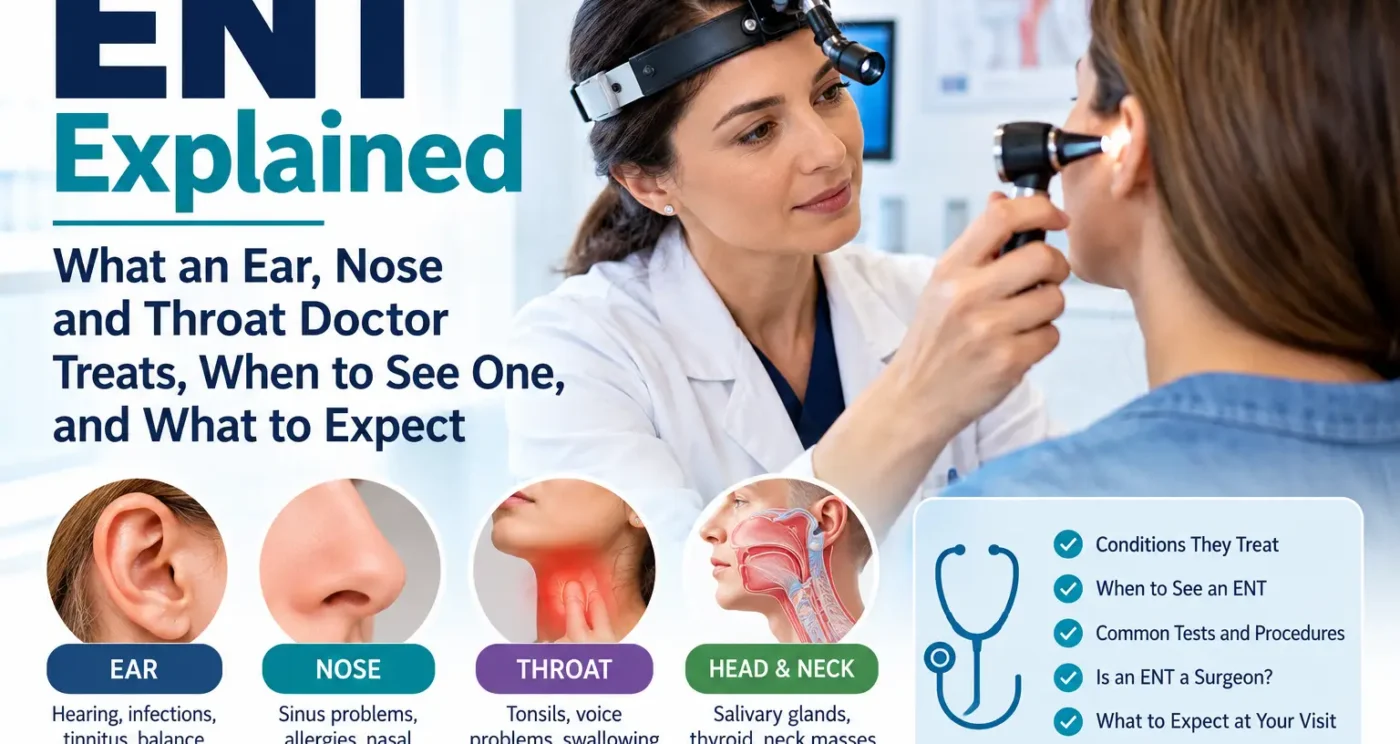
You wake up with a blocked ear, your voice has been hoarse for weeks, or another sinus infection seems to be starting. At that point, a common question is not just “What is causing this?” but “Is this something my primary care clinician can handle, or do I need an ENT?”
ENT stands for ear, nose, and throat. The formal specialty is otolaryngology-head and neck surgery, and an ENT doctor is an otolaryngologist. The name sounds narrow, but the specialty is not. ENT physicians care for problems involving the ears, hearing and balance, the nose and sinuses, the throat and voice box, swallowing, the upper airway, and many structures of the head and neck. They are trained in both medical and surgical treatment. The American Academy of Otolaryngology-Head and Neck Surgery describes otolaryngologists as physicians who manage disorders of the ears, nose, throat, and related head and neck structures in both adults and children.
That does not mean every stuffy nose, sore throat, or earache needs specialist care. Many short-lived problems can start in primary care. ENT becomes especially useful when symptoms keep returning, do not resolve as expected, affect hearing or breathing, suggest a structural problem, or require a procedure or more specialized examination.
ENT at a Glance
| Question | Quick answer |
| What does ENT stand for? | Ear, nose, and throat. |
| What is the formal specialty? | Otolaryngology-head and neck surgery. |
| Is an ENT a physician? | Yes. An otolaryngologist is a physician trained in medical and surgical care. |
| What can an ENT treat? | Ear and hearing problems, sinus and nasal disorders, tonsil and throat conditions, voice and swallowing problems, selected sleep-related airway disorders, and head and neck disease. |
| Do all ENT problems need surgery? | No. Many are treated with medication, observation, rehabilitation, office procedures, or coordinated care. |
| When is ENT urgent? | Examples include sudden unexplained hearing loss and serious breathing or airway symptoms. |
What Does ENT Mean?
ENT is the everyday name for the specialty that treats disorders of the ear, nose, and throat. The formal term, otolaryngology, is longer because the field covers much more than those three body parts. “Head and neck surgery” is often included in the specialty name because ENTs also diagnose and treat conditions involving structures such as the larynx, oral cavity, salivary glands, thyroid and parathyroid glands, facial structures, and neck masses.
You may therefore see several terms on appointment schedules or insurance directories: ENT doctor, ENT physician, otolaryngologist, otolaryngologist-head and neck surgeon, or ear, nose and throat specialist. In everyday patient care, these usually refer to physicians in the same specialty. Individual doctors may focus more narrowly on areas such as ear surgery, pediatric ENT, sinus disease, voice disorders, sleep surgery, facial plastic surgery, or head and neck cancer.
What Does an ENT Doctor Treat?
An ENT appointment may begin with a symptom that seems small: muffled hearing, nasal blockage, ringing in one ear, repeated tonsil infections, or a voice that will not return to normal. The specialist’s job is to work out whether the problem is infectious, inflammatory, structural, neurologic, allergic, related to hearing or balance, or part of a broader head and neck condition.
Common reasons people are evaluated in ENT include:
- Recurrent or complicated ear infections
- Hearing loss or a significant change in hearing
- Tinnitus, especially when persistent, one-sided, pulsatile, or associated with hearing changes
- Vertigo or balance symptoms that may involve the inner ear
- Chronic or recurrent sinus symptoms
- Persistent nasal obstruction or a deviated septum
- Nasal polyps, recurrent nosebleeds, or loss of smell
- Recurrent tonsillitis or enlarged tonsils and adenoids
- Persistent hoarseness or other voice changes
- Swallowing difficulty
- Snoring or suspected upper-airway obstruction
- Salivary gland problems
- Thyroid, parathyroid, or other neck masses within the ENT specialist’s scope
- Benign or malignant tumors involving the head and neck
The exact scope varies by clinician and practice. An ENT may also work closely with audiologists, speech-language pathologists, allergists, neurologists, pulmonologists, gastroenterologists, dentists, oncologists, and primary care professionals.
Ear Problems: Hearing, Infections, Tinnitus, and Balance
Ear complaints are one of the clearest reasons people think of ENT care, but there is a wide range between a routine earache and a complex inner-ear disorder.
An ENT may evaluate recurrent middle-ear infections, persistent fluid behind the eardrum, eardrum perforation, chronic drainage, ear-canal problems, cholesteatoma, hearing loss, tinnitus, dizziness, and certain balance disorders. Some of these conditions are treated medically. Others may require hearing testing, a procedure, surgery, or care shared with an audiologist.
The National Institute on Deafness and Other Communication Disorders distinguishes the roles clearly: an otolaryngologist provides medical and surgical diagnosis and treatment, while an audiologist specializes in testing hearing, identifying the type and degree of hearing loss, and providing hearing rehabilitation and devices such as hearing aids.
Sudden Hearing Loss Is Different From Gradual Hearing Loss
A sudden unexplained drop in hearing should not be treated like ordinary ear congestion. Sudden sensorineural hearing loss can develop all at once or over a few days, often in one ear. People sometimes assume it is wax, allergies, or a sinus problem and wait to see whether it clears.
NIDCD describes sudden sensorineural hearing loss as a medical emergency and advises immediate medical evaluation. Timely diagnosis matters because treatment may be less effective when care is delayed. If hearing suddenly drops, especially with ear fullness, tinnitus, or dizziness, seek urgent medical attention rather than waiting for a routine ENT appointment weeks later.
What About Tinnitus and Vertigo?
Tinnitus means hearing sound when there is no external source, often described as ringing, buzzing, humming, or hissing. It can have many causes. The NIDCD tinnitus guide notes that people may be referred to both an ENT and an audiologist, depending on the presentation.
Vertigo and balance problems are also not automatically “an ear problem.” The vestibular system in the inner ear is one possible source, but dizziness can have neurologic, cardiovascular, medication-related, metabolic, and other causes. NIDCD notes that balance evaluations may involve an otolaryngologist and an audiologist and can require more than one type of test. Persistent, recurrent, severe, or neurologically associated dizziness deserves medical assessment rather than self-diagnosis.
Nose and Sinus Problems
A blocked nose is not always a sinus infection. Congestion can come from a viral illness, allergic or nonallergic rhinitis, a deviated septum, nasal polyps, medication effects, swelling inside the nose, or other conditions. If nasal symptoms have been dragging on for months, repeatedly returning, or affecting normal breathing and sleep, an ENT evaluation can help sort out what is actually happening.
For more background on nasal symptoms and the difference between allergy-type symptoms and other causes, see MedIntelHub’s Sniffles Explained guide.
Not Every Sinus Symptom Means a Bacterial Infection
This is one of the most common ENT misconceptions. Colored drainage by itself does not prove that a sinus problem is bacterial or that antibiotics are needed. The 2025 AAO-HNS adult sinusitis guideline update emphasizes diagnostic accuracy, conservative treatment when appropriate, and more thoughtful antibiotic use.
The Academy’s patient material explains that acute viral sinusitis is more likely when symptoms have been present for fewer than 10 days and are not worsening. Acute bacterial sinusitis becomes more likely when symptoms fail to improve for at least 10 days or worsen after beginning to improve. Those patterns are more useful than mucus color alone.
ENT referral may be useful when sinus infections repeatedly return, symptoms persist between episodes, nasal obstruction is chronic, polyps are suspected, smell remains reduced, the diagnosis is unclear, or treatment has not produced the expected improvement.
Throat, Tonsil, Voice, and Swallowing Problems
ENT specialists also evaluate problems that sit deeper than a quick look at the back of the mouth can reveal. That includes recurrent tonsillitis, enlarged tonsils or adenoids, chronic throat symptoms, voice disorders, swallowing difficulty, and certain laryngeal conditions.
A single sore throat usually does not require ENT care. Recurrent infections, an abscess, persistent asymmetry, obstructive tonsils, or repeated problems that disrupt sleep, eating, school, or work are different. MedIntelHub’s strep throat guide explains why symptoms alone cannot reliably confirm group A strep and why testing can matter when strep is suspected.
Persistent Hoarseness Should Be Evaluated
Most voice changes from a short respiratory infection improve as the illness resolves. A voice that stays hoarse is a different situation. The AAO-HNS 2026 dysphonia quality measure calls for laryngeal examination or referral when dysphonia has persisted beyond four weeks, and it supports earlier visualization when a serious cause is suspected. The purpose is not to assume the worst; it is to avoid repeatedly treating a persistent voice problem without seeing the larynx.
Hoarseness can arise from benign problems such as inflammation, voice overuse, reflux-related irritation, benign vocal-fold lesions, or medication effects. It can also occur with vocal-fold weakness and, less commonly, cancer. The AAO-HNS dysphonia measure reflects the importance of timely laryngeal examination when symptoms do not resolve.
ENT and Head and Neck Conditions
The “head and neck surgery” part of the specialty matters when symptoms extend beyond the ears, nose, and throat. Depending on training and subspecialty, ENT physicians may evaluate salivary gland disease, thyroid or parathyroid conditions, unexplained neck masses, mouth or throat lesions, and head and neck tumors.
Most neck lumps and throat symptoms are not cancer. Still, persistent findings should not be ignored. The National Cancer Institute lists warning symptoms of head and neck cancers that can include a neck lump, a mouth or throat sore that does not heal, persistent sore throat, difficulty swallowing, and voice changes or hoarseness. These symptoms can also have noncancerous causes, so the goal is evaluation rather than self-diagnosis.
Snoring is common, but loud habitual snoring accompanied by pauses in breathing, choking or gasping during sleep, restless sleep, or marked daytime sleepiness can raise concern for obstructive sleep apnea. An ENT may assess whether nasal obstruction, tonsil or adenoid enlargement, or other upper-airway anatomy contributes to the problem.
The ENT Health information on snoring and sleep apnea notes that ENT examination can include the nose, mouth, throat, palate, and neck, sometimes using a flexible scope, while a sleep study may be needed to determine whether snoring is actually obstructive sleep apnea. ENT is only one part of sleep-apnea care; many patients are managed collaboratively with sleep medicine and other clinicians.
Pediatric ENT: Why Children See Ear, Nose and Throat Specialists
Children often see ENT specialists for a different mix of problems than adults. Recurrent ear infections, persistent middle-ear fluid, hearing concerns, enlarged tonsils and adenoids, chronic nasal obstruction, sleep-disordered breathing, airway problems, and congenital head and neck conditions are common pediatric ENT issues.
Tonsils and adenoids can become a focus when they are repeatedly infected or enlarged enough to interfere with breathing or sleep. The ENT Health overview of tonsils and adenoids explains that enlargement may contribute to mouth breathing, nasal obstruction, snoring, restless sleep, or pauses in breathing. Surgery is not automatic; the decision depends on the child’s symptoms, examination, infection pattern, sleep concerns, hearing, and other clinical factors.
ENT vs. Primary Care, Audiology, Allergy, and Speech-Language Pathology
One of the hardest parts for patients is deciding which professional to see first. There is overlap, but the roles are not interchangeable.
| Professional | Typical role | Examples of when they may be involved |
| Primary care clinician | First-line evaluation for many common acute and chronic problems | Earache, short-duration sore throat, uncomplicated cold symptoms, initial hearing complaint, medication review, general evaluation and referral |
| ENT / otolaryngologist | Medical and surgical evaluation of ear, nose, throat, airway, and head-and-neck disorders | Recurrent infections, structural blockage, chronic sinus disease, persistent hoarseness, complex ear disease, selected swallowing/airway problems, procedures |
| Audiologist | Hearing and vestibular testing and rehabilitation | Audiograms, hearing-aid evaluation, hearing rehabilitation, selected balance testing |
| Allergist / immunologist | Evaluation of allergic and immunologic disease | Persistent allergic rhinitis, asthma with allergy, unclear triggers, consideration of allergy testing or immunotherapy |
| Speech-language pathologist | Evaluation and therapy for communication, voice, and swallowing functions | Voice therapy, swallowing rehabilitation, speech or communication concerns |
A referral may move between these professionals. For example, someone with hearing loss may start with primary care, see an audiologist for testing, and see ENT if there is a medical or surgical cause to evaluate. Someone with persistent voice changes may be examined by ENT and then receive voice therapy from a speech-language pathologist.
When Should You See an ENT?
There is no single symptom list that decides every referral. Duration, severity, recurrence, age, examination findings, and medical history all matter. In general, an ENT discussion becomes more reasonable when a problem is persistent, recurrent, one-sided, structurally suspicious, affecting an important function, or not responding as expected to appropriate first-line care.
Examples include:
- Repeated ear infections or persistent ear drainage
- Hearing loss that is unexplained, asymmetric, or worsening
- Ongoing tinnitus, particularly when one-sided or pulsatile
- Recurring vertigo or balance symptoms that may involve the inner ear
- Sinus symptoms that repeatedly return or persist for months
- Chronic nasal blockage, suspected polyps, or a known deviated septum causing symptoms
- Recurrent nosebleeds that need evaluation
- Repeated tonsillitis or enlarged tonsils/adenoids affecting breathing, swallowing, or sleep
- Hoarseness lasting more than about four weeks, or sooner when there are concerning features
- Persistent swallowing difficulty
- A neck lump, persistent throat lesion, or other unexplained head-and-neck finding
- Snoring with suspected sleep apnea or upper-airway obstruction
A referral does not prove that a serious disorder is present. It simply means a more specialized examination or test may be useful.
When Primary Care May Be the Better First Stop
Not every ENT-area symptom needs a specialist. Primary care is often an appropriate starting point for a first uncomplicated ear infection, a short-lived sore throat, a typical viral upper-respiratory illness, mild temporary congestion, or an initial hearing concern. A primary care clinician can look for wax, infection, medication effects, common respiratory causes, and other straightforward explanations and then decide whether specialty care is needed.
A routine preventive visit, however, is not the same as a problem-focused appointment. If a new ear, nose, throat, hearing, or breathing concern is significant, do not assume it will be fully addressed during a yearly checkup. MedIntelHub’s guide to what happens during an annual physical explains why preventive visits and visits for a specific medical problem can have different goals.
When ENT Symptoms Need Urgent or Emergency Care
Some symptoms should bypass the ordinary referral process.
Seek urgent or emergency evaluation for sudden unexplained hearing loss. NIDCD specifically treats sudden sensorineural hearing loss as a medical emergency because prompt diagnosis and treatment can affect the chance of hearing recovery.
Serious breathing difficulty is also not a routine ENT-office problem. MedlinePlus advises emergency care when breathing difficulty begins suddenly or seriously interferes with breathing or talking. Unexplained stridor – a high-pitched sound caused by narrowed airflow – can also be an emergency, especially in a child. See the MedlinePlus breathing-difficulty guidance and stridor guidance for general emergency information.
Other situations may require prompt assessment depending on severity, including rapidly increasing facial or neck swelling, significant uncontrolled bleeding, a suspected inhaled foreign object, or severe swallowing difficulty. If symptoms are rapidly worsening or you are unsure whether an airway is safe, emergency assessment is more appropriate than waiting for a standard specialist appointment.
What Happens at an ENT Appointment?
Most ENT visits begin with history, not a scope. The doctor will want to know what the symptom is doing over time and how it affects hearing, breathing, sleep, swallowing, voice, work, or daily life.
Useful details include when the problem started, whether it is constant or episodic, whether one side is worse, what treatments have already been tried, what helped, what did not, and whether there are associated symptoms such as fever, drainage, tinnitus, dizziness, facial pressure, weight loss, or sleep disruption.
The Physical Examination
The exact exam depends on the complaint. The ENT may inspect the ears and eardrums, nose, mouth, throat, neck, and facial structures. A tuning fork may occasionally be used for a quick hearing distinction, but formal hearing assessment requires audiologic testing. Neck examination can include the thyroid, salivary glands, lymph nodes, and other structures when relevant.
Hearing Tests
If hearing is part of the concern, an audiogram may measure hearing at different frequencies and speech levels. Other tests can assess middle-ear function or parts of the balance system. The right test depends on whether the concern is hearing loss, ear pressure, tinnitus, vertigo, or another symptom.
Nasal Endoscopy
A nasal endoscopy uses a thin rigid or flexible instrument with a light and camera to look deeper inside the nose than an ordinary front-of-nose examination can. The MedlinePlus nasal endoscopy guide describes its use in problems such as recurrent sinus symptoms, nasal drainage, breathing difficulty through the nose, nosebleeds, loss of smell, polyps, or suspected blockage. It is not required for every sinus complaint.
Laryngoscopy
Laryngoscopy allows the clinician to see the larynx and vocal folds. A common office technique uses a small flexible scope passed through the nose while the patient is awake. MedlinePlus notes that flexible nasolaryngoscopy is commonly used to examine the voice box and can be performed in an office setting. See the MedlinePlus laryngoscopy overview for a patient-oriented description.
Imaging and Other Tests
CT, MRI, ultrasound, laboratory testing, biopsy, allergy testing, sleep studies, and other investigations may be useful in selected cases, but they are not routine for every ENT symptom. For example, uncomplicated acute rhinosinusitis generally does not need imaging unless a complication or another diagnosis is suspected. Testing should answer a clinical question rather than simply add more tests.
Does Seeing an ENT Mean You Will Need Surgery?
No. The fact that the formal specialty includes “head and neck surgery” can make a first ENT appointment sound more dramatic than it is. Many conditions are treated with medication, observation, hearing rehabilitation, voice or swallowing therapy, allergy management, lifestyle changes, or office procedures.
Surgery becomes relevant when there is a specific reason that medical care cannot adequately address. Examples may include certain chronic ear conditions, obstructive tonsils or adenoids, symptomatic structural nasal obstruction, selected chronic sinus disease, some head and neck masses, and other conditions where an operation is expected to provide meaningful benefit.
Common ENT procedures include ear-tube placement, tonsillectomy, adenoidectomy, septoplasty, selected sinus procedures, surgery to repair or reconstruct parts of the ear, and operations involving thyroid, salivary, or other head and neck structures. The procedure that makes sense for one patient may be inappropriate for another with similar-sounding symptoms.
Do You Need a Referral to See an ENT?
Sometimes, but not always. Referral requirements depend on the healthcare system, insurance plan, network rules, and local specialist policies. Some plans allow patients to schedule directly with an in-network ENT, while others require a primary care referral for coverage or authorization purposes.
Before scheduling, it is reasonable to ask the ENT office whether a referral is needed and to confirm the specialist’s network status with the health plan. A clinician may also recommend a referral even when the insurance plan does not formally require one, because the referral can communicate relevant history, previous treatment, and test results.
How to Prepare for an ENT Appointment
A good ENT visit does not require a medical binder. A short, accurate timeline is usually more useful than a long list of guesses about what the diagnosis might be.
Consider bringing or writing down:
- When the symptom began and whether it is constant or comes and goes
- Which side is affected, if one side is worse
- Previous ear infections, sinus infections, tonsil problems, or similar episodes
- Medication, nasal spray, antibiotic, or other treatments already tried
- An updated medication and supplement list
- Previous hearing tests, imaging, sleep-study results, or operative reports when relevant
- Known allergies and major medical conditions
- A short list of the questions you most want answered
If you are preparing for a referral, MedIntelHub’s specialist appointment guide offers a simple way to organize symptoms, medications, previous results, and questions without overpreparing.
Questions Worth Asking the ENT
- What are the most likely causes of my symptoms?
- Is there anything on the examination that changes how urgent this is?
- Do I need a hearing test, scope, scan, sleep study, or other test? What will it help answer?
- What can reasonably be tried before a procedure or surgery?
- If surgery is an option, what problem is it intended to correct?
- What symptoms should make me call sooner or seek urgent care?
- When should I follow up if the problem does not improve?
Common ENT Misconceptions
“ENT and otolaryngology are different specialties.”
They are two names for the same medical specialty. ENT is simply the shorter term most patients use.
“An ENT only treats infections.”
Infections are only one part of the field. ENTs also treat structural disorders, hearing and balance problems, voice and swallowing conditions, sleep-related airway problems, and head and neck disease.
“If I see an ENT, I will probably need surgery.”
Most first visits are diagnostic. The treatment may be observation, medication, therapy, rehabilitation, an office procedure, or surgery depending on the cause.
“Green or yellow mucus proves I need antibiotics.”
It does not. Duration and symptom pattern are more useful for distinguishing likely viral from bacterial acute sinusitis. The 2025 AAO-HNS guidance emphasizes avoiding unnecessary antibiotics and using evidence-based diagnostic patterns.
“An audiologist and an ENT do the same job.”
Their work overlaps, but their training differs. Audiologists specialize in hearing and vestibular assessment and rehabilitation. ENTs are physicians who diagnose and medically or surgically treat ear and related head-and-neck disorders.
“Hoarseness is harmless if it does not hurt.”
Pain is not required for a voice problem to deserve evaluation. Persistent hoarseness – especially beyond about four weeks or with other concerning symptoms – should be assessed rather than repeatedly ignored.
Frequently Asked Questions About ENT
What does ENT stand for?
ENT stands for ear, nose, and throat. The formal specialty is otolaryngology-head and neck surgery.
Is an ENT the same as an otolaryngologist?
Yes. ENT is the common name for an otolaryngologist or otolaryngologist-head and neck surgeon.
Is an ENT a surgeon?
Yes. Otolaryngologists are physicians trained in both medical and surgical management. Seeing one does not mean surgery will be recommended.
What problems does an ENT doctor treat?
Common areas include ear infections and hearing problems, sinus and nasal disease, tonsil and throat conditions, voice and swallowing disorders, selected sleep-related airway problems, and head-and-neck conditions.
Can an ENT treat sinus infections?
Yes, particularly recurrent, chronic, complicated, or diagnostically unclear sinus problems. Many uncomplicated acute sinus infections can begin with primary care.
Does an ENT treat allergies?
ENT physicians may manage nasal allergy symptoms, especially when they overlap with sinus disease or structural nasal problems. An allergist may be more appropriate when broader allergy or immunology evaluation is needed.
Does an ENT treat vertigo?
Some vertigo and balance disorders arise from the inner ear and fall within ENT care. Because dizziness has many possible causes, evaluation may also involve primary care, audiology, neurology, cardiology, or other specialties.
Does an ENT treat tinnitus?
Yes, ENTs often evaluate tinnitus when a medical ear cause needs to be considered. Audiologists may also perform hearing tests and help with tinnitus-focused management.
Can an ENT help with snoring?
Yes, especially when nasal obstruction, tonsils, adenoids, or other upper-airway anatomy may contribute. Snoring can also be a sign of obstructive sleep apnea, which may require a sleep study and multidisciplinary care.
Should I see an ENT for a sore throat?
A single short-lived sore throat usually does not need ENT care. Recurrent tonsillitis, persistent symptoms, abscess, swallowing problems, structural concerns, or other red flags may justify referral.
How long should hoarseness last before I see someone?
Short-term hoarseness often improves with a respiratory illness. Current AAO-HNS guidance supports laryngeal examination or referral when dysphonia lasts more than four weeks, or sooner if a serious cause is suspected.
What happens during an ENT appointment?
The visit usually includes a detailed history and focused examination. Depending on the complaint, hearing testing, nasal endoscopy, laryngoscopy, imaging, or other tests may be recommended.
Will a nasal scope or throat scope hurt?
Office endoscopy usually causes pressure, a strange sensation, or temporary discomfort rather than significant pain. Numbing and decongestant sprays are often used when appropriate.
Do I need a referral to see an ENT?
It depends on your insurance plan, healthcare system, and specialist. Check both the ENT office and your health plan if coverage or referral rules are unclear.
When is an ENT problem an emergency?
Sudden unexplained hearing loss and serious breathing or airway symptoms are important examples. Rapidly worsening swelling, major uncontrolled bleeding, or a suspected airway foreign body can also require urgent or emergency care.
The Bottom Line
An ENT doctor is not simply the person you see after too many sinus infections. Otolaryngologists are physicians and surgeons who care for disorders involving hearing and balance, the ears, nose and sinuses, throat and voice, swallowing, upper airway, and many head and neck structures.
For routine, short-lived symptoms, primary care is often a reasonable place to start. ENT becomes more useful when symptoms are persistent, recurrent, one-sided, structurally complex, affecting hearing, breathing, sleep, voice, or swallowing, or not improving with appropriate first-line care.
A few symptoms should not wait for a routine referral. Sudden unexplained hearing loss needs urgent medical evaluation, and serious breathing difficulty or stridor may require emergency care. Persistent hoarseness, unexplained neck lumps, swallowing difficulty, and other ongoing head-and-neck symptoms also deserve timely evaluation rather than indefinite observation.
Resources
American Academy of Otolaryngology-Head and Neck Surgery — What Is an Otolaryngologist?
Overview of the specialty, its medical and surgical scope, and the structures and conditions otolaryngologists manage.
AAO-HNS: What Is an Otolaryngologist?
American Academy of Otolaryngology-Head and Neck Surgery — Clinical Practice Guideline: Adult Sinusitis Update
Current 2025 evidence-based guidance on identifying and managing adult sinusitis, including diagnostic accuracy and appropriate use of antibiotics and testing.
AAO-HNS Adult Sinusitis Guideline
American Academy of Otolaryngology-Head and Neck Surgery — Dysphonia: Laryngeal Examination+
2026 quality-measure guidance reflecting the recommendation for laryngeal examination or referral when dysphonia persists beyond four weeks.
AAO-HNS Dysphonia Laryngeal Examination
National Institute on Deafness and Other Communication Disorders — Sudden Deafness
Explains sudden sensorineural hearing loss, why it is treated as a medical emergency, how it is diagnosed, and why timely care matters.
National Institute on Deafness and Other Communication Disorders — Hearing Loss Professionals
Explains the distinct roles of primary care clinicians, otolaryngologists, audiologists, and hearing instrument specialists.
NIDCD Hearing Loss Professionals
MedlinePlus — Nasal Endoscopy
Patient-oriented overview of how nasal endoscopy is performed, why it may be used, and what to expect.
MedlinePlus — Laryngoscopy and Nasolaryngoscopy
Overview of common methods for examining the larynx and vocal folds, including flexible office laryngoscopy.
Editorial Guidelines & Medical Disclaimer
MedIntelHub provides educational and informational health content. This article explains the role of ear, nose, and throat specialists and common reasons people may be referred for ENT care; it does not diagnose the cause of an individual reader’s symptoms or determine whether a particular person needs a procedure, medication, test, or surgery.
ENT symptoms can overlap with primary care, allergy, audiology, neurology, sleep medicine, dentistry, gastroenterology, pulmonology, oncology, and other areas of medicine. The appropriate clinician and urgency depend on the symptom pattern, duration, examination findings, age, medical history, and local healthcare system.
Medication decisions should be made with an appropriate healthcare professional. Do not start, stop, or change prescription treatment based only on general online information. Antibiotic use for sinus or throat symptoms should be based on an appropriate clinical assessment rather than mucus color or symptom assumptions alone.
Sudden unexplained hearing loss, serious breathing difficulty, stridor, rapidly worsening airway symptoms, significant uncontrolled bleeding, or other severe symptoms may require urgent or emergency evaluation. If a symptom is severe or rapidly worsening, seek appropriate medical care rather than waiting for a routine specialist appointment.
Clinical recommendations, referral pathways, insurance requirements, and coverage policies can change and can differ by location and payer. This article uses authoritative medical and public-health sources, including AAO-HNS, NIDCD, NCI, and MedlinePlus. Readers can review MedIntelHub’s Editorial Policy for information about sourcing, review, updates, and educational guidance.

David Bennett
David Bennett is an author at MedIntelHub, where he creates clear, practical, and well-researched content about healthcare, medical billing, insurance, and patient education. His goal is to make complex healthcare topics easier for readers to understand and use in everyday situations. David emphasizes accuracy, transparency, and reliable sourcing, using information from trusted organizations and official healthcare resources whenever possible. Content published by David is intended for educational purposes and should not replace advice from qualified medical, legal, or healthcare professionals.