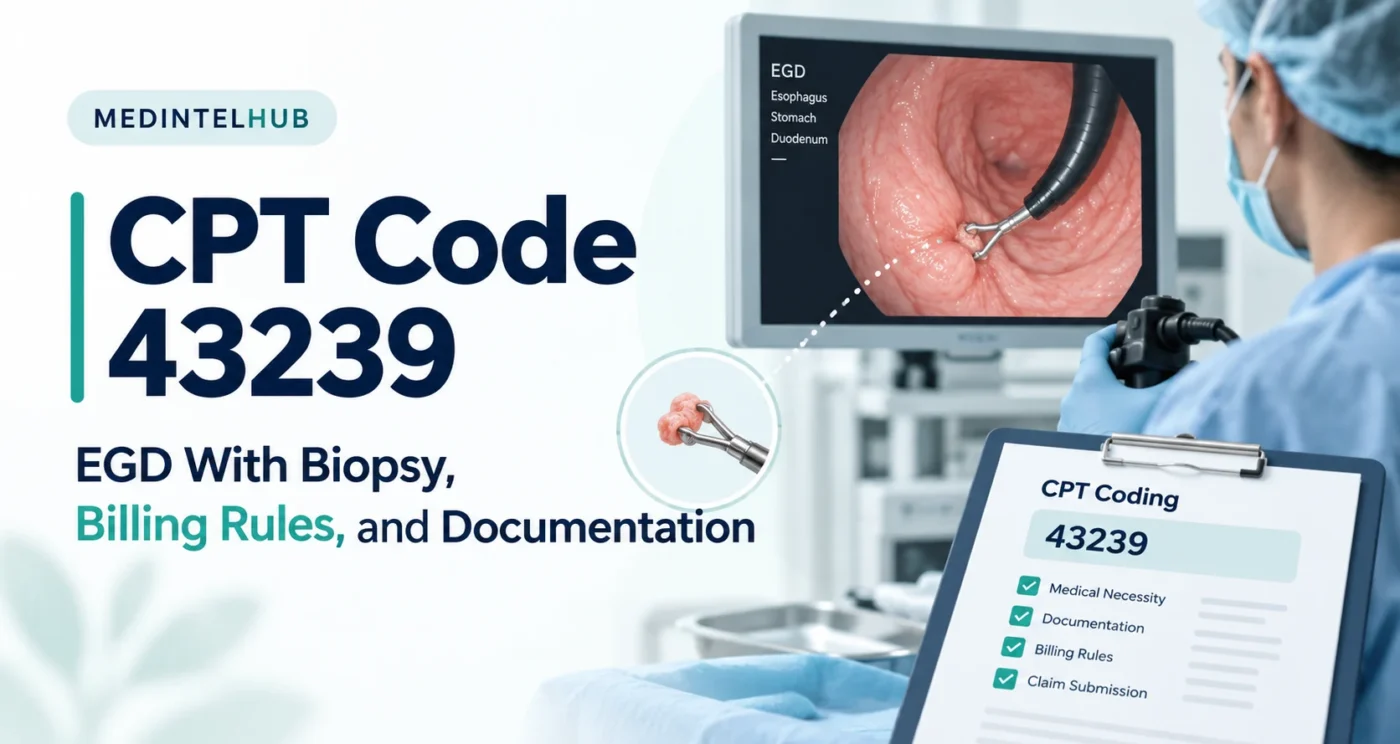
CPT® code 43239 is used when a flexible transoral upper gastrointestinal endoscopy, commonly called an EGD, includes biopsy sampling. The code selection sounds straightforward, but many claim problems arise after the procedure: whether diagnostic EGD should be reported separately, whether multiple biopsy sites mean multiple units, when another endoscopic service can also be billed, and whether documentation supports the code that reaches the claim.
For 2026 claims, those questions should be answered with the current CPT code set, Medicare National Correct Coding Initiative (NCCI) edits and policy, the applicable payer’s rules, and the actual procedure note. A valid CPT code does not by itself guarantee coverage or payment.
CPT 43239 at a Glance
| Question | Practical answer |
| What type of code is 43239? | A CPT procedure code in the EGD/endoscopy family. |
| What does it generally describe? | Flexible transoral EGD in which one or more tissue biopsies are obtained. |
| Is a separate diagnostic EGD usually billed with it? | No. The diagnostic examination is ordinarily included in the more comprehensive endoscopic biopsy service. |
| Do several biopsy specimens automatically mean several units? | No. The code is structured for biopsy, single or multiple, during the qualifying EGD session. |
| Does the code guarantee coverage? | No. Documentation, medical necessity, payer policy, benefit design, and claim edits still matter. |
| Should 2026 edits be checked? | Yes. Medicare NCCI files are updated quarterly, and commercial or Medicaid payers may apply different rules. |
What Is CPT Code 43239?
CPT 43239 identifies an esophagogastroduodenoscopy (EGD) performed through the mouth with tissue biopsy. In practical terms, the clinician advances a flexible endoscope through the upper digestive tract, inspects the mucosa, and obtains one or more tissue samples for diagnostic analysis.
CMS data continue to identify 43239 as an EGD biopsy service for a single or multiple biopsies. AAPC’s public code summary likewise describes upper endoscopy with one or more tissue specimens obtained from the esophagus, stomach, or duodenum. The exact official CPT descriptor remains proprietary to the American Medical Association, so practices should verify the current 2026 codebook or another properly licensed CPT resource before claim submission.
For a broader overview of annual code-set changes, see MedIntelHub’s 2026 CPT Code Changes: What Providers Need to Know.
What an EGD Examines
EGD is short for esophagogastroduodenoscopy. The procedure allows direct visualization of the upper gastrointestinal tract, generally including the esophagus, stomach, and duodenum. During the same session, the physician may perform only a diagnostic examination or may add a therapeutic or diagnostic intervention such as biopsy, dilation, removal of a foreign body, hemostasis, or lesion removal.
The intervention actually performed matters for code selection. A scheduled biopsy does not justify 43239 if no biopsy was ultimately obtained, and a biopsy technique should not be confused with another tissue-removal method that has its own code.
CPT 43239 vs. CPT 43235
| Code | General role | Key distinction |
| 43235 | Diagnostic flexible transoral EGD | Used when the examination is diagnostic and no separately coded therapeutic/biopsy service replaces it. |
| 43239 | Flexible transoral EGD with biopsy | The diagnostic inspection is part of the biopsy service; the biopsy is the distinguishing work. |
One of the most common coding errors is treating the diagnostic examination and the biopsy as two independent procedures. Medicare NCCI policy follows the general rule that a diagnostic endoscopy is included in a surgical or more extensive endoscopic service when both occur in the same endoscopic session. In an EGD with biopsy, the diagnostic visualization is not normally separated and billed as though it were a second procedure.
That means a typical EGD in which the physician examines the upper GI tract and then takes gastric or esophageal biopsies points to the biopsy code rather than a diagnostic EGD code plus a biopsy code combination.
Can CPT 43235 and 43239 Be Billed Together?
Ordinarily, no. Reporting 43235 simply because the physician first inspected the upper GI tract and then performed a biopsy would fragment one endoscopic service into components. CMS NCCI policy instructs providers to use the most comprehensive code that describes the service and not to unbundle component work.
Unusual circumstances should be evaluated against the current CPT instructions, NCCI Procedure-to-Procedure edits, documentation, and payer policy. A modifier should not be added merely because a claim edit blocks payment.
Single Versus Multiple Biopsies: How Units Work
The phrase that causes the most confusion is “single or multiple.” It means the biopsy service can encompass more than one tissue sample obtained during the qualifying endoscopic session. It does not mean each specimen, each jar, or each anatomical site automatically creates another unit of 43239.
For example, a physician might obtain specimens from the distal esophagus, stomach, and duodenum during the same EGD. Those separate specimens may be clinically important and should be documented, but the number of jars sent to pathology is not by itself a reason to multiply the endoscopy code.
Before reporting additional units or unusual billing, check the current Medicare Medically Unlikely Edit (MUE) file when Medicare is the payer and the applicable policy for non-Medicare plans. CMS updates NCCI edit files during the year, so older screenshots, cheat sheets, or static coding blogs should not replace the current files.
Documentation Requirements for CPT 43239
The procedure note should tell a reviewer what was done, where it was done, and why. A claim for 43239 is strongest when the note supports both the endoscopic examination and the biopsy work without relying on assumptions from the pathology report.
- The indication for the EGD and the clinical question being evaluated.
- The route and extent of the endoscopic examination.
- Relevant findings in the esophagus, stomach, duodenum, or other examined area.
- The site or sites from which tissue was obtained.
- The biopsy technique or device, when relevant to distinguish biopsy from another removal method.
- Whether specimens were obtained and sent for analysis.
- Any additional endoscopic procedure performed during the same session.
- Any limitation, incomplete examination, complication, or change in the planned procedure that could affect coding.
Pathology documentation is related but separate. The pathology report can confirm what tissue was examined microscopically, but the endoscopist’s own procedure documentation should support the endoscopic biopsy code.
Clinical Situations in Which an EGD With Biopsy May Be Used
Biopsy during upper endoscopy can be appropriate in many clinical settings. The presence of a biopsy does not mean cancer is suspected, and tissue may be sampled even when the mucosa does not show a dramatic visible abnormality.
- Evaluation of abnormal or inflamed esophageal, gastric, or duodenal mucosa.
- Assessment of suspected celiac disease or other mucosal disorders when tissue sampling is clinically indicated.
- Evaluation or surveillance of conditions such as Barrett’s esophagus when biopsy is part of the clinical plan.
- Sampling of ulcers, masses, nodules, or other lesions when tissue diagnosis is needed.
- Evaluation of symptoms or findings in which histology may help establish or exclude a diagnosis.
Clinical indications alone do not determine reimbursement. The diagnosis, documentation, medical necessity, payer policy, and benefit rules still have to align for the claim being submitted.
ICD-10-CM Diagnosis Coding and Medical Necessity
A CPT code describes the procedure; the diagnosis coding explains the condition, symptom, finding, or reason for the service. The two parts of the claim need to make clinical sense together, but there is no single universal ICD-10-CM diagnosis that “guarantees” payment for 43239.
Medicare coverage can depend on the patient’s circumstances and the local policies of the Medicare Administrative Contractor (MAC). Commercial insurers and Medicaid programs may use different medical-necessity criteria, prior-authorization rules, or claims edits. Coders should therefore distinguish four separate questions:
- Does the documentation support the CPT service reported?
- Does the diagnosis coding accurately represent the clinical reason for the procedure?
- Does the payer consider the service medically necessary or covered in this circumstance?
- Does the claim meet the payer’s coding, authorization, frequency, and reimbursement rules?
A correct CPT code and a valid ICD-10-CM code do not override an exclusion, missing authorization, benefit limitation, or payer-specific policy.
Modifier 59 and the X{EPSU} Modifiers
Modifier 59 is frequently misunderstood in gastrointestinal endoscopy billing. Its purpose is not to force payment for two codes that are normally bundled. Under Medicare NCCI, a modifier associated with a PTP edit may be appropriate only when the services are genuinely distinct under the applicable rules and the medical record supports that distinction.
CMS also recognizes the more specific X{EPSU} subset modifiers in appropriate situations: XE for a separate encounter, XP for a separate practitioner, XS for a separate structure, and XU for an unusual non-overlapping service. The exact modifier choice depends on the circumstances and payer instructions.
For 43239, the practical rule is simple: do not append modifier 59 or an X modifier solely because another endoscopy code denied. First determine whether both services are separately reportable under current CPT and NCCI logic. Then verify the documentation and the payer’s modifier policy.
Billing CPT 43239 With Other Upper-GI Endoscopy Procedures
An EGD session may involve more than a biopsy. The same encounter can include dilation, removal of a foreign body, control of bleeding, snare removal, injection, or another endoscopic intervention. Whether multiple codes may be reported depends on the procedures performed and the current edits.
CMS applies special multiple-endoscopy payment logic to many procedures in the same endoscopic family. That payment methodology is different from the basic question of whether a code pair is reportable at all. Coding teams should therefore work in this order:
- Identify every procedure actually performed and documented.
- Choose the correct CPT codes for the techniques used.
- Check current NCCI PTP edits for the date of service.
- Determine whether any edit can be bypassed in the documented circumstances.
- Apply a modifier only when supported and accepted by the payer.
- Then review the payer’s multiple-procedure or endoscopy payment methodology.
Biopsy vs. Other Tissue-Removal Techniques
Not every removal of tissue during EGD is a biopsy. Snare removal, endoscopic mucosal resection, ablation, and other techniques may fall under different code descriptions. The operative note should describe the technique clearly enough for the coder to distinguish sampling from removal or destruction of a lesion.
Coding should follow what was performed, not what the specimen container or pathology report happens to call the tissue.
Does CPT 43239 Include the Pathology Service?
No. The endoscopic biopsy service and the laboratory/pathology examination of the specimen are separate types of work. CPT 43239 describes the endoscopic procedure that obtains the tissue. A pathologist may separately evaluate the specimen when that service is ordered, performed, documented, and billable under the applicable rules.
This distinction also explains why the number of pathology specimens or containers should not automatically be converted into multiple units of the endoscopy code.
Does CPT 43239 Have a Fixed Reimbursement Amount?
There is no single universal reimbursement amount for 43239. Medicare payment can vary by year, geographic locality, facility versus nonfacility setting, and other payment-system factors. Commercial insurers may use contracted fee schedules that differ substantially from Medicare.
The amount shown on one provider’s historical Medicare claims data is not a national fee. Likewise, an allowed amount is not necessarily what the patient owes or what the practice ultimately collects. When a precise reimbursement figure is needed, use the current payer fee schedule or contract for the relevant place of service and date of service.
Common Billing and Coding Errors With CPT 43239
| Common error | Why it causes problems |
| Billing 43235 separately with 43239 | The diagnostic examination is ordinarily included in the biopsy endoscopy service. |
| Reporting extra units for extra biopsy jars | Single or multiple biopsies may be included in the endoscopic biopsy code; specimen count does not automatically equal code units. |
| Coding from the scheduled procedure | The final code should reflect the procedure actually completed. |
| Using modifier 59 as a denial fix | A modifier must represent a real, documented distinction that is permitted by the applicable edit. |
| Confusing biopsy with lesion removal | Different endoscopic techniques may map to different CPT codes. |
| Relying on pathology to prove the endoscopy | The procedure note itself should document the biopsy work. |
| Assuming Medicare policy applies to every payer | Commercial and Medicaid plans may use different coverage, authorization, and reimbursement rules. |
| Assuming a valid diagnosis guarantees coverage | Medical necessity, benefits, authorization, and payer policy remain separate questions. |
For a broader denial-prevention workflow, see MedIntelHub’s Claim Denials: Prevention and Follow-Up Checklist.
Practical Claim Examples
Example 1: Diagnostic EGD only
The physician completes a diagnostic upper endoscopy and obtains no biopsy or other separately coded intervention. In that setting, the diagnostic EGD code may be the appropriate starting point, assuming its requirements are met.
Example 2: EGD with gastric biopsy
The physician examines the esophagus, stomach, and duodenum and takes tissue samples from abnormal gastric mucosa. The biopsy endoscopy code describes the combined service; the diagnostic inspection is not normally reported as an additional stand-alone EGD.
Example 3: Biopsies from several sites
During one EGD, the physician takes samples from the distal esophagus, stomach, and duodenum. The separate anatomical sites should be documented, but multiple specimens do not automatically create multiple units of 43239.
Example 4: Biopsy plus another endoscopic intervention
The physician performs biopsy and another therapeutic procedure during the same endoscopic session. The coder should identify both techniques, check the current CPT instructions and NCCI edits, and determine whether the services are separately reportable. If a PTP edit exists, a modifier is used only when the documented circumstances meet the requirements for an allowed bypass and the payer accepts that modifier.
The EGD code family contains several procedure-specific options. The following table is intentionally paraphrased and should not replace the official CPT codebook.
| Code | General service |
| 43235 | Diagnostic flexible transoral EGD. |
| 43239 | EGD with tissue biopsy, single or multiple. |
| 43247 | EGD involving removal of a foreign body. |
| 43248 | EGD with guide-wire dilation. |
| 43249 | EGD with balloon dilation. |
| 43251 | EGD with lesion removal using snare technique. |
| 43255 | EGD with control of bleeding. |
When more than one of these services occurs during the same encounter, do not assume they are automatically payable together. Review the current codebook instructions and payer edits for the specific combination.
For another example of endoscopy coding logic, MedIntelHub also has a guide to CPT Code 52000.
2026 Medicare NCCI Considerations
CMS’s 2026 Medicare NCCI Policy Manual has a revision date of January 1, 2026. CMS states that the NCCI program is continuously refined and publishes four versions each year, effective January 1, April 1, July 1, and October 1. That makes date-of-service verification especially important for coding teams handling procedures that may be subject to PTP edits or MUEs.
For a September 2026 claim, for example, an older January edit file may no longer be the most current source. The appropriate quarterly file, payer policy, and the date of service should be checked before deciding that a code combination or unit count is acceptable.
The same principle applies to commercial and Medicaid claims: a plan may adopt NCCI logic, modify it, or apply its own edits. Medicare rules should not be presented as though they automatically govern every payer.
A Simple Pre-Submission Checklist
- Confirm that a biopsy was actually performed during the EGD.
- Make sure the procedure note identifies the biopsy site or sites and supports the technique used.
- Do not add a separate diagnostic EGD code merely because visualization occurred before biopsy.
- Do not equate multiple specimens with multiple units without checking the applicable edit and payer rule.
- Check other endoscopic procedures from the same session against current CPT instructions and NCCI PTP edits.
- Use modifier 59 or an X{EPSU} modifier only when the documented services are truly distinct and the payer permits it.
- Validate the ICD-10-CM diagnosis coding against the clinical indication.
- Confirm payer-specific medical-necessity, authorization, and reimbursement requirements.
- Use the correct rules and edit files for the actual date of service.
Frequently Asked Questions About CPT Code 43239
What does CPT code 43239 mean?
CPT 43239 is an upper-GI endoscopy code used when a flexible transoral EGD includes tissue biopsy. The code encompasses biopsy sampling performed during the qualifying endoscopic session.
What is an EGD?
EGD stands for esophagogastroduodenoscopy. It is an upper endoscopic examination used to view the esophagus, stomach, and duodenum.
What is the difference between CPT 43235 and 43239?
43235 is the diagnostic EGD code, while 43239 represents EGD with biopsy. When biopsy is performed during the same EGD, the diagnostic examination is ordinarily included rather than billed separately.
Can 43235 and 43239 be billed together?
Usually not for the same routine endoscopic session. Medicare NCCI policy generally includes the diagnostic endoscopy in the more comprehensive endoscopic service. Unusual circumstances require review of current CPT guidance, NCCI edits, documentation, and payer policy.
Can CPT 43239 be billed more than once for multiple biopsy sites?
Multiple biopsy sites or specimens do not automatically support multiple units. The code is structured for single or multiple biopsy sampling during the qualifying EGD. Check current MUE and payer rules before reporting unusual unit counts.
Does 43239 include pathology?
No. 43239 describes the endoscopic procedure used to obtain the tissue. Microscopic pathology examination is a separate service when ordered, performed, documented, and otherwise billable.
Does CPT 43239 require modifier 59?
Not routinely. Modifier 59 is appropriate only when it truthfully identifies a distinct service under the applicable coding edit and the documentation supports that distinction. It should not be appended simply to overcome a denial.
Can 43239 be billed with another EGD procedure?
Sometimes, depending on the specific procedure combination. The codes, current NCCI PTP edits, modifier indicators, documentation, and payer policy all need to be checked.
What documentation supports 43239?
The procedure note should support the EGD, the biopsy itself, the biopsy location or locations, relevant findings, and any additional endoscopic work. The record should also support the clinical indication.
Does a biopsy mean cancer is suspected?
No. Upper-GI biopsies are used for many reasons, including evaluation of inflammation, mucosal disorders, ulcers, surveillance, and other diagnostic questions.
What diagnosis code should be used with 43239?
There is no single universal diagnosis code. The ICD-10-CM code should accurately represent the patient’s documented condition, symptom, finding, or other clinical indication. Medical-necessity and coverage rules vary by payer.
Does Medicare cover CPT 43239?
Medicare may cover medically necessary EGD with biopsy when applicable requirements are met, but coverage can depend on the clinical indication, documentation, local Medicare contractor guidance, and other claim rules.
How much does Medicare pay for 43239?
There is no single national amount that applies in every circumstance. Payment varies by year, locality, setting, fee-schedule methodology, and other factors. Use the current Medicare fee schedule or payer contract for a precise estimate.
What happens if an EGD was planned with biopsy but no biopsy was taken?
Coding should reflect the procedure actually completed. The scheduled plan alone does not establish the final CPT code.
Where should coders verify current 2026 rules?
Use the current AMA CPT codebook or a properly licensed CPT resource, CMS NCCI policy and edit files for Medicare, the Medicare Coverage Database when relevant, and the individual payer’s current provider policies.
Practical Takeaway
CPT 43239 is best understood as an EGD biopsy service, not as a diagnostic EGD plus a separate biopsy line. The biggest billing risks come from unbundling the diagnostic examination, multiplying units because several specimens were collected, using modifiers as a generic denial fix, and assuming one payer’s rules apply everywhere.
A defensible claim starts with the procedure note, then moves through current CPT guidance, the date-specific NCCI edits when Medicare is involved, accurate diagnosis coding, and the payer’s own medical-necessity and reimbursement requirements.
Resources
Centers for Medicare & Medicaid Services — 2026 Medicare NCCI Policy Manual
CMS explains Medicare correct-coding principles, PTP edits, modifiers, MUE concepts, and the quarterly NCCI update process.
Centers for Medicare & Medicaid Services — 2026 Medicare NCCI Policy Manual
CMS — Medicare NCCI Procedure-to-Procedure Edits
Use the current PTP files to review code-pair edits and modifier indicators for Medicare claims.
CMS — Medicare NCCI Procedure-to-Procedure Edits
CMS — Medicare NCCI Medically Unlikely Edits
Use current MUE resources when unit reporting is in question.
CMS — Medicare NCCI Medically Unlikely Edits
CMS — Medicare Coverage Database
Search national and local Medicare coverage documents, including LCDs and billing articles relevant to a patient’s jurisdiction.
CMS — Medicare Coverage Database
American Medical Association — CPT Overview and Resources
The AMA maintains the official CPT code set and coding guidance. Use the current 2026 codebook or another properly licensed CPT resource for the official descriptor and instructions.
American Medical Association — CPT Overview and Resources
AAPC Codify — CPT 43239 Public Summary
AAPC’s public summary provides a plain-language overview of the upper-endoscopy biopsy service.
AAPC Codify — CPT 43239 Public Summary
Editorial Guidelines & Medical Disclaimer
This article is for educational and informational purposes and does not provide medical advice, diagnose a condition, or replace professional clinical judgment. It also is not a substitute for the official CPT codebook, payer manuals, coding advice from the American Medical Association, or a qualified coding/compliance professional.
Coding, billing, coverage, modifier, medical-necessity, and reimbursement requirements can change. Medicare NCCI edits may change quarterly, and Medicaid and commercial payer policies can differ. Before submitting a claim, verify the current CPT/HCPCS/ICD-10-CM resources, the rules that apply to the date of service, and the patient’s payer policy.
MedIntelHub develops health and coding content using authoritative medical, public-health, and billing sources. Review our Editorial Policy for more information about our standards.
SEO Metadata
Meta Title
Meta Description

David Bennett
David Bennett is an author at MedIntelHub, where he creates clear, practical, and well-researched content about healthcare, medical billing, insurance, and patient education. His goal is to make complex healthcare topics easier for readers to understand and use in everyday situations. David emphasizes accuracy, transparency, and reliable sourcing, using information from trusted organizations and official healthcare resources whenever possible. Content published by David is intended for educational purposes and should not replace advice from qualified medical, legal, or healthcare professionals.