A claim comes back with no insurance payment, and the remittance shows PR-204. The billing system moves the balance into the patient column. Should the practice send a statement, correct the claim, or ask the insurer to take another look?
There is no safe one-click answer. PR-204 usually points to a benefit-plan coverage issue, but the code alone does not explain whether the exclusion was applied correctly or whether the provider is allowed to collect the charge. The next step depends on the actual service, the patient’s coverage on the date of service, the complete remittance, and the applicable payer and provider rules.
For a quick answer: PR-204 means the payer processed a service, equipment item, or drug as not covered by the patient’s current benefit plan and placed the adjustment in the patient-responsibility category. Before billing anyone, check why the plan excluded the item and whether patient liability is permitted.
What Is the PR-204 Denial Code Description?
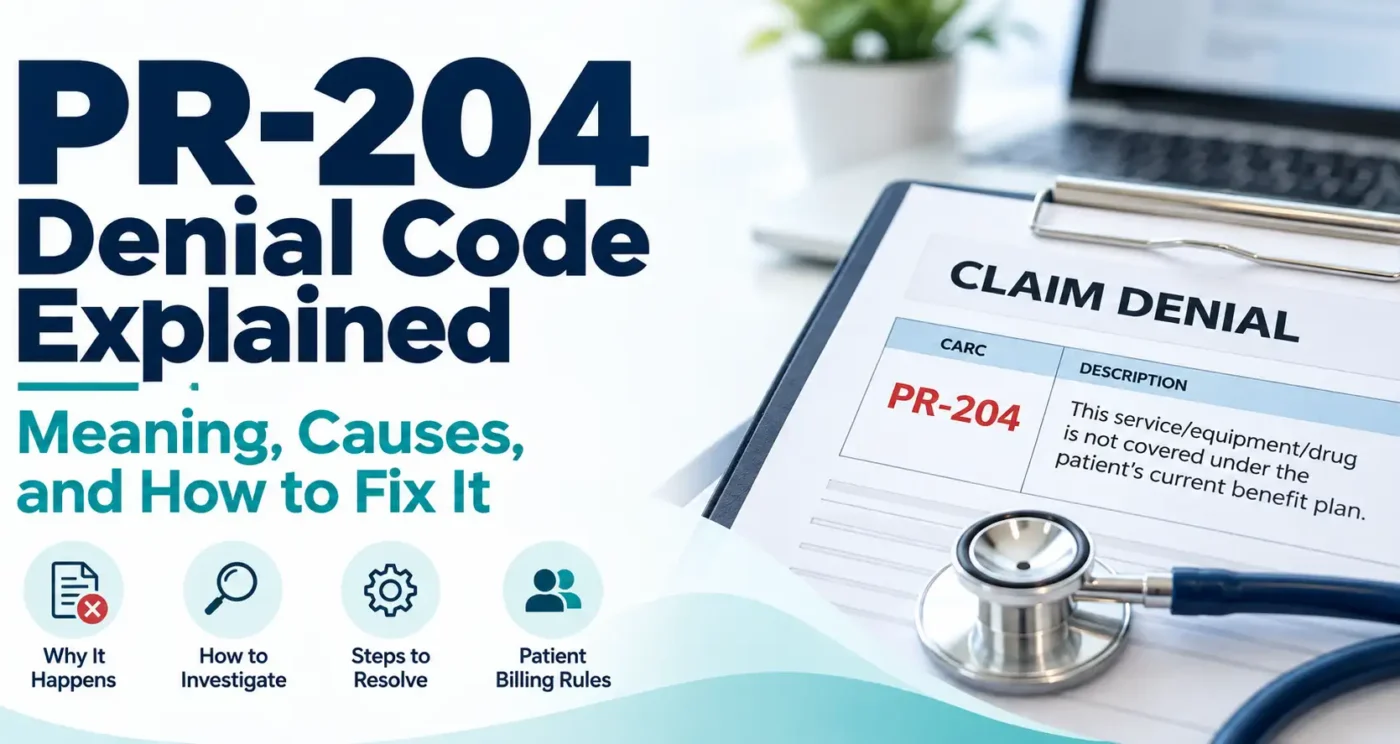
PR-204 combines two separate standardized remittance codes. The PR claim adjustment group code means Patient Responsibility. 204 is a Claim Adjustment Reason Code (CARC) whose official X12 description is: “This service/equipment/drug is not covered under the patient’s current benefit plan.”
The X12 Claim Adjustment Reason Code list defines CARC 204, while the X12 Claim Adjustment Group Code list defines PR and other adjustment groups. X12 maintains the standardized terminology used in electronic healthcare remittances.
In plain language, the insurer is saying that the billed item is outside the benefits it recognizes for this patient under the policy it used to adjudicate the claim. That may be an accurate determination. It may also reflect a wrong plan, an incorrect benefit classification, a service-code problem, or a payer processing error.
PR-204 at a Glance
| Item | Meaning |
| PR | Patient Responsibility: the adjustment is assigned to the patient in the remittance. |
| 204 | The service, equipment, or drug is not covered by the patient’s current benefit plan. |
| Code family | CARC 204 paired with a Claim Adjustment Group Code; not an ICD-10-CM or CPT code. |
| Immediate review | Check the exact claim line, EOB/ERA remarks, benefit terms, service date, and other coverage. |
| Possible action | Confirm exclusion, correct a genuine error, request reconsideration, or appeal when supported. |
| Patient billing | Review laws, payer contracts, notices, and plan-specific liability rules first. |
PR-204 is an adjudication adjustment, not a claim rejection code. A claim rejected before normal adjudication—because of an invalid data format, for instance—calls for a different workflow. A PR-204 adjustment ordinarily appears after the payer has applied its benefit rules to a processed claim or claim line.
How PR-204 Appears on an ERA or EOB
Providers commonly see PR-204 in an Electronic Remittance Advice (ERA), a paper remittance, or an adjustment detail screen in their practice management system. Patients may see a plain-language equivalent on an Explanation of Benefits (EOB), even when the insurer does not display the standardized code itself.
The CMS Health Care Payment and Remittance Advice guidance explains that remittances may use three complementary code sets: a Group Code identifying financial responsibility, a CARC explaining the adjustment reason, and a Remittance Advice Remark Code (RARC) supplying more detail. A coverage explanation in the remark text or payer portal may be decisive.
An Illustrative PR-204 Claim Line
| Claim field | Example |
| Billed service | A medical supply submitted for $280 |
| Payer decision | $0 paid for the item |
| Adjustment | PR-204 for $280 |
| Claim message | Item not covered under the member’s plan |
| Appropriate first action | Verify the item, benefit language, member plan, provider agreement, and billing restrictions. |
This hypothetical line is not a model for posting all PR-204 denials. A real remit may include multiple adjustments, other payer payments, contractual amounts, or special limitations. The full claim—not just a single adjustment field—must reconcile before any balance is finalized.
A patient trying to understand the insurer’s decision can use MedIntelHub’s guide to reading an Explanation of Benefits to compare the plan’s statement with a provider bill.
Why Does a PR-204 Denial Happen?
The same adjustment can arise from very different situations. That is why a generic instruction to “appeal PR-204” often wastes time.
The Service Is Specifically Excluded
A benefit contract may not cover a particular category of care or a specific item. An elective service, equipment upgrade, or noncovered convenience item may fall outside the terms of a plan. The exact exclusions depend on the contract and the product—not on the insurer’s name alone.
If the exclusion is genuine and correctly applied, sending additional medical records may not change the result. Medical necessity is not the same thing as having a covered benefit.
The Drug or Equipment Does Not Fit the Plan’s Benefit
Coverage of medications and medical equipment can depend on benefit category, drug formulary, supply restrictions, supplier requirements, and other plan terms. A claim may have been routed to the wrong benefit or sent to a plan that does not cover that item. For a drug, there can also be a distinction between a medical benefit and a pharmacy benefit.
The review should establish whether the payer considered the right benefit, not merely whether the item is medically useful.
The Wrong Insurance Product Was Billed
Two plans issued by the same insurer may have different benefits. A patient might have changed employers, switched plan options, or moved to another product before the date of service. A claim submitted under an outdated member record can produce a misleading coverage denial.
Confirm the actual member ID, plan identifier, effective dates, and coordination-of-benefits information before challenging an exclusion.
The Service Was Classified Incorrectly
An inaccurate procedure code, supply code, modifier, quantity, or place-of-service detail can cause the payer to evaluate the wrong benefit. Sometimes a legitimate covered service appears to be excluded because the claim describes something other than what the clinician documented.
In that case, a corrected claim may be appropriate. A revised code must match the service that was genuinely furnished and documented; it should never be chosen solely to evade a denial.
A Benefit Limit or Coverage Condition Was Misapplied
Plans can apply visit or quantity limits and other conditions. Not every limit-related denial uses CARC 204, but a payer’s adjudication may place a particular service outside the available benefit. Look at the RARC, plan policy, and utilization record to distinguish a real limit from an error in the payer’s count.
A previous authorization or an eligibility response is useful evidence, but neither should be treated as an unconditional guarantee of payment.
PR-204 vs. CO-204: What’s the Difference?
The number 204 is identical in both combinations. The two-letter prefix changes the financial-responsibility message.
| Adjustment | What the remittance communicates | What to do |
| PR-204 | A benefit-plan exclusion assigned to patient responsibility. | Investigate whether the exclusion and patient liability are correct before billing. |
| CO-204 | A benefit-plan exclusion assigned to contractual obligation. | Generally treat the adjustment as the provider’s responsibility, subject to the full remit and applicable contract. |
The word “generally” matters. Remittance codes communicate how the payer adjudicated the claim. They do not replace the payer contract, state law, federal protections, or a required advance notice. A provider should challenge an incorrect PR assignment rather than automatically moving the balance to a patient account.
For example, suppose an in-network practice bills for a service the contract requires it to furnish without separate member charges. If the payer assigns PR-204 in error, posting that amount to the patient may create an inappropriate bill. The billing team should request clarification or reprocessing and review the agreement.
Do not replace PR with CO—or CO with PR—in the practice management system simply to change who appears responsible. Reconcile the payer’s actual remittance and document any authorized adjustment or correction.
How to Fix PR-204: A Step-by-Step Denial Workflow
The strongest workflow starts by investigating the basis for the coverage decision rather than by drafting an appeal letter.
Step 1: Read the Exact Remittance Detail
Identify the patient, claim number, date of service, payer, CPT/HCPCS code when applicable, units, line-level adjustment amount, and any RARC or free-text explanation. Verify whether other lines on the same claim were paid.
Also check whether a second payer has processed the service. A primary insurer’s denial does not always settle the final financial picture.
Step 2: Verify Eligibility and the Correct Benefit Plan
Confirm that the patient was enrolled in the identified plan on the date the service was provided. Ask whether the plan has different medical, pharmacy, dental, vision, or equipment benefits relevant to the item. Review the member’s actual plan documents when available.
A successful eligibility response only establishes certain information about enrollment or benefits. It does not prove that this specific claim must be paid.
Step 3: Request the Exact Coverage Basis
Do not settle for “not covered” when the reason is unclear. Ask the payer to identify the applicable benefit provision, exclusion, policy document, or adjudication rule. If a service was categorized incorrectly, ask how the classification can be corrected.
Capture the representative’s name, contact date, reference number, plan document or policy reference, and the explanation received. When possible, obtain the determination in writing or through the payer portal.
Step 4: Review the Claim Against the Medical Record
Confirm the service was billed accurately. Look for a genuinely wrong code, modifier, quantity, date, place of service, or benefit-routing detail. Verify whether the record supports a different coding choice before making any change.
Avoid “diagnosis shopping” or reporting a procedure that was not performed. If the payer’s decision concerns a clear contractual exclusion, adding a diagnosis will not necessarily make the service covered.
Step 5: Choose Correction, Reconsideration, or Appeal
A corrected claim is appropriate when the original submission contains an actual claim error and the payer permits correction through that pathway. A payer reconsideration can be useful when an adjudication error can be resolved without a formal appeal. A formal appeal is appropriate when you dispute the coverage determination and have a supportable policy or factual basis.
These processes have different deadlines and filing requirements. Ask the payer which route applies to the specific claim and preserve the original filing and denial records. For a broader work-queue approach, see MedIntelHub’s claim denials prevention and follow-up checklist.
Step 6: Hold Patient Billing Until Liability Is Reviewed
Before transferring the balance, review the provider’s network status and contract; applicable federal and state billing protections; the patient’s coverage type; any valid advance notice or cost agreement; and whether a secondary insurer may pay.
If the patient has already received a statement and the amount is disputed, the billing office should explain that the claim is being reviewed and follow its procedures for preventing premature collection activity.
Step 7: Follow Through and Close the Account Correctly
Track who owns the account, the exact action submitted, the deadline, confirmation number, next follow-up date, and payer response. After reprocessing or appeal, update payment posting and the patient balance using the final remittance and governing rules.
A resolved account should also receive a root-cause tag: benefit exclusion, wrong plan, claim data error, benefit-classification problem, payer error, or another confirmed cause. Those tags are more useful for prevention than a spreadsheet showing only “PR-204.”
Can You Appeal a PR-204 Denial?
Sometimes. An appeal has a stronger basis when the insurer used the wrong plan benefits, misunderstood the service, misapplied an exclusion, overlooked covered alternatives permitted by the policy, or relied on incorrect information. A clinical letter may support an appeal when the plan’s actual coverage rules make clinical criteria relevant.
A medical-necessity letter cannot, by itself, erase every plan exclusion. If the item is expressly outside the benefit and no applicable exception exists, there may be no basis for payment under that policy.
For many employer-sponsored and individual health plans subject to the federal internal-appeal rules, HealthCare.gov explains the internal appeals process and generally describes a 180-day filing window after notice of denial. Do not treat 180 days as a universal deadline. Original Medicare, Medicare Advantage, Medicaid, and other plans use different procedures or timelines, and particular employer plans may have additional provisions.
For Original Medicare fee-for-service claims, CMS describes first-level redetermination, including a generally applicable 120-day request deadline from receipt of the initial determination. CMS also distinguishes claim corrections and reopenings from formal appeals.
What Should a PR-204 Appeal Include?
An appeal package usually works best when it makes one clear argument rather than sending a stack of unrelated records. Depending on the dispute, include:
- The denied claim, EOB/ERA, and any payer reference number.
- The relevant coverage document and exact disputed clause or benefit category.
- A short account of why the service fits the covered benefit or why the exclusion was misapplied.
- Clinical documentation only when it directly supports the required criteria.
- Authorization or eligibility records, if they bear on the payer’s decision.
- The specific action requested: reprocessing, coverage review, reversal, or corrected patient-liability determination.
Send the appeal through the route and within the timeframe the payer requires. Document proof of delivery and check for a written decision.
Can You Bill the Patient for PR-204?
Not solely because PR appears on the remittance. PR tells you how the payer assigned the adjustment. Whether the balance is legally collectible is a separate question.
For commercial insurance, review network agreements, benefit terms, required disclosures, state laws, and any applicable federal protections. A genuine noncovered benefit may sometimes be a permissible patient charge, particularly when the provider gave the required information or agreement before the service. But a provider error or contractual write-off cannot automatically be shifted to the patient.
Original Medicare and Advance Beneficiary Notices
In Original Medicare fee-for-service, an Advance Beneficiary Notice of Noncoverage (ABN) may be required in specified situations where Medicare payment is expected to be denied and the provider wishes to transfer potential liability to the beneficiary. The CMS FFS ABN guidance explains the notice’s role and points to the official instructions.
Do not assume that every Medicare noncovered service requires an ABN, or that any signed form will establish liability. Requirements differ for certain medical-necessity denials versus items that are statutorily excluded from Medicare coverage; timing, content, and beneficiary choice also matter. A commercial-plan waiver is not an Original Medicare ABN.
Medicaid and Medicare–Medicaid Coverage
Medicaid is administered through state programs and participating managed-care plans, and patient charging rules are often restrictive. Federal Medicaid regulation 42 CFR § 447.15 establishes payment-in-full requirements for Medicaid-participating providers, subject to permitted cost sharing. Whether a separately requested noncovered service can be billed privately depends on the state’s rules and the circumstances; a PR-204 label is not enough to answer it.
For beneficiaries in the Qualified Medicare Beneficiary (QMB) program, CMS expressly prohibits providers from billing Medicare Part A or Part B cost sharing on Medicare-covered items and services. That protection is described in the CMS QMB billing guidance. QMB protection should not be misrepresented as the rule for every item that Medicare excludes entirely.
Surprise-Billing Protections May Also Matter
A service may generate confusing patient-liability language in a situation protected by the federal No Surprises Act, such as certain emergency services or non-emergency services furnished by out-of-network professionals at in-network facilities. These protections are specific; they do not turn every excluded service into a covered benefit. CMS explains the relevant settings in its consumer medical-bill guidance.
If the collection rules are uncertain, escalate the account to the appropriate billing compliance or payer-contract specialist rather than making a guess from the adjustment code.
Realistic PR-204 Denial Examples
These examples are illustrations, not representations of any particular insurer’s policy. Actual CARC assignment can differ, even when two plans deny similar services.
Example 1: An Excluded Elective Service
A practice submits a claim for an elective service. The patient’s benefit documents explicitly exclude that service. The payer assigns PR-204, and the service description matches what was actually performed.
Next step: Confirm the exclusion and determine whether the practice met all applicable financial-disclosure and patient-billing requirements. If the decision was correct, a clinical appeal alone may not secure coverage.
Example 2: Medical Equipment Billed to the Wrong Benefit
A supplier submits a piece of equipment under a plan benefit that does not cover it. The patient may have another active benefit or payer relevant to that equipment.
Next step: Verify the actual benefit structure, any supplier requirements, and coordination of benefits. Correct the claim or submit to the appropriate payer only if the coverage facts and payer instructions support it.
Example 3: A Coding Error Makes a Covered Service Look Excluded
Documentation supports one type of service, but the claim contains a different procedure or supply code. The payer determines that the submitted item is excluded and returns PR-204.
Next step: Correct the unsupported code through the payer’s approved process, retaining documentation of the original error. Do not submit an alternate code unless it accurately represents the work.
Example 4: The Patient Changed Plans Midyear
A clinic verified eligibility before an appointment using an old insurance card. The patient changed to another product with different benefits by the date of service. The claim is processed under the wrong coverage record.
Next step: Establish the correct coverage and effective dates, confirm the right payer and member identifier, and use the proper correction or new-claim procedure within the filing limits.
Example 5: The Claim Is Correct, but Patient Liability Is Not
A payer assigns PR-204 to a service, while the participating provider’s contract or applicable regulation restricts additional patient billing. The adjustment may have been miscategorized, or the service may be subject to special protections.
Next step: Review the contract and rules and ask the payer to clarify or correct the liability assignment. Do not send the patient a bill merely to clear the aging report.
PR-204 vs. Other Common Denial Codes
The word “noncovered” appears across several denial categories, but the codes are not interchangeable.
| Code | General X12 meaning | Typical issue to investigate |
| CARC 204 | Service, equipment, or drug not covered under the current benefit plan. | Plan exclusion or benefit classification. |
| CARC 96 | Non-covered charge(s); an explanatory remark is required. | The particular reason for noncoverage in remarks and payer policy. |
| CARC 50 | Service not covered because payer does not deem it medically necessary. | Medical-necessity policy and clinical documentation. |
| CARC 197 | Required precertification, authorization, or notification absent. | Authorization workflow and evidence. |
These descriptions come from the official X12 CARC directory. A CARC number by itself does not determine patient versus provider responsibility; read the associated group code and any remarks.
A missing authorization, for example, should not automatically be managed as if the plan never offered the benefit. Likewise, a medical-necessity denial is not necessarily proof that the service category is excluded from the plan.
How to Prevent PR-204 Denials
No verification process can prevent a claim for a genuinely excluded benefit from being unpaid. It can, however, prevent surprises and reduce denials caused by incorrect coverage data or claim classification.
Verify Benefits for the Specific Service
Ask about the proposed service, equipment, or drug—not merely whether the patient has active insurance. Check whether the relevant benefit is medical, pharmacy, or another category. Record the plan, date, reference number, benefit information, and any warning that authorization or medical-necessity criteria also apply.
Set Clear Financial Expectations Before Care
When an item appears noncovered, confirm the actual policy, explain the anticipated charge accurately, and use the notices or agreements required by the payer and law. Patient acknowledgment is not a substitute for a valid benefit or a legally required notice.
Review Coding and Payer Routing
Check the service description against the clinical record and verify current code sets and modifiers. If a drug belongs under a pharmacy benefit rather than the medical claim pathway, route it correctly where the contract and plan rules require that treatment.
Audit Trends by Payer and Service
Review PR-204 adjustments by health plan product, CPT/HCPCS or supply category, location, and denial cause. An increase after a plan-year renewal may indicate changed benefits; a cluster under one supply code may reveal incorrect code mapping.
MedIntelHub’s overview of the medical billing workflow from visit to payment places these checks in the larger process of registration, verification, claim creation, adjudication, payment posting, and follow-up.
A Practical PR-204 Work-Queue Checklist
- Confirm the correct patient, service line, date of service, and payer product.
- Read the Group Code, CARC 204, any RARC, and the full EOB or ERA.
- Obtain the benefit document or payer policy supporting the exclusion.
- Check active coverage, benefit category, and possible other insurance.
- Verify coding and documentation without changing accurate codes to force payment.
- Decide whether a correction, reconsideration, formal appeal, or no further payer action is appropriate.
- Confirm filing and appeal deadlines for that specific payer and plan.
- Review patient liability under law, provider agreements, and required notices.
- Record the outcome and the verified denial root cause.
Frequently Asked Questions About PR-204
1. What is the PR-204 denial code description?
It means the payer considers the billed service, equipment, or drug outside the patient’s current benefit plan and has assigned the adjustment to the patient-responsibility group. The official underlying reason is CARC 204.
2. Does PR-204 mean the patient owes the full bill?
Not necessarily. The remittance is a starting point, not final legal permission to collect. Contracts, government-program protections, notice requirements, and other claim adjustments can limit liability.
3. Is PR-204 the same as CO-204?
No. Both use the same underlying CARC 204 benefit-exclusion reason. PR communicates patient responsibility; CO communicates contractual obligation. The group-code difference requires careful account handling.
4. Can PR-204 be corrected and resubmitted?
Yes, when the original claim contained an actual error and the payer permits a corrected-claim route. A correct claim for a genuinely excluded benefit generally does not become payable simply by resubmitting it unchanged.
5. Can a provider appeal PR-204?
An appeal may be appropriate when the coverage decision was wrong or an applicable plan exception supports the claim. Use the payer’s appeal pathway, present the precise basis for disagreement, and meet its deadlines.
6. Does PR-204 mean the insurance policy was inactive?
No. A patient can have active insurance but lack benefits for the particular item. Eligibility should still be rechecked, especially if the wrong plan was used.
7. Does medical necessity override PR-204?
Not automatically. A medically appropriate service can still be outside the plan’s covered benefits. Medical-necessity evidence helps only when relevant to the plan’s coverage criteria or a permitted exception.
8. Is PR-204 an ICD-10 or CPT code?
Neither. The number 204 is an X12 Claim Adjustment Reason Code. PR is a Claim Adjustment Group Code, used on remittances to categorize responsibility for an adjustment.
9. What is the difference between PR-204 and PR-96?
CARC 204 specifically addresses an item excluded under the patient’s current benefit plan. CARC 96 is the broader noncovered-charge reason and requires a qualifying remark code. The remittance may use either in different circumstances.
10. What is the difference between PR-204 and CO-50?
PR-204 describes a benefit-plan exclusion with patient responsibility assigned. CO-50 communicates a medical-necessity noncoverage determination classified as contractual obligation. Both the reason and responsibility grouping differ.
No. Authorization may satisfy one plan requirement without overriding a benefit exclusion or other coverage conditions. Review what was authorized, the applicable benefit, and the plan’s terms.
12. Can a Medicaid provider charge a patient after PR-204?
Not based on the code alone. Medicaid payment-in-full requirements and state-specific rules apply. A separately requested noncovered service may be handled differently from a covered Medicaid service, so the state policy and required disclosures must be checked.
13. Is an ABN always needed for Medicare PR-204?
No. Original Medicare has specific ABN requirements for certain expected denials, and statutory exclusions can be treated differently. The ABN rules do not apply identically to Medicare Advantage or commercial insurance.
14. How long do you have to appeal PR-204?
There is no single deadline. For many plans covered by federal internal-appeal rules, HealthCare.gov describes a 180-day filing period. Original Medicare first-level redeterminations generally use a 120-day timeframe. Verify the notice and plan-specific requirements.
15. Can PR-204 appear on only one line of a claim?
Yes. Remittance adjustments may apply at claim or service-line level. Other services on the same claim can be paid, adjusted differently, or processed by another insurer.
16. What should a patient do after seeing PR-204 on an EOB?
Compare the EOB with any actual provider bill and ask the insurer which plan term caused the denial. Ask the provider whether a correction or appeal is pending and whether the proposed patient balance complies with the plan and billing rules.
What to Remember Before Closing a PR-204 Account
PR-204 begins with a benefit question: was this service, equipment, or drug actually covered under the plan in effect on the service date? The next question is separate: even if the plan will not pay, who is allowed to bear the charge?
Answer both before closing the denial. A corrected claim may solve a coding mistake. An appeal may reverse a benefit misclassification. A genuine exclusion may leave no payer payment available, but it still requires a careful patient-liability review. Treating those situations differently protects revenue accuracy and helps prevent patients from receiving bills they should not owe.
Resources
X12 — Claim Adjustment Reason Codes
Official code directory defining CARC 204 and related denial reasons, including CARCs 96, 50, and 197.
View X12 Claim Adjustment Reason Codes
X12 — Claim Adjustment Group Codes
Defines PR, CO, and other adjustment groups used to categorize responsibility for claim adjustments.
View X12 Claim Adjustment Group Codes
Centers for Medicare & Medicaid Services — Health Care Payment and Remittance Advice
Explains how Group Codes, CARCs, and RARCs work together on provider remittances.
Read CMS remittance advice guidance
Centers for Medicare & Medicaid Services — Original Medicare ABN
Official guidance on advance beneficiary notices and circumstances in which a notice may transfer potential financial liability.
HealthCare.gov — Internal Appeals
Explains appeal rights and common deadlines for health plans subject to the federal appeals framework.
Review HealthCare.gov internal appeal guidance
Centers for Medicare & Medicaid Services — Original Medicare Redetermination
Describes the first level of Medicare fee-for-service claim appeals and filing requirements.
Review Medicare redetermination guidance
Centers for Medicare & Medicaid Services — QMB Billing Protections
Explains federal restrictions on billing Qualified Medicare Beneficiaries for Medicare Part A and B cost sharing.
Read CMS QMB billing protections
Centers for Medicare & Medicaid Services — Medical Bill Rights
Outlines federal protections involving certain surprise medical bills and the limits of those protections.
Read CMS consumer billing rights
Editorial Guidelines & Medical Disclaimer
MedIntelHub publishes educational and informational material using authoritative coding, healthcare policy, and public-agency sources. This article explains a remittance adjustment; it does not diagnose any condition, determine whether a particular service was medically necessary, provide individualized legal or billing advice, or guarantee coverage or reimbursement. Medication and treatment decisions belong with qualified healthcare professionals.
Claim adjustment codes, CPT/HCPCS and ICD-10-CM resources, payer contracts, appeal procedures, benefit designs, and reimbursement policies can change. Requirements may differ among commercial plans, Original Medicare, Medicare Advantage, Medicaid programs, and individual states. Always verify the current code descriptions, date-of-service requirements, plan documents, notices, and payer instructions before claim submission, appeal, or patient billing. Readers can review MedIntelHub’s editorial standards.

David Bennett
David Bennett is an author at MedIntelHub, where he creates clear, practical, and well-researched content about healthcare, medical billing, insurance, and patient education. His goal is to make complex healthcare topics easier for readers to understand and use in everyday situations. David emphasizes accuracy, transparency, and reliable sourcing, using information from trusted organizations and official healthcare resources whenever possible. Content published by David is intended for educational purposes and should not replace advice from qualified medical, legal, or healthcare professionals.